
Online Database of Chemicals from Around the World
| Simagchem Corporation | China | |||
|---|---|---|---|---|
 | www.simagchem.com | |||
 | +86 13806087780 | |||
 | +86 (592) 268-0237 | |||
 | sale@simagchem.com | |||
| Chemical manufacturer since 2002 | ||||
| chemBlink Standard supplier since 2008 | ||||
| Zhejiang Synose Tech Co., Ltd. | China | |||
|---|---|---|---|---|
| www.synose.com | |||
| +86(579)8227-5537 8917-2081 | |||
| +86 (579) 8227-7133 | |||
| expo@synose.com | |||
| Chemical manufacturer since 1996 | ||||
| chemBlink Standard supplier since 2011 | ||||
| Biosynth AG. | Switzerland | |||
|---|---|---|---|---|
| www.biosynth.com | |||
| +41 (71) 858-2020 | |||
| +41 (71) 858-2030 | |||
| welcome@biosynth.ch | |||
| Chemical manufacturer | ||||
| chemBlink Standard supplier since 2014 | ||||
| Classification | Biochemical >> Carbohydrate >> Double sugar |
|---|---|
| Name | Octaacetyl-beta-maltose |
| Synonyms | beta-D-Maltose octaacetate; beta-D-Maltopyranose octaacetate; 4-O-(2,3,4,6-Tetra-O-acetyl-alpha-D-glucopyranosyl)-beta-D-glucopyranose tetraacetate |
| Molecular Structure | 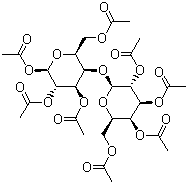 |
| Molecular Formula | C28H38O19 |
| Molecular Weight | 678.60 |
| CAS Registry Number | 22352-19-8 |
| EC Number | 606-994-8 |
| SMILES | CC(=O)OC[C@@H]1[C@H]([C@@H]([C@H]([C@@H](O1)OC(=O)C)OC(=O)C)OC(=O)C)O[C@@H]2[C@@H]([C@H]([C@@H]([C@H](O2)COC(=O)C)OC(=O)C)OC(=O)C)OC(=O)C |
| Density | 1.4±0.1 g/cm3 Calc.* |
|---|---|
| Melting point | 224 - 231 °C (Expl.) |
| Boiling point | 683.1±55.0 °C 760 mmHg (Calc.)* |
| Flash point | 281.2±31.5 °C (Calc.)* |
| Index of refraction | 1.507 (Calc.)* |
| * | Calculated using Advanced Chemistry Development (ACD/Labs) Software. |
| Hazard Symbols |  GHS07 Warning Details GHS07 Warning Details |
|---|---|
| Risk Statements | H302 Details |
| Safety Statements | P280-P305+P351+P338 Details |
| SDS | Available |
 chemBlink Chemical Story
|
Octaacetyl-beta-maltose is a fully acetylated derivative of maltose in which all eight hydroxyl groups of the disaccharide are converted to acetate esters. Maltose itself was identified in the nineteenth century as a product of starch hydrolysis, particularly through the action of diastase, an enzyme preparation obtained from malted grain. Early carbohydrate research established maltose as a reducing disaccharide composed of two glucose units linked through an alpha-1,4-glycosidic bond. Structural elucidation of maltose and related sugars formed a central part of classical carbohydrate chemistry and laid the groundwork for systematic derivatization studies. The acetylation of sugars became an important analytical and synthetic technique in the late nineteenth and early twentieth centuries. Chemists discovered that treatment of carbohydrates with acetic anhydride, often in the presence of catalysts such as pyridine, converts hydroxyl groups into acetate esters. This transformation increases the stability and crystallinity of many sugars, facilitating purification and structural characterization. Octaacetyl-beta-maltose is obtained by acetylating maltose under controlled conditions that preserve the beta configuration at the anomeric center of the reducing glucose unit. The resulting compound contains eight acetyl substituents corresponding to the eight original hydroxyl groups of maltose. The preparation and study of peracetylated sugars played a crucial role in confirming structural proposals for disaccharides. By converting all hydroxyl groups to acetate esters, chemists were able to determine substitution patterns, measure optical rotation, and investigate anomeric configurations. In the case of maltose, the existence of distinct alpha and beta forms at the reducing end was demonstrated through derivatization and subsequent analysis. Octaacetyl-beta-maltose provided a stable, crystalline derivative suitable for melting point determination and other classical characterization methods, which were essential tools before the advent of modern spectroscopic techniques. Beyond its importance in structural studies, octaacetyl-beta-maltose has served as a protected intermediate in synthetic carbohydrate chemistry. The acetyl groups mask the hydroxyl functions, reducing hydrogen bonding and altering solubility, typically increasing solubility in organic solvents such as chloroform or dichloromethane. This property enables further chemical transformations, including selective deacetylation or participation in glycosylation reactions after activation of the anomeric position. The controlled removal of acetyl groups under basic or acidic conditions regenerates the corresponding hydroxyl functionalities, allowing stepwise manipulation of the disaccharide framework. Peracetylated disaccharides have also been used as reference materials in studies of carbohydrate reactivity and mechanism. Because acetyl groups withdraw electron density and modify steric environments, they influence the behavior of glycosidic bonds under various reaction conditions. Investigations of hydrolysis, transglycosylation, and substitution reactions have relied on well-defined acetylated substrates to establish kinetic and mechanistic principles. Octaacetyl-beta-maltose, with its fully protected structure, provides a reproducible model compound for such work. The broader development of acetylated sugars contributed significantly to advances in glycochemistry and the synthesis of oligosaccharides. Protecting group strategies based on acetylation enabled chemists to overcome the challenge posed by multiple similar hydroxyl groups in carbohydrate molecules. The availability of compounds such as octaacetyl-beta-maltose reflects the maturation of these methods and their application to increasingly complex targets. Although octaacetyl-beta-maltose is not used directly as a food ingredient or pharmaceutical agent, its historical and practical importance lies in its role as a well-characterized derivative of maltose. Through its use in structural determination, synthetic methodology, and mechanistic investigation, it has contributed to the experimentally verified body of knowledge that defines modern carbohydrate chemistry. References 2012. Enhancement of Amorphous Celecoxib Stability by Mixing It with Octaacetylmaltose: The Molecular Dynamics Study. Molecular Pharmaceutics. DOI: 10.1021/mp200436q |
| Market Analysis Reports |