
Online Database of Chemicals from Around the World
| Taizhou Crene Biotechnology Co., Ltd. | China | |||
|---|---|---|---|---|
 | www.pharm-intermediates.com | |||
 | +86 (576) 8881-3233 8820-5808 +86 13396860566 | |||
 | +86 (576) 8822-9589 | |||
 | sales@pharm-intermediates.com | |||
 | QQ Chat | |||
| Chemical manufacturer since 2011 | ||||
| chemBlink Standard supplier since 2009 | ||||
| Gihi Chemicals Co., Ltd. | China | |||
|---|---|---|---|---|
| www.gihichem.com | |||
| +86 (571) 8621-7390 +86 18072806364 | |||
| +86 (571) 8621-7391 | |||
| sales@gihichem.com | |||
| Chemical manufacturer since 2000 | ||||
| chemBlink Standard supplier since 2013 | ||||
| Changzhou Comwin Fine Chemical Co., Ltd. | China | |||
|---|---|---|---|---|
| www.comwin-china.com | |||
| +86 (519) 8661-9955 | |||
| +86 (519) 8661-3190 | |||
| info@comwin-china.com | |||
| Chemical manufacturer since 1992 | ||||
| chemBlink Standard supplier since 2024 | ||||
| Classification | API >> Other chemicals |
|---|---|
| Name | Oclacitinib maleate |
| Synonyms | PF 03394197-11 |
| Molecular Structure | 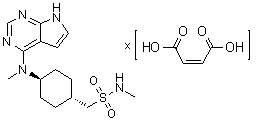 |
| Molecular Formula | C15H23N5O2S.x(C4H4O4) |
| CAS Registry Number | 1208319-27-0 |
| EC Number | 968-552-3 |
| SMILES | CNS(=O)(=O)CC1CCC(CC1)N(C)C2=NC=NC3=C2C=CN3.C(=CC(=O)O)C(=O)O |
| Melting point | 135-137 °C |
|---|---|
| Hazard Symbols |   GHS07;GHS09 Warning Details GHS07;GHS09 Warning Details | ||||||||||||||||||||
|---|---|---|---|---|---|---|---|---|---|---|---|---|---|---|---|---|---|---|---|---|---|
| Risk Statements | H302-H315-H319-H335 Details | ||||||||||||||||||||
| Safety Statements | P261-P280-P301+P312-P302+P352-P305+P351+P338 Details | ||||||||||||||||||||
| Hazard Classification | |||||||||||||||||||||
| |||||||||||||||||||||
| SDS | Available | ||||||||||||||||||||
 chemBlink Chemical Story
|
Oclacitinib maleate is a drug for the treatment of canine allergic dermatitis. It is a Janus kinase (JAK) inhibitor that specifically targets JAK1, which plays an important role in inflammatory processes and immune responses. The discovery of oclacitinib maleate stemmed from the need for effective treatments for chronic allergies in veterinarians, which led to research focused on immune system modulation. The compound was developed by Zoetis Inc. and approved by the U.S. Food and Drug Administration (FDA) in 2013. The chemical formula of oclacitinib maleate is C17H22N6O•C4H4O4. It is a white to pale yellow powder that is soluble in water and organic solvents. The structure of the compound includes a pyrrolo[2,3-d]pyrimidine core, which is essential for the inhibition of the JAK1 enzyme. The maleate salt form enhances its stability and bioavailability. Oclacitinib maleate is primarily used to treat pruritus associated with allergic dermatitis in dogs. It effectively reduces itching and inflammation, relieves symptoms, and improves the quality of life of affected dogs. It is also used to treat atopic dermatitis, a chronic skin disease characterized by inflammation and itching. Oclacitinib maleate works quickly, with improvements typically seen within four hours of dosing, making it a first choice for acute flare-ups. By inhibiting JAK1, oclacitinib maleate interferes with the signaling pathways of various cytokines involved in inflammation and immune responses. This makes it a potent immunomodulator for use in situations where modulation of the immune response is desired. Oclacitinib maleate works by selectively inhibiting the JAK1 enzyme involved in multiple cytokine signaling pathways. These cytokines, such as IL-2, IL-4, IL-6, IL-13, and IL-31, play a key role in the development of allergic reactions and inflammation. By blocking these pathways, oclacitinib maleate reduces the production of inflammatory mediators, resulting in relief of itching and inflammation. Clinical studies have demonstrated the safety and efficacy of oclacitinib maleate in dogs. It is well tolerated, with common side effects being mild and transient, such as vomiting, diarrhea, and lethargy. Long-term studies have shown it to be effective in treating chronic allergic diseases with no significant adverse effects. However, it is not recommended for use in dogs younger than 12 months or with severe infections because it can suppress immune function. References 2013. The pharmacokinetics of oclacitinib maleate, a Janus kinase inhibitor, in the dog. Journal of Veterinary Pharmacology and Therapeutics. DOI: 10.1111/jvp.12087 2014. Oclacitinib (APOQUEL®) is a novel Janus kinase inhibitor with activity against cytokines involved in allergy. Journal of Veterinary Pharmacology and Therapeutics. DOI: 10.1111/jvp.12101 2023. Oclacitinib 10 years later: lessons learned and directions for the future. Journal of the American Veterinary Medical Association. DOI: 10.2460/javma.22.12.0570 |
| Market Analysis Reports |