
Online Database of Chemicals from Around the World
| Shanghai Boka-chem Tech Inc. | China | |||
|---|---|---|---|---|
 | www.bokachem.com | |||
 | +86 (21) 6478-0600 | |||
 | +86 (21) 6459-2060 | |||
 | lidong@bokachem.com | |||
| Chemical distributor | ||||
| chemBlink Standard supplier since 2009 | ||||
| Sinocompound Catalysts Co., Ltd. | China | |||
|---|---|---|---|---|
| www.sinocompound.com | |||
| +86 (512) 6721-6630 | |||
| +86 (512) 5631-6689 | |||
| sales@sinocompound.com | |||
| Chemical manufacturer since 2008 | ||||
| chemBlink Standard supplier since 2010 | ||||
| Hangzhou Leap Chem Co., Ltd. | China | |||
|---|---|---|---|---|
| www.leapchem.com | |||
| +86 (571) 8771-1850 | |||
| market19@leapchem.com | |||
 | QQ Chat | |||
| Chemical manufacturer since 2006 | ||||
| chemBlink Standard supplier since 2015 | ||||
| Zhengzhou Kingorgchem Chemical Technology Co., Ltd. | China | |||
|---|---|---|---|---|
| www.kingorgchem.com | |||
| +86 (371) 6551-1006 | |||
| +86 (371) 6575-6965 | |||
| sales@kingorgchem.com | |||
| QQ Chat | |||
 | WeChat: 18625597674 | |||
| Chemical manufacturer since 2015 | ||||
| chemBlink Standard supplier since 2016 | ||||
| Shanghai Fuxin Pharmaceutical Co., Ltd. | China | |||
|---|---|---|---|---|
| www.fuxinpharm.com | |||
| +86 (21) 3130-0828 +86 18645121291 | |||
| +86 (21) 3130-0828 | |||
| contact@fuxinpharm.com | |||
| Chemical manufacturer since 2016 | ||||
| chemBlink Standard supplier since 2018 | ||||
| Xinxiang Runyu Material Co., Ltd. | China | |||
|---|---|---|---|---|
| www.runvmat.com | |||
| +86 (373) 775-9608 | |||
| +86 (373) 775-9608 | |||
| sales@runvmat.com | |||
| QQ Chat | |||
| Chemical manufacturer since 2017 | ||||
| chemBlink Standard supplier since 2019 | ||||
| Dalchem | Russia | |||
|---|---|---|---|---|
| www.dalchem.com | |||
| +7 (8312) 753-772 | |||
| +7 (8312) 750-799 | |||
| dregichy@dalchem.com | |||
| Chemical manufacturer since 1997 | ||||
| Classification | Organic raw materials >> Organic phosphine compound |
|---|---|
| Name | 2-Di-tert-butylphosphino-2'-methylbiphenyl |
| Synonyms | ditert-butyl-[2-(2-methylphenyl)phenyl]phosphane |
| Molecular Structure | 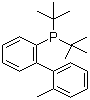 |
| Molecular Formula | C21H29P |
| Molecular Weight | 312.43 |
| CAS Registry Number | 255837-19-5 |
| EC Number | 607-748-2 |
| SMILES | CC1=CC=CC=C1C2=CC=CC=C2P(C(C)(C)C)C(C)(C)C |
| Melting point | 90-95 °C |
|---|---|
| Hazard Symbols |  GHS07 Warning Details GHS07 Warning Details |
|---|---|
| Risk Statements | H315-H319-H335 Details |
| Safety Statements | P261-P264-P264+P265-P271-P280-P302+P352-P304+P340-P305+P351+P338-P319-P321-P332+P317-P337+P317-P362+P364-P403+P233-P405-P501 Details |
| SDS | Available |
 chemBlink Chemical Story
|
2-Di-tert-butylphosphino-2'-methylbiphenyl is an important compound in the field of organometallic chemistry, particularly renowned for its role as a ligand in transition metal catalysis. Its unique structure and properties have made it a valuable tool in various catalytic processes, contributing significantly to advancements in synthetic chemistry. The discovery of 2-Di-tert-butylphosphino-2'-methylbiphenyl emerged from research efforts aimed at developing new, highly effective ligands for catalytic applications. The ligand was introduced in the early 2000s as part of a broader investigation into sterically demanding phosphine ligands that could offer enhanced performance in catalytic reactions. The structure of this compound consists of a biphenyl framework with a di-tert-butylphosphino group at the 2 position and a methyl group at the 2' position of one of the biphenyl rings. This design was intended to maximize steric hindrance and fine-tune electronic properties, leading to improved catalytic behavior. The synthesis of 2-Di-tert-butylphosphino-2'-methylbiphenyl involves several key steps. Initially, the biphenyl framework is synthesized through coupling reactions of phenyl-containing precursors. The introduction of the di-tert-butylphosphino group is achieved by reacting the biphenyl intermediate with a phosphorus-containing reagent, followed by the addition of the methyl group at the 2' position. The final product is purified using techniques such as column chromatography to obtain a high-purity ligand. One of the primary applications of 2-Di-tert-butylphosphino-2'-methylbiphenyl is in asymmetric catalysis. The ligand is employed to create chiral metal complexes that can catalyze a range of asymmetric reactions, including hydrogenation, hydroformylation, and cross-coupling reactions. The presence of the bulky di-tert-butyl groups provides significant steric protection, which enhances the selectivity and efficiency of the catalysts. In asymmetric hydrogenation, 2-Di-tert-butylphosphino-2'-methylbiphenyl is used to develop catalysts that facilitate the reduction of unsaturated compounds with high enantioselectivity. The steric effects of the di-tert-butyl groups help stabilize the transition states, leading to improved yields and selective formation of the desired enantiomers. The compound is also utilized in asymmetric hydroformylation reactions, where it assists in the conversion of alkenes into aldehydes. The ligand's influence on the reaction rate and selectivity is crucial for achieving high precision in the production of aldehydes, minimizing by-products and enhancing the overall efficiency of the process. In cross-coupling reactions, 2-Di-tert-butylphosphino-2'-methylbiphenyl acts as a ligand that promotes the formation of carbon-carbon bonds. The unique combination of steric and electronic effects provided by the ligand contributes to higher yields and better selectivity in the synthesis of complex organic molecules. The advantages of using 2-Di-tert-butylphosphino-2'-methylbiphenyl include its ability to create a well-defined steric and electronic environment around the metal center, which enhances catalytic performance. However, challenges may include the need for precise optimization of reaction conditions and the potential for ligand deactivation under certain circumstances. Future research on 2-Di-tert-butylphosphino-2'-methylbiphenyl may focus on exploring new catalytic applications and optimizing its performance in various reactions. Researchers may also investigate modifications to the ligand structure to further improve its properties and develop new derivatives with enhanced reactivity and selectivity. References 2008. Role of the ligand in the palladium-catalyzed C-2 and C-3 arylation of the indole magnesium salt. Doklady Chemistry, 423(2). DOI: 10.1134/s0012500808120057 2012. Palladium-Catalyzed Cross Coupling of Aryl Halides or Sulfonates. Science of Synthesis. URL: SD-208-00407 2012. Arylation of Nitroalkanes. Science of Synthesis. URL: SD-208-00400 |
| Market Analysis Reports |