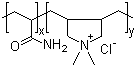
Poly(acrylamide-co-diallyldimethylammonium chloride), often abbreviated as poly(AM-co-DADMAC), is a water-soluble copolymer widely used in various industries due to its unique properties. This compound is a copolymer of acrylamide and diallyldimethylammonium chloride (DADMAC), combining the flocculating properties of acrylamide with the cationic nature of DADMAC. The discovery and development of poly(AM-co-DADMAC) have allowed for its extensive application in water treatment, paper manufacturing, cosmetics, and other fields that require coagulation, flocculation, or stabilization of particles in aqueous solutions.
The synthesis of acrylamide-based polymers, such as polyacrylamide, dates back to the early 20th century, where its applications as a water treatment agent were first explored. DADMAC, a quaternary ammonium salt, was later introduced into the copolymer structure to impart cationic charge, which enhances its performance in situations requiring the removal of negatively charged particles. The copolymerization of acrylamide and DADMAC produces poly(AM-co-DADMAC), a versatile polymer that effectively combines the advantages of both components: high molecular weight and flocculation efficiency from acrylamide, and electrostatic interaction capabilities from DADMAC.
Poly(AM-co-DADMAC) finds its most significant use in water and wastewater treatment processes. In these applications, it acts as a flocculant, aggregating suspended particles in the water to form larger clusters, or flocs, which can then be easily removed through sedimentation or filtration. The cationic nature of the DADMAC units in the copolymer allows it to bind effectively to negatively charged contaminants, such as organic matter, colloids, and fine particles. This makes poly(AM-co-DADMAC) particularly effective in clarifying drinking water and treating industrial effluents, where it helps to remove turbidity, color, and other pollutants.
In the paper industry, poly(AM-co-DADMAC) is used as a retention aid, helping to improve the retention of fine particles and fillers during the papermaking process. It enhances the strength of paper by promoting the bonding of fibers and additives, while also increasing the efficiency of water removal during the production process. The copolymer's flocculating properties aid in the separation of fibers from water, leading to better formation and smoother paper surfaces. Additionally, its cationic charge interacts with the anionic components present in the pulp, resulting in enhanced performance in paper sheet formation and overall quality.
In cosmetics and personal care products, poly(AM-co-DADMAC) is used as a conditioning agent due to its ability to form a smooth film on the skin and hair, providing moisturization and improved texture. The cationic nature of DADMAC allows it to bind to negatively charged surfaces, such as hair and skin, reducing static electricity and improving manageability in hair care formulations. It is also used in lotions, creams, and other personal care products where film-forming and moisturizing properties are desirable.
Beyond these industries, poly(AM-co-DADMAC) has found applications in oil and gas recovery, mining, and textile manufacturing. In oil recovery, it is used in enhanced oil recovery (EOR) techniques to increase the efficiency of oil extraction by improving the viscosity of water injected into oil wells, which helps to displace the oil more effectively. In the mining industry, it is employed in mineral processing to separate valuable minerals from ores through flocculation, while in textiles, it serves as a dye-fixing agent, improving the fastness and brightness of dyed fabrics.
While poly(AM-co-DADMAC) is highly effective in various applications, its use requires careful consideration of environmental and safety concerns. As with many synthetic polymers, the release of poly(AM-co-DADMAC) into the environment must be minimized, particularly in water bodies, where it may affect aquatic ecosystems. In industrial settings, regulations often require the proper handling and disposal of this compound to prevent adverse environmental effects. Additionally, while the polymer itself is generally regarded as safe for use in water treatment and personal care products, care must be taken to avoid exposure to the monomeric components, particularly acrylamide, which is a known neurotoxin.
In conclusion, poly(acrylamide-co-diallyldimethylammonium chloride) is a versatile copolymer that has revolutionized various industries due to its unique combination of flocculation efficiency and cationic properties. Its applications in water treatment, paper production, cosmetics, and other sectors highlight its importance in modern industrial processes. As technology and environmental awareness continue to evolve, efforts to optimize its use and minimize its environmental impact remain crucial.
|




 chemBlink Chemical Story