
Online Database of Chemicals from Around the World
| NANJING TOMMLAB PHARMATECH Co., LTD | China | |||
|---|---|---|---|---|
 | www.tommlab.com | |||
 | +86 (025) 8616-1360 | |||
 | tommlab@163.com | |||
 | QQ Chat | |||
| Chemical manufacturer since 2020 | ||||
| chemBlink Standard supplier since 2020 | ||||
| Classification | Organic raw materials >> Heterocyclic compound >> Indazoles |
|---|---|
| Name | 1-(6-Bromo-5-fluoro-1-methylindazol-3-yl)-1,3-diazinane-2,4-dione |
| Molecular Structure | 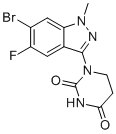 |
| Molecular Formula | C12H10BrFN4O2 |
| Molecular Weight | 341.14 |
| CAS Registry Number | 2760850-50-6 |
| EC Number | 980-867-8 |
| SMILES | CN1C2=CC(=C(C=C2C(=N1)N3CCC(=O)NC3=O)F)Br |
| Density | 1.9±0.1 g/cm3 Calc.* |
|---|---|
| Index of refraction | 1.745 (Calc.)* |
| * | Calculated using Advanced Chemistry Development (ACD/Labs) Software. |
| Hazard Symbols |  GHS07 Warning Details GHS07 Warning Details |
|---|---|
| Risk Statements | H302-H315-H319-H335 Details |
| Safety Statements | P261-P264-P264+P265-P270-P271-P280-P301+P317-P302+P352-P304+P340-P305+P351+P338-P319-P321-P330-P332+P317-P337+P317-P362+P364-P403+P233-P405-P501 Details |
 chemBlink Chemical Story
|
1-(6-Bromo-5-fluoro-1-methylindazol-3-yl)-1,3-diazinane-2,4-dione is an organic compound featuring a combination of an indazole ring and a diazinane-2,4-dione structure. The compound contains several notable functional groups that are of interest in various fields of chemical research, especially in the domains of medicinal and pharmaceutical chemistry. The indazole ring system, which is part of this compound, is a bicyclic structure containing both nitrogen and carbon atoms. The substitution of this ring with a bromo group at the 6-position and a fluoro group at the 5-position provides enhanced chemical reactivity and potentially significant biological activity. Substituted indazoles are well known for their biological properties, including anticancer, antimicrobial, and anti-inflammatory effects. The methyl group at the 1-position of the indazole ring further enhances the stability and lipophilicity of the compound, which could influence its pharmacokinetic properties. The diazinane-2,4-dione portion of the molecule, often referred to as a piperazine-dione structure, is a heterocyclic compound containing two nitrogen atoms and a carbonyl group at positions 2 and 4. This structure is commonly associated with various bioactive molecules, particularly those with anti-inflammatory, analgesic, and antiviral activities. The presence of these functional groups allows for the potential modulation of enzyme interactions and receptor binding, making this type of structure a common motif in drug design. The presence of the bromo and fluoro substituents on the indazole ring adds to the overall molecular diversity and could affect the compound's interaction with biological targets. Halogenated aromatic compounds, particularly those with bromine and fluorine, often exhibit enhanced binding affinity to specific proteins or receptors, making them useful in the design of drugs that target specific enzymes, receptors, or ion channels. The combination of the indazole and diazinane-2,4-dione substructures in this compound makes it a potentially useful candidate for the development of novel therapeutic agents. The indazole moiety could contribute to the compound's activity in cancer therapy or as a selective inhibitor for certain enzymatic pathways, while the diazinane-2,4-dione portion might contribute to the overall pharmacological activity through its ability to interact with receptors or enzymes involved in inflammatory processes. Such compounds are also relevant in the search for treatments for neurological disorders, where the ability to modulate neurotransmitter receptors or enzymes could have therapeutic implications. Additionally, compounds featuring both indazole and piperazine rings have shown promise in other therapeutic areas, including antimicrobial and antiviral treatments, due to their structural flexibility and potential to interact with various biological targets. In summary, 1-(6-bromo-5-fluoro-1-methylindazol-3-yl)-1,3-diazinane-2,4-dione is a structurally interesting compound with potential applications in medicinal chemistry. The combination of the indazole and diazinane-2,4-dione moieties offers significant opportunities for further development in drug design, particularly in the areas of cancer therapy, antimicrobial and anti-inflammatory treatments, and neurological disorder management. The presence of halogen substitutions enhances its biological activity, making it a candidate for further investigation in pharmaceutical research. |
| Market Analysis Reports |