
Online Database of Chemicals from Around the World
| Zhengzhou Kingorgchem Chemical Technology Co., Ltd. | China | |||
|---|---|---|---|---|
 | www.kingorgchem.com | |||
 | +86 (371) 6551-1006 | |||
 | +86 (371) 6575-6965 | |||
 | sales@kingorgchem.com | |||
 | QQ Chat | |||
 | WeChat: 18625597674 | |||
| Chemical manufacturer since 2015 | ||||
| chemBlink Standard supplier since 2016 | ||||
| Classification | Organic raw materials >> Organometallic compound >> Organic palladium |
|---|---|
| Name | 1,3-Bis(phenylphosphino)propane |
| Synonyms | phenyl(3-phenylphosphanylpropyl)phosphane |
| Molecular Structure | 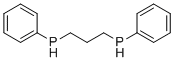 |
| Molecular Formula | C15H18P2 |
| Molecular Weight | 260.25 |
| CAS Registry Number | 28240-66-6 |
| EC Number | 681-703-5 |
| SMILES | C1=CC=C(C=C1)PCCCPC2=CC=CC=C2 |
| Boiling point | 160-165 °C (1 mmHg) |
|---|---|
| Hazard Symbols |  GHS07 Warning Details GHS07 Warning Details |
|---|---|
| Risk Statements | H315-H319-H335 Details |
| Safety Statements | P261-P264-P264+P265-P271-P280-P302+P352-P304+P340-P305+P351+P338-P319-P321-P332+P317-P337+P317-P362+P364-P403+P233-P405-P501 Details |
| SDS | Available |
 chemBlink Chemical Story
|
1,3-Bis(phenylphosphino)propane, often abbreviated as dppp, is an important compound in organometallic chemistry, valued for its role as a bidentate ligand in various catalytic processes. Its structure consists of a propane backbone with two phenylphosphine groups attached at the 1 and 3 positions, making it a versatile ligand in metal complexation. The discovery of 1,3-bis(phenylphosphino)propane stemmed from the need for effective ligands that could stabilize transition metals and enhance catalytic activity in organic synthesis. Its development was a major advance in the field, providing a new tool for researchers working with metal-catalyzed reactions. 1,3-Bis(phenylphosphino)propane is widely used in various catalytic processes, including cross-coupling reactions such as Suzuki and Stille couplings. These reactions are essential for the formation of carbon-carbon bonds, which are fundamental to the synthesis of complex organic molecules, including pharmaceuticals and advanced materials. The dppp ligand has an electron-donating phosphorus atom that stabilizes the metal center and promotes the efficient and selective formation of these bonds. In addition to cross-coupling reactions, dppp is also used in other types of metal-catalyzed transformations, such as hydrosilylation, hydroamination, and hydrogenation reactions. Its ability to form stable metal complexes with a range of transition metals, including palladium, platinum, and rhodium, makes it a valuable ligand in synthetic chemistry. The versatility of 1,3-bis(phenylphosphino)propane extends to its role in asymmetric catalysis, where it can help produce chiral compounds with high enantioselectivity. Its application in this field is beneficial for the development of chiral drugs and other fine chemicals. Overall, 1,3-bis(phenylphosphino)propane is an important ligand in organometallic chemistry. Its ability to stabilize metal centers and enhance catalytic reactions makes it of great interest in both academic research and industrial applications. References 2022. Back to basics. Nature Chemistry, 14(9). DOI: 10.1038/s41557-022-01029-5 2018. Novel representatives of 16-membered aminomethylphosphines with alkyl substituents at nitrogen and their gold(I) complexes. Russian Chemical Bulletin, 67(2). DOI: 10.1007/s11172-018-2078-7 2015. New Iron-Phosphine Macrocycle Complexes for Use in the Pressure-Swing Purification of Natural Gas. Journal of Inorganic and Organometallic Polymers and Materials, 25(4). DOI: 10.1007/s10904-015-0211-8 |
| Market Analysis Reports |