
Online Database of Chemicals from Around the World
| Gou Hebei Chemicals | India | |||
|---|---|---|---|---|
 | gouhebeichems.store | |||
 | +86 15874272473 | |||
 | info@gouhebeichems.store | |||
| Chemical distributor since 2009 | ||||
| chemBlink Standard supplier since 2023 | ||||
| Classification | Pharmaceutical intermediate >> Heterocyclic compound intermediate >> Pyrimidine compound >> Amine |
|---|---|
| Name | alpha-Methyl-6-benzofuranethanamine |
| Synonyms | 1-(Benzofuran-6-yl)propan-2-amine; 6-(2-Aminopropyl)benzofuran; 6-APB |
| Molecular Structure | 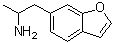 |
| Molecular Formula | C11H13NO |
| Molecular Weight | 175.23 |
| CAS Registry Number | 286834-85-3 |
| SMILES | CC(CC1=CC2=C(C=C1)C=CO2)N |
| Solubility | Very slightly soluble (0.42 g/L) (25 °C), Calc.* |
|---|---|
| Density | 1.097±0.06 g/cm3 (20 °C 760 Torr), Calc.* |
| Boiling point | 277.1±15.0 °C (760 Torr), Calc.* |
| Flash point | 121.4±20.4 °C, Calc.* |
| * | Calculated using Advanced Chemistry Development (ACD/Labs) Software V11.02 (©1994-2017 ACD/Labs) |
 chemBlink Chemical Story
|
α-Methyl-6-benzofuranamine, commonly known as 6-APB, is a compound that has attracted much attention for its psychoactive effects and potential therapeutic applications. 6-APB belongs to the class of benzofuran derivatives, which are structurally similar to hallucinogens such as amphetamine and MDMA (ecstasy). 6-APB was first synthesized and studied in the late 1990s as part of the search for novel psychoactive substances. Its chemical structure features a benzofuran ring fused to the amphetamine backbone with a methyl substitution at the α position. α-Methyl-6-benzofuranethylamine is formed by the condensation of 2-amino-1-phenylethane-1-one with 1-(2-benzofuranyl)propan-2-amine under controlled conditions. Pharmacologically, 6-APB acts as a serotonin-norepinephrine-dopamine releasing agent (SNDRA). This means that it promotes the release of neurotransmitters such as serotonin, dopamine, and norepinephrine from presynaptic neurons. By enhancing neurotransmitter activity in the brain, 6-APB induces psychoactive effects characterized by increased empathy, elevated mood, and altered sensory perception. These effects are similar to those of MDMA, albeit with different pharmacokinetic properties. Due to its hallucinogenic and stimulating properties, 6-APB has gained popularity in recreational drug use settings. It is typically taken orally in tablet or capsule form. Users report feelings of euphoria, increased sociability, and heightened sensory perception, which contributes to its appeal as a recreational substance. However, like other psychoactive drugs, 6-APB carries risks, including potential adverse effects such as increased heart rate, hypertension, and serotonin syndrome at high doses. In addition to recreational use, there is growing interest in exploring the therapeutic potential of 6-APB. Its ability to modulate serotonin and dopamine levels suggests that it could be used to treat mood disorders such as depression and anxiety. Some preliminary studies have investigated its use in psychotherapy settings to enhance empathy and communication, but further clinical studies are needed to determine its safety and efficacy. The regulatory status of 6-APB varies across the globe. In many countries, it is classified as a controlled substance due to its psychoactive effects and potential for abuse. This regulatory framework limits its availability to authorized medical and research purposes, emphasizing the need for careful supervision and control of use in scientific research. References 2019. Emerging club drugs: 5-(2-aminopropyl)benzofuran (5-APB) is more toxic than its isomer 6-(2-aminopropyl)benzofuran (6-APB) in hepatocyte cellular models. Archives of Toxicology, 94(1). DOI: 10.1007/s00204-019-02638-9 2018. Serotonergic Psychedelics: Experimental Approaches for Assessing Mechanisms of Action. Handbook of Experimental Pharmacology, 252. DOI: 10.1007/164_2018_107 2016. New psychoactive substance α-PVP in a traffic accident case. Forensic Toxicology, 34(2). DOI: 10.1007/s11419-016-0309-x |
| Market Analysis Reports |