
Online Database of Chemicals from Around the World
| Tianjin Zhongxin Chem-tech Co., Ltd. | China | |||
|---|---|---|---|---|
 | www.tjzxchem.com | |||
 | +86 (22) 6688-0623 | |||
 | +86 (22) 8988-0739 ex 8030 | |||
 | sales@tjzxchem.com | |||
| Chemical manufacturer since 2007 | ||||
| chemBlink Premium supplier since 2009 | ||||
| Classification | Organic raw materials >> Organometallic compound >> Organotin |
|---|---|
| Name | Stannous octoate |
| Synonyms | Tin 2-ethylhexanoate; Bis(2-ethylhexanoate)tin; Stannous-2-ethyl hexanoate |
| Molecular Structure | 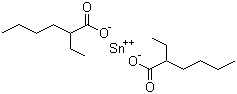 |
| Molecular Formula | C16H30O4Sn |
| Molecular Weight | 405.10 |
| CAS Registry Number | 301-10-0 |
| EC Number | 206-108-6 |
| SMILES | CCCCC(CC)C(=O)[O-].CCCCC(CC)C(=O)[O-].[Sn+2] |
| Density | 1.251 g/mL |
|---|---|
| Index of Refraction | 1.4945 |
| Hazard Symbols |     GHS06;GHS07;GHS08;GHS09 Danger Details GHS06;GHS07;GHS08;GHS09 Danger Details | ||||||||||||||||||||||||||||||||||||||||||||||||||||||||
|---|---|---|---|---|---|---|---|---|---|---|---|---|---|---|---|---|---|---|---|---|---|---|---|---|---|---|---|---|---|---|---|---|---|---|---|---|---|---|---|---|---|---|---|---|---|---|---|---|---|---|---|---|---|---|---|---|---|
| Risk Statements | H315-H317-H318-H319-H360D-H361-H411-H412 Details | ||||||||||||||||||||||||||||||||||||||||||||||||||||||||
| Safety Statements | P203-P261-P264-P264+P265-P272-P273-P280-P302+P352-P305+P351+P338-P305+P354+P338-P317-P318-P321-P332+P317-P333+P317-P337+P317-P362+P364-P391-P405-P501 Details | ||||||||||||||||||||||||||||||||||||||||||||||||||||||||
| Hazard Classification | |||||||||||||||||||||||||||||||||||||||||||||||||||||||||
| |||||||||||||||||||||||||||||||||||||||||||||||||||||||||
| SDS | Available | ||||||||||||||||||||||||||||||||||||||||||||||||||||||||
 chemBlink Chemical Story
|
Stannous octoate, also known as tin(II) octoate, is an organotin compound commonly used as a catalyst in the production of polyurethanes and silicones. Its structure consists of a tin atom coordinated with two octanoate (octanoic acid) ligands, which enhances its catalytic properties. Stannous octoate has been extensively studied and utilized since its discovery in the mid-20th century, largely due to its effectiveness in promoting various chemical reactions, particularly in polymer synthesis. The discovery of stannous octoate dates back to research efforts aimed at finding effective catalysts for the polymerization of polyesters and polyurethanes. The compound emerged as a reliable catalyst due to its ability to accelerate the curing process of polyurethane formulations. This development was pivotal in the growth of the polyurethane industry, which sought durable and flexible materials for various applications. One of the primary applications of stannous octoate is in the production of polyurethane elastomers. It acts as a catalyst in the reaction between isocyanates and polyols, facilitating the formation of polyurethane networks. This application is crucial in the manufacturing of flexible foams, coatings, and adhesives, where stannous octoate contributes to the desired mechanical properties and performance characteristics. The ability to control the curing time and the physical properties of the final product makes it a preferred choice in industrial applications. In addition to its role in polyurethanes, stannous octoate is also utilized in the production of silicone materials. It serves as a catalyst in the condensation reactions of siloxanes, leading to the formation of silicone polymers. These silicone materials are highly valued for their thermal stability, chemical resistance, and flexibility, making them suitable for applications in automotive, aerospace, and electronics industries. Moreover, stannous octoate has found applications in the field of coatings and sealants. Its effectiveness as a catalyst enhances the curing process of various resin formulations, resulting in coatings with improved adhesion, durability, and chemical resistance. This makes it an essential component in industrial coatings, where performance and longevity are critical. Despite its widespread use, stannous octoate is subject to regulatory scrutiny due to potential health and environmental concerns associated with organotin compounds. Studies have indicated that certain organotin compounds may have toxic effects on aquatic life and can disrupt endocrine functions. As a result, manufacturers and researchers are increasingly seeking alternative catalysts that offer similar benefits without the associated risks. Ongoing research into stannous octoate aims to optimize its use in various applications while addressing safety concerns. This includes exploring safer alternatives and developing more environmentally friendly formulations. Innovations in catalysis are focused on enhancing the efficiency of stannous octoate in polymer synthesis, thereby improving the performance characteristics of polyurethane and silicone products. The discovery and application of stannous octoate exemplify its importance as a catalyst in the field of polymer chemistry. Its roles in the production of polyurethanes, silicones, and coatings underscore the impact of this compound in advancing material science and technology while highlighting the need for responsible usage and environmental considerations. References 2018. Protein delivery nanosystem of six-arm copolymer poly(ε-caprolactone)–poly(ethylene glycol) for long-term sustained release. International Journal of Nanomedicine, 13. DOI: 10.2147/ijn.s161006 2007. Synthesis of poly(L-lactide) and polyglycolide by ring-opening polymerization. Nature Protocols, 2(11). DOI: 10.1038/nprot.2007.391 2002. Influence of polymerization conditions on the hydrolytic degradation of poly(dl-lactide) polymerized in the presence of stannous octoate or zinc-metal. Biomaterials, 23(4). DOI: 10.1016/s0142-9612(01)00209-5 |
| Market Analysis Reports |