
Online Database of Chemicals from Around the World
| Changzhou Ditong Chemical Co., Ltd. | China | |||
|---|---|---|---|---|
 | www.edengenechem.com | |||
 | +86 (519) 8829-8848 +86 18118010980 | |||
 | info@edengenechem.com sale@edengenechem.com | |||
 | QQ Chat | |||
 | WeChat: 18118010980 | |||
| Chemical manufacturer since 2006 | ||||
| chemBlink Premium supplier since 2026 | ||||
| Classification | Organic raw materials >> Carboxylic compounds and derivatives >> Carboxylic esters and their derivatives |
|---|---|
| Name | 2-Ethyl-2-adamantyl acrylate |
| Molecular Structure | 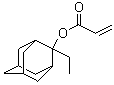 |
| Molecular Formula | C15H22O2 |
| Molecular Weight | 234.33 |
| CAS Registry Number | 303186-14-3 |
| SMILES | CCC1(C2CC3CC(C2)CC1C3)OC(=O)C=C |
| Density | 1.1±0.1 g/cm3 Calc.* |
|---|---|
| Boiling point | 301.9±11.0 °C 760 mmHg (Calc.)* |
| Flash point | 123.0±16.7 °C (Calc.)* |
| Index of refraction | 1.517 (Calc.)* |
| * | Calculated using Advanced Chemistry Development (ACD/Labs) Software. |
 chemBlink Chemical Story
|
2-Ethyl-2-adamantyl acrylate is an acrylate ester containing an adamantane-derived alcohol moiety and an ethyl-substituted adamantyl group. It belongs to the class of specialty acrylate monomers and is primarily recognized for its use as a functional building block in polymer chemistry, especially in the development of advanced photoresist materials and specialty polymers. The adamantane structure was first isolated in the early twentieth century during studies of petroleum-derived hydrocarbons. Its unusual three-dimensional carbon framework, which closely resembles the diamond lattice, attracted considerable interest because of its rigidity, thermal stability, and well-defined molecular shape. As synthetic methods for adamantane derivatives developed, many functionalized adamantane compounds were prepared for applications in pharmaceuticals, materials science, and polymer chemistry. Acrylate derivatives containing adamantane groups, including 2-ethyl-2-adamantyl acrylate, were developed to combine the unique properties of adamantane with the polymerizable acrylate functionality. The molecular structure of 2-ethyl-2-adamantyl acrylate contains two major components: an acrylate group and a substituted adamantyl ester group. The acrylate portion contains a carbon-carbon double bond conjugated with an ester carbonyl group. This unsaturated system is capable of undergoing free-radical polymerization, allowing the compound to serve as a monomer for the preparation of polymers and copolymers. The adamantyl portion consists of a rigid tricyclic hydrocarbon framework formed by fused cyclohexane rings arranged in a stable three-dimensional structure. Unlike flexible linear hydrocarbons, adamantane derivatives have restricted molecular motion and high carbon density. The ethyl substituent attached to the adamantyl group modifies the size, steric environment, and physical properties of the monomer while maintaining the characteristic rigidity of the adamantane framework. The discovery and application of adamantane-based acrylate monomers are closely related to the development of chemically amplified photoresists used in semiconductor manufacturing. Modern semiconductor fabrication requires photoresist materials with high resolution, thermal stability, and suitable resistance to processing conditions. Adamantane-containing polymers have been investigated because the rigid hydrophobic structure of adamantane can improve properties such as glass transition temperature, dry etching resistance, and mechanical stability. 2-Ethyl-2-adamantyl acrylate has been used as a monomer component in polymer systems designed for advanced lithographic applications. When incorporated into copolymers, the adamantane unit can contribute to the physical properties required for fine pattern formation. The acrylate functionality allows controlled incorporation into polymer backbones, while the bulky adamantane structure influences polymer morphology and performance. The ester group in 2-ethyl-2-adamantyl acrylate provides chemical functionality that can be modified through polymer design. In photoresist chemistry, acrylate polymers containing acid-sensitive ester groups have been developed because controlled chemical changes during exposure and development processes can alter polymer solubility. Adamantane-containing acrylates have therefore been investigated as components of materials for advanced imaging technologies. Beyond photoresist applications, adamantane-containing acrylates have been studied in the broader field of specialty polymers. The rigid adamantane structure can improve thermal properties, optical characteristics, and mechanical performance when introduced into polymer chains. These properties have made adamantane derivatives valuable in the design of high-performance materials. The chemical behavior of 2-ethyl-2-adamantyl acrylate is dominated by the acrylate double bond and the ester functionality. The carbon-carbon double bond can participate in radical polymerization, while the ester linkage provides a connection between the polymerizable group and the adamantane framework. The hydrocarbon adamantane structure itself is chemically stable under many conditions because of its saturated carbon framework. Overall, 2-ethyl-2-adamantyl acrylate is a specialized acrylate monomer developed by combining the polymerization capability of acrylate chemistry with the rigidity and stability of the adamantane framework. Its principal applications are in advanced polymer materials, particularly photoresist formulations for semiconductor manufacturing, where its structural characteristics contribute to the performance of high-resolution materials. |
| Market Analysis Reports |