
Online Database of Chemicals from Around the World
| Hangzhou TJM Chemical Co., Ltd. | China | |||
|---|---|---|---|---|
 | www.tjmchem.com | |||
 | +86 13388471767 | |||
 | +86 (571) 8822-3279 | |||
 | sales@tjmchem.com | |||
| Chemical manufacturer | ||||
| chemBlink Standard supplier since 2011 | ||||
| Biosynth AG. | Switzerland | |||
|---|---|---|---|---|
| www.biosynth.com | |||
| +41 (71) 858-2020 | |||
| +41 (71) 858-2030 | |||
| welcome@biosynth.ch | |||
| Chemical manufacturer | ||||
| chemBlink Standard supplier since 2014 | ||||
| Changchun BC&HC Pharmaceutical Technology Co., Ltd. | China | |||
|---|---|---|---|---|
| www.bchc-china.com | |||
| +86 (431) 8087-1788 8087-1588 +86 15804318207 | |||
| +86 (431) 8841-7879 | |||
| 3468242165@qq.com | |||
 | QQ Chat | |||
| Chemical manufacturer since 2014 | ||||
| chemBlink Standard supplier since 2016 | ||||
| R&D Scientific Inc. | Canada | |||
|---|---|---|---|---|
| www.rdscientific.com | |||
| +1 (226) 600-0236 | |||
| sales@rdscientific.com | |||
| Chemical manufacturer since 2016 | ||||
| chemBlink Standard supplier since 2023 | ||||
| Shenzhen Geneseqtools Bioscience & Technology Co. Ltd. | China | |||
|---|---|---|---|---|
| geneseqtools.com | |||
| +86 (0755) 2325-1735 | |||
| sales@geneseqtools.com | |||
| QQ Chat | |||
 | WeChat: 13302967066 | |||
| Chemical manufacturer since 2015 | ||||
| chemBlink Standard supplier since 2025 | ||||
| Classification | Organic raw materials >> Heterocyclic compound >> Indoles |
|---|---|
| Name | 5-Bromo-4-chloro-1H-indol-3-ol 3-acetate |
| Synonyms | 5-Bromo-4-chloro-1H-indol-3-ol acetate (ester); 5-Bromo-4-chloro-indoxyl acetate; 5-Bromo-4-chloro-3-indolyl acetate; 5-Bromo-4-chloro-3-indoxyl acetate |
| Molecular Structure | 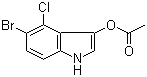 |
| Molecular Formula | C10H7BrClNO2 |
| Molecular Weight | 288.53 |
| CAS Registry Number | 3252-36-6 |
| SMILES | CC(=O)OC1=CNC2=C1C(=C(C=C2)Br)Cl |
| Density | 1.721±0.1 g/cm3 Calc.* |
|---|---|
| Melting point | 106-107 °C |
| Boiling point | 429.3±40.0 °C 760 mmHg (Calc.)* |
| Flash point | 213.4±27.3 °C (Calc.)* |
| Index of refraction | 1.668 (Calc.)* |
| * | Calculated using Advanced Chemistry Development (ACD/Labs) Software. |
| Hazard Symbols |  GHS07 Warning Details GHS07 Warning Details |
|---|---|
| Risk Statements | H302-H315-H319-H335 Details |
| Safety Statements | P261-P305+P351+P338 Details |
| SDS | Available |
 chemBlink Chemical Story
|
5-Bromo-4-chloro-1H-indol-3-ol 3-acetate is a chemically modified derivative of indole, characterized by the presence of bromine and chlorine atoms substituted at the 5 and 4 positions of the indole ring, respectively. The molecule also contains a hydroxyl group at the 3-position of the indole, which is esterified as an acetate. This combination of halogenation and acetylation imparts distinct chemical and biological properties to the compound. The indole core structure is a bicyclic system consisting of a six-membered benzene ring fused to a five-membered nitrogen-containing pyrrole ring. Indole derivatives are widely studied due to their prevalence in natural products and their importance in medicinal chemistry. The substitution pattern on the indole ring affects its reactivity, polarity, and interaction with biological targets. The bromine and chlorine atoms in 5-bromo-4-chloro-1H-indol-3-ol 3-acetate contribute to increased molecular weight and influence electronic distribution within the molecule. Halogen atoms often enhance lipophilicity and can modulate binding affinity to enzymes or receptors. Halogenated indoles have been investigated for diverse biological activities including antimicrobial, anticancer, and enzyme inhibitory effects. The acetylation of the hydroxyl group at the 3-position forms an ester functional group, which can improve the compound's stability and membrane permeability. Acetate esters are commonly employed in drug design to modify pharmacokinetic properties such as absorption and distribution. This ester group may also serve as a prodrug moiety, undergoing enzymatic hydrolysis in vivo to release the active 3-hydroxyindole derivative. The synthesis of 5-bromo-4-chloro-1H-indol-3-ol 3-acetate typically involves halogenation reactions starting from indole or indol-3-ol derivatives, followed by selective acetylation of the hydroxyl group. The introduction of halogens is commonly achieved through electrophilic substitution using brominating and chlorinating agents under controlled conditions to obtain regioselective substitution. Subsequent acetylation employs acetic anhydride or acetyl chloride in the presence of a base or catalyst to form the ester. This compound has potential utility in biochemical research as a building block or intermediate in the synthesis of more complex molecules. Its halogenated indole scaffold makes it suitable for investigations into receptor binding, enzyme inhibition, and as a ligand in drug discovery programs. The ability to modify both electronic and steric aspects of the indole ring through halogenation and esterification provides a versatile platform for exploring structure-activity relationships. In addition to research applications, halogenated indole derivatives such as 5-bromo-4-chloro-1H-indol-3-ol 3-acetate are of interest in the development of pharmaceutical agents targeting various biological pathways. Their chemical properties allow interaction with protein targets implicated in diseases including cancer, infectious diseases, and neurological disorders. Further studies on this compound and its analogs could reveal valuable insights into their mechanism of action and therapeutic potential. Overall, 5-bromo-4-chloro-1H-indol-3-ol 3-acetate is a chemically distinct halogenated and acetylated indole derivative with applications in chemical synthesis, biomedical research, and drug development. Its unique substitution pattern influences both its chemical behavior and biological activity, making it a significant compound for continued investigation in medicinal chemistry and related fields. References 1989. Histochemical detection of alpha-D-galactosidase with 5-Br-4-Cl-3-indoxyl alpha-D-galactoside. Acta Histochemica, 85(2). DOI: 10.1016/S0065-1281(89)80071-6 |
| Market Analysis Reports |