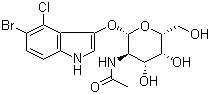
5-Bromo-4-chloro-3-indolyl N-acetyl-β-D-glucosaminide is a synthetic chromogenic substrate widely used in biochemical and molecular biology applications to detect the activity of the enzyme β-N-acetylglucosaminidase. This compound belongs to the class of substituted indolyl glycosides, where the indole moiety is halogenated with bromine and chlorine atoms at the 5 and 4 positions, respectively, and conjugated to the sugar derivative N-acetyl-β-D-glucosamine.
The discovery of substituted indolyl glycosides as enzymatic substrates dates back several decades, with the design aimed at enabling easy visual or spectrophotometric detection of enzymatic hydrolysis. The halogen substitutions on the indole ring enhance the chromogenic properties of the molecule, producing a strongly colored product upon enzymatic cleavage. 5-Bromo-4-chloro-3-indolyl N-acetyl-β-D-glucosaminide was developed to improve sensitivity and specificity in assays targeting β-N-acetylglucosaminidase, an enzyme involved in the degradation of glycoconjugates and widely studied in microbiology and biochemistry.
The compound functions as a substrate for β-N-acetylglucosaminidase, which cleaves the glycosidic bond between the indolyl group and the N-acetyl-β-D-glucosamine unit. Upon cleavage, the indolyl moiety is released and undergoes oxidation to form a colored indigo dye, which precipitates and can be visually detected as a blue or blue-green coloration. This colorimetric change allows researchers to monitor enzyme activity qualitatively and quantitatively.
In microbiology, 5-bromo-4-chloro-3-indolyl N-acetyl-β-D-glucosaminide is widely used in agar media for the identification and differentiation of bacterial species based on their enzymatic profiles. It serves as an indicator in chromogenic culture media where bacterial colonies producing β-N-acetylglucosaminidase cleave the substrate and develop a characteristic color, facilitating rapid and straightforward microbial detection without requiring complex instrumentation.
The compound also finds application in enzymology for kinetic studies of β-N-acetylglucosaminidase and related enzymes. Its chromogenic properties allow researchers to track enzyme activity in real-time, enabling the assessment of enzyme inhibitors, activators, and substrate specificity. The sensitivity of this substrate improves the detection limits in various assays compared to non-halogenated analogs.
In addition to microbiological and enzymatic applications, 5-bromo-4-chloro-3-indolyl N-acetyl-β-D-glucosaminide is employed in histochemical techniques. It is used to localize β-N-acetylglucosaminidase activity in tissue samples or cell cultures, where the formation of the colored precipitate marks the enzyme’s spatial distribution. This feature assists in studying biological processes involving glycoconjugate metabolism and pathological conditions linked to enzyme dysfunction.
The compound is typically synthesized through glycosylation reactions that link the halogenated indolyl derivative to N-acetyl-β-D-glucosamine under controlled conditions. Its stability and purity are critical for reliable assay results, and it is generally stored under refrigerated, dry, and protected conditions to prevent degradation.
In summary, 5-bromo-4-chloro-3-indolyl N-acetyl-β-D-glucosaminide is an established chromogenic substrate extensively used in biochemical, microbiological, and histochemical applications for the sensitive detection of β-N-acetylglucosaminidase activity. Its development has enabled straightforward visual identification of enzyme function, contributing significantly to research and diagnostic methodologies.
|




 GHS07 Warning Details
 chemBlink Chemical Story