
Online Database of Chemicals from Around the World
| Simagchem Corporation | China | |||
|---|---|---|---|---|
 | www.simagchem.com | |||
 | +86 13806087780 | |||
 | +86 (592) 268-0237 | |||
 | sale@simagchem.com | |||
| Chemical manufacturer since 2002 | ||||
| chemBlink Standard supplier since 2008 | ||||
| Ningbo Jinteng Chemical Co., Ltd. | China | |||
|---|---|---|---|---|
| www.jintengchem.com | |||
| +86 (574) 8793-9316 | |||
| +86 (574) 8793-9319 | |||
| jian@jintengchem.com | |||
| Chemical manufacturer | ||||
| chemBlink Standard supplier since 2009 | ||||
| Hefei TNJ Chemical Industry Co., Ltd. | China | |||
|---|---|---|---|---|
| www.tnjchem.com | |||
| +86 (551) 6541-8684 | |||
| +86 (551) 6541-8697 | |||
| sales@tnjchem.com | |||
| Chemical manufacturer since 2001 | ||||
| chemBlink Standard supplier since 2010 | ||||
| BOC Sciences | USA | |||
|---|---|---|---|---|
| www.bocsci.com | |||
| +1 (631) 485-4226 | |||
| +1 (631) 614-7828 | |||
| info@bocsci.com | |||
| Chemical manufacturer | ||||
| chemBlink Standard supplier since 2010 | ||||
| Hangzhou Leap Chem Co., Ltd. | China | |||
|---|---|---|---|---|
| www.leapchem.com | |||
| +86 (571) 8771-1850 | |||
| market19@leapchem.com | |||
 | QQ Chat | |||
| Chemical manufacturer since 2006 | ||||
| chemBlink Standard supplier since 2015 | ||||
| Panjin Jiahe Shengshi Pharmaceutical Technology Co., Ltd | China | |||
|---|---|---|---|---|
| www.jhssw.com | |||
| +86 13032431717 | |||
| sale@jhssw.com | |||
| QQ Chat | |||
| Chemical manufacturer since 2016 | ||||
| chemBlink Standard supplier since 2021 | ||||
| Cfm Oskar Tropitzsch GmbH | Germany | |||
|---|---|---|---|---|
| www.cfmot.de | |||
| +49 (9231) 9619-0 | |||
| +49 (9231) 9619-60 | |||
| info@cfmot.de | |||
| Chemical distributor since 1985 | ||||
| chemBlink Standard supplier since 2022 | ||||
| Santa Cruz Biotechnology, Inc. | USA | |||
|---|---|---|---|---|
| www.scbt.com | |||
| +1 (831) 457-3800 | |||
| +1 (831) 457-3801 | |||
| scbt@scbt.com | |||
| Chemical manufacturer | ||||
| Toronto Research Chemicals Inc. | Canada | |||
|---|---|---|---|---|
| www.trc-canada.com | |||
| +1 (416) 665-9696 | |||
| +1 (416) 665-4439 | |||
| info@trc-canada.com | |||
| Chemical manufacturer since 1982 | ||||
| Shanghai Worldyang Chemical Co., Ltd. | China | |||
|---|---|---|---|---|
| www.worldyachem.com | |||
| +86 13651600618 +86 (21) 5679-5779 | |||
| +86 (21) 5679-5266 | |||
| sales7777@worldyachem.com | |||
| QQ Chat | |||
 | WeChat: 13651600618 | |||
 | WhatsApp:+86 13651600618 | |||
| Chemical manufacturer since 2012 | ||||
| Classification | API >> Synthetic anti-infective drugs >> Disinfectant antiseptic |
|---|---|
| Name | Chlorhexidine hydrochloride |
| Synonyms | Chlorhexidine dihydrochloride; Hexamethylenebis(5-(p-chlorophenyl)biguanide) dihydrochloride; Hibitane chlorhexidine dihydrochloride; 1,1'-Hexamethylenebis(5-(p-chlorophenyl))-biguanide dihydrochloride; AY 5312 |
| Molecular Structure | 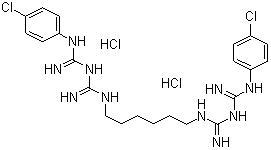 |
| Molecular Formula | C22H30Cl2N10.2(HCl);C22H32Cl4N10 |
| Molecular Weight | 578.37 |
| CAS Registry Number | 3697-42-5 |
| EC Number | 223-026-6 |
| SMILES | C1=CC(=CC=C1N/C(=N/C(=NCCCCCCN=C(/N=C(/NC2=CC=C(C=C2)Cl)N)N)N)/N)Cl.Cl.Cl |
| Melting point | 255-262 °C |
|---|---|
| Water solubility | 0.06 g/100 mL (20 °C) |
| Hazard Symbols |    GHS07;GHS08;GHS09 Warning Details GHS07;GHS08;GHS09 Warning Details | ||||||||||||||||||||||||||||||||||||||||||||
|---|---|---|---|---|---|---|---|---|---|---|---|---|---|---|---|---|---|---|---|---|---|---|---|---|---|---|---|---|---|---|---|---|---|---|---|---|---|---|---|---|---|---|---|---|---|
| Risk Statements | H315-H319-H335-H373-H400-H410-H411 Details | ||||||||||||||||||||||||||||||||||||||||||||
| Safety Statements | P260-P261-P264-P264+P265-P271-P273-P280-P302+P352-P304+P340-P305+P351+P338-P319-P321-P332+P317-P337+P317-P362+P364-P391-P403+P233-P405-P501 Details | ||||||||||||||||||||||||||||||||||||||||||||
| Hazard Classification | |||||||||||||||||||||||||||||||||||||||||||||
| |||||||||||||||||||||||||||||||||||||||||||||
| SDS | Available | ||||||||||||||||||||||||||||||||||||||||||||
 chemBlink Chemical Story
|
Chlorhexidine hydrochloride is a salt form of chlorhexidine, a cationic polybiguanide compound known for its broad-spectrum antimicrobial activity. It is widely used as a disinfectant and antiseptic in medical, dental, and personal hygiene applications. The hydrochloride salt improves the water solubility of chlorhexidine, allowing for effective formulation in aqueous solutions such as mouthwashes, skin cleansers, and wound irrigation fluids. Chlorhexidine was first synthesized in the 1950s by Imperial Chemical Industries (ICI) in the United Kingdom during a program to discover new disinfectants. Its development marked a significant advancement in antiseptic chemistry due to its long-lasting antimicrobial effect, which was superior to many existing agents at the time. The compound was introduced into clinical practice in the late 1950s and has since become one of the most widely used antiseptics globally. The mechanism of action of chlorhexidine hydrochloride involves disruption of microbial cell membranes. Being positively charged, the chlorhexidine molecule binds to the negatively charged surfaces of bacterial cell walls, leading to increased membrane permeability. This results in leakage of intracellular components, ultimately causing cell death. At low concentrations, chlorhexidine is bacteriostatic, while at higher concentrations, it is bactericidal. It is effective against a wide range of Gram-positive and Gram-negative bacteria, and to a lesser extent against yeasts and some viruses. However, it is not effective against bacterial spores and certain mycobacteria. Chlorhexidine hydrochloride has found numerous applications in healthcare. It is commonly used in oral hygiene as a component of mouthwashes for the treatment and prevention of gingivitis and periodontitis. It helps reduce dental plaque formation and bacterial load in the oral cavity, especially in patients with compromised oral health or after dental surgery. In surgical settings, chlorhexidine-containing solutions are used for preoperative skin preparation, hand scrubbing by medical personnel, and disinfection of surgical instruments. It is also included in catheter dressings and antiseptic wound care products to prevent hospital-acquired infections. In ophthalmology, chlorhexidine hydrochloride may be used in dilute concentrations for ocular antisepsis prior to surgery or invasive procedures. In veterinary medicine, it is similarly employed for antiseptic purposes in animals. The compound is valued for its residual activity, meaning it continues to exert antimicrobial effects for hours after application due to its ability to bind to skin and mucosal surfaces. The compound is typically formulated in concentrations ranging from 0.05% to 4% depending on the intended use. It is generally well tolerated, but some users may experience side effects such as local irritation, allergic reactions, or staining of teeth and tongue when used as a mouth rinse. Rare but serious reactions, such as anaphylaxis, have also been reported. Care must be taken to avoid chlorhexidine solutions entering the middle ear or brain cavities, where toxicity has been observed. Chlorhexidine hydrochloride is chemically stable under normal storage conditions, though it is incompatible with certain anionic compounds, such as soaps and other surfactants, which can reduce its efficacy. It is usually stored in tightly closed containers protected from light and heat. Analytical techniques such as ultraviolet-visible (UV-Vis) spectroscopy, high-performance liquid chromatography (HPLC), and mass spectrometry are employed to assess the purity and concentration of chlorhexidine hydrochloride in pharmaceutical formulations. Its antimicrobial activity is typically verified through standardized microbiological assays. In summary, chlorhexidine hydrochloride is a widely used and highly effective antiseptic agent that plays a critical role in infection prevention across medical, dental, and personal care settings. Its persistent activity, broad-spectrum efficacy, and safety in topical applications have made it a cornerstone of modern antimicrobial hygiene practices. References 2024. Lycium barbarum (Goji berry) mouthwash is a viable alternative to 0.2% chlorhexidine gluconate for managing chronic periodontitis: a randomized clinical trial. F1000Research, 13. DOI: 10.12688/f1000research.129891.1 1987. Recolonization of Human Tooth Surfaces by Streptococcus mutans after Suppression by Chlorhexidine Treatment. Journal of Dental Research, 66(9). DOI: 10.1177/00220345870660091801 1987. A Mixed-culture Chemostat System to Predict the Effect of Anti-microbial Agents on the Oral Flora: Preliminary Studies using Chlorhexidine. Journal of Dental Research, 66(8). DOI: 10.1177/00220345870660080501 |
| Market Analysis Reports |