
Online Database of Chemicals from Around the World
| wuhan chemi Pharmacy Chemical Technology Co., Ltd. | China | |||
|---|---|---|---|---|
 | www.chemipharm.com.cn | |||
 | +86 13971619949 | |||
 | gmn424@chemipharm.com.cn | |||
 | QQ Chat | |||
 | WeChat: 13971619949 | |||
| Chemical manufacturer since 2014 | ||||
| chemBlink Standard supplier since 2026 | ||||
| Classification | Chemical reagent >> Organic reagent >> Imide |
|---|---|
| Name | 1,1PR-Bisuccinimide(N,npr-bisuccinimidyl) |
| Synonyms | 1-(2,5-dioxopyrrolidin-1-yl)pyrrolidine-2,5-dione |
| Molecular Structure | 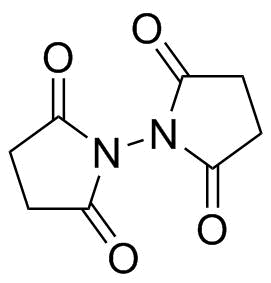 |
| Molecular Formula | C8H8N2O4 |
| Molecular Weight | 196.16 |
| CAS Registry Number | 3741-24-0 |
| EC Number | 654-582-1 |
| SMILES | C1CC(=O)N(C1=O)N2C(=O)CCC2=O |
| Density | 1.6±0.1 g/cm3 Calc.* |
|---|---|
| Boiling point | 341.6±25.0 °C 760 mmHg (Calc.)* |
| Flash point | 164.7±15.5 °C (Calc.)* |
| Index of refraction | 1.633 (Calc.)* |
| * | Calculated using Advanced Chemistry Development (ACD/Labs) Software. |
| Hazard Symbols |  GHS06 Danger Details GHS06 Danger Details | ||||||||
|---|---|---|---|---|---|---|---|---|---|
| Risk Statements | H301 Details | ||||||||
| Safety Statements | P264-P270-P301+P316-P321-P330-P405-P501 Details | ||||||||
| Hazard Classification | |||||||||
| |||||||||
 chemBlink Chemical Story
|
The compound referred to as **1,1PR-bisuccinimide (N,N′-bisuccinimidyl)** corresponds to **1,1′-bipyrrolidine-2,2′,5,5′-tetrone**, also known as **N,N′-bisuccinimide**, with CAS number **3741-24-0**. It is a symmetrical cyclic imide dimer derived from succinimide units and belongs to the class of dicarboximide-based heterocycles. Structurally, it consists of two succinimide (pyrrolidine-2,5-dione) rings linked through a nitrogen–nitrogen bond, forming a rigid bis-imide framework with four carbonyl groups. The compound is part of a family of succinimide derivatives that became widely studied in organic and applied chemistry due to the reactivity of the imide functional group. Succinimide itself and its N-substituted derivatives have long been used in synthetic chemistry as intermediates, particularly in reactions involving radical halogenation, oxidation systems, and as leaving-group precursors in activated esters. The development of N-halosuccinimides, such as N-bromosuccinimide and N-iodosuccinimide, established the broader importance of the succinimide scaffold in selective organic transformations. In the case of 1,1′-bipyrrolidine-2,2′,5,5′-tetrone, the structure differs from monomeric succinimide derivatives by the presence of a direct N–N bond linking two imide rings. This dimeric arrangement creates a highly electron-deficient system due to the presence of four carbonyl groups distributed across the molecule. The conjugation and inductive effects of these carbonyl groups strongly stabilize the imide framework while also making the molecule relatively rigid. Compounds of this type are typically associated with use as specialized reagents or intermediates in synthetic organic chemistry. The electrophilic character of imide carbonyls makes succinimide-based structures useful in the formation of activated esters and coupling reagents. Although the parent bis-succinimide structure is less commonly used directly compared with N-halosuccinimides or N-alkoxy derivatives, it is part of the same functional family that underpins many modern bioconjugation and peptide coupling methodologies. The succinimide framework has historical importance in the development of peptide synthesis chemistry. Activated succinimide esters, often referred to as NHS esters (N-hydroxysuccinimide esters), became widely adopted in the second half of the twentieth century as efficient reagents for amide bond formation. While 1,1′-bipyrrolidine-2,2′,5,5′-tetrone itself is not an NHS ester, it is structurally related to this broader class of imide-based activating groups that enable controlled acyl transfer reactions. From a structural perspective, the molecule is expected to exhibit significant planarity within each succinimide ring due to conjugation between the nitrogen atom and adjacent carbonyl groups. The N–N bond linking the two rings introduces a central axis of symmetry, and the overall geometry is influenced by repulsion between the carbonyl oxygen atoms. These features contribute to a relatively high degree of rigidity compared with simpler aliphatic imides. The compound has been reported in chemical supplier catalogs and chemical databases as a specialized reagent and is occasionally referenced in the context of synthetic methodology development. Its utility is primarily linked to its relationship with other succinimide derivatives rather than widespread standalone industrial application. Like many highly functionalized imide systems, it is generally handled as a research chemical used in controlled laboratory environments. Overall, 1,1′-bipyrrolidine-2,2′,5,5′-tetrone (N,N′-bisuccinimide) represents a dimeric succinimide framework within the broader family of imide-based reagents. Its significance lies in its structural relationship to widely used succinimide activation chemistry and its role as a representative example of highly electron-deficient cyclic imide systems used in synthetic organic chemistry. References 2004. Synthesis by Ring-Closure Reactions. Science of Synthesis. URL: https://science-of-synthesis.thieme.com/app/text/?id=SD-246-00105 |
| Market Analysis Reports |