
Online Database of Chemicals from Around the World
| Shenyang OllyChem Technology Co., Ltd. | China | |||
|---|---|---|---|---|
 | www.ollychem.com | |||
 | +86 (24) 6225-9849 +86 13840042106 | |||
 | +86 (24) 6225-9831 | |||
 | info@ollychem.com oliverdu@ollychem.com | |||
| Chemical manufacturer since 2001 | ||||
| chemBlink Premium supplier since 2007 | ||||
| Classification | Chemical reagent >> Organic reagent >> Phosphonate / phosphonate |
|---|---|
| Name | Dimethyl (3-phenoxy-2-oxopropyl)phosphonate |
| Synonyms | Dimethyl (3-phenoxyacetonyl)phosphonate |
| Molecular Structure | 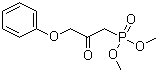 |
| Molecular Formula | C11H15O5P |
| Molecular Weight | 258.21 |
| CAS Registry Number | 40665-68-7 |
| SMILES | COP(=O)(CC(=O)COC1=CC=CC=C1)OC |
| Density | 1.2±0.1 g/cm3, Calc.* |
|---|---|
| Index of Refraction | 1.491, Calc.* |
| Boiling Point | 369.8±22.0 °C (760 mmHg), Calc.* |
| Flash Point | 191.1±42.7 °C, Calc.* |
| * | Calculated using Advanced Chemistry Development (ACD/Labs) Software. |
| Hazard Symbols |  GHS07 Warning Details GHS07 Warning Details |
|---|---|
| Risk Statements | H302-H315-H319-H335 Details |
| Safety Statements | P261-P305+P351+P338 Details |
| SDS | Available |
 chemBlink Chemical Story
|
Dimethyl (3-phenoxy-2-oxopropyl)phosphonate is an organophosphorus compound widely used in organic synthesis, particularly as a key intermediate in the formation of carbon-carbon bonds. The discovery of this compound stems from the broader exploration of phosphonates, which are valuable in synthetic chemistry due to their reactivity and stability. Phosphonate compounds, like dimethyl (3-phenoxy-2-oxopropyl)phosphonate, are frequently utilized in the Horner-Wadsworth-Emmons (HWE) reaction, an important tool for synthesizing alkenes with high stereocontrol. The synthesis of dimethyl (3-phenoxy-2-oxopropyl)phosphonate typically involves the reaction of dimethyl phosphite with 3-phenoxy-2-oxopropanal or similar compounds under basic conditions. The resulting product contains both a phosphonate group and a phenoxy-substituted carbonyl group, which can undergo further chemical transformations. This dual reactivity enhances the compound’s versatility in various synthetic applications. Dimethyl (3-phenoxy-2-oxopropyl)phosphonate is widely employed in the pharmaceutical industry for constructing complex molecular frameworks, particularly in the development of biologically active compounds. Its phosphonate group allows it to participate in olefination reactions, creating carbon-carbon double bonds, while the phenoxy group can modulate the electronic and steric properties of the molecules it helps build. This makes the compound an attractive starting material or intermediate in drug discovery and agrochemical development. In addition to its role in organic synthesis, dimethyl (3-phenoxy-2-oxopropyl)phosphonate is valued for its stability and ability to mimic phosphate groups in biological systems. This property is useful in designing enzyme inhibitors or compounds that interact with phosphorylated biological molecules, such as nucleotides and proteins. The compound’s ability to serve as a phosphate analog has potential applications in medicinal chemistry, where it can help study enzyme-substrate interactions or be used in developing enzyme inhibitors. Overall, dimethyl (3-phenoxy-2-oxopropyl)phosphonate represents a crucial tool for synthetic chemists, offering a range of applications in the creation of complex molecules for pharmaceutical, agrochemical, and biological research. References 2010. Tafluprost. Pharmaceutical Substances. URL: https://pharmaceutical-substances.thieme.com/ps/search-results?docUri=KD-20-0221 |
| Market Analysis Reports |