
Online Database of Chemicals from Around the World
| Wilshire Technologies, Inc. | USA | |||
|---|---|---|---|---|
 | www.wilshiretechnologies.com | |||
 | +1 (609) 683-1117 | |||
 | +1 (732) 274-0049 | |||
 | Wilshire-info@evonik.com | |||
| Chemical manufacturer since 1997 | ||||
| chemBlink Standard supplier since 2010 | ||||
| BOC Sciences | USA | |||
|---|---|---|---|---|
| www.bocsci.com | |||
| +1 (631) 485-4226 | |||
| +1 (631) 614-7828 | |||
| info@bocsci.com | |||
| Chemical manufacturer | ||||
| chemBlink Standard supplier since 2010 | ||||
| Cangzhou Enke Pharma-tech Co., Ltd. | China | |||
|---|---|---|---|---|
| www.enkepharma.com | |||
| +86 (317) 529-6180 510-6597 +86 15533709196 | |||
| +86 (317) 510-6596 | |||
| sale@enkepharma.com enkepharma@126.com | |||
 | QQ Chat | |||
 | Skype Chat | |||
 | WeChat: ymzhao | |||
| Chemical manufacturer since 2011 | ||||
| chemBlink Standard supplier since 2016 | ||||
| Nanjing Fred Technology Co., Ltd. | China | |||
|---|---|---|---|---|
| www.fredbio.com | |||
| +86 (25) 8469-6168 | |||
| Austin@fredchem.cn | |||
| QQ Chat | |||
| Skype Chat | |||
| WeChat: NJFred01 | |||
 | WhatsApp:+86 17302533743 | |||
| Chemical manufacturer since 2020 | ||||
| chemBlink Standard supplier since 2025 | ||||
| BoroPharm Inc. | USA | |||
|---|---|---|---|---|
| www.boropharm.com | |||
| +1 (888) 366-1496 | |||
| +1 (248) 348-5760 | |||
| sales@boropharm.com | |||
| Chemical manufacturer | ||||
| Classification | Organic raw materials >> Nitrile compound |
|---|---|
| Name | 3-Chloro-5-hydroxybenzonitrile |
| Molecular Structure | 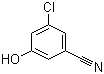 |
| Molecular Formula | C7H4ClNO |
| Molecular Weight | 153.57 |
| CAS Registry Number | 473923-97-6 |
| EC Number | 691-717-3 |
| SMILES | C1=C(C=C(C=C1O)Cl)C#N |
| Density | 1.4±0.1 g/cm3 Calc.* |
|---|---|
| Melting point | 170 - 173 °C (Expl.) |
| Boiling point | 265.4±25.0 °C 760 mmHg (Calc.)* |
| Flash point | 114.3±23.2 °C (Calc.)* |
| Index of refraction | 1.611 (Calc.)* |
| * | Calculated using Advanced Chemistry Development (ACD/Labs) Software. |
| Hazard Symbols |   GHS06;GHS07 Danger Details GHS06;GHS07 Danger Details | ||||||||||||||||||||||||||||||||
|---|---|---|---|---|---|---|---|---|---|---|---|---|---|---|---|---|---|---|---|---|---|---|---|---|---|---|---|---|---|---|---|---|---|
| Risk Statements | H301-H302-H312-H315-H319-H332-H335 Details | ||||||||||||||||||||||||||||||||
| Safety Statements | P261-P262-P264-P264+P265-P270-P271-P280-P301+P316-P301+P317-P302+P352-P304+P340-P305+P351+P338-P316-P317-P319-P321-P330-P332+P317-P337+P317-P361+P364-P362+P364-P403+P233-P405-P501 Details | ||||||||||||||||||||||||||||||||
| Hazard Classification | |||||||||||||||||||||||||||||||||
| |||||||||||||||||||||||||||||||||
| SDS | Available | ||||||||||||||||||||||||||||||||
 chemBlink Chemical Story
|
3-Chloro-5-hydroxybenzonitrile is a halogenated phenolic nitrile compound that belongs to the class of substituted benzonitriles. It features a hydroxyl group at the 5-position, a chlorine atom at the 3-position, and a nitrile group at the 1-position of the benzene ring. This specific substitution pattern provides unique electronic and chemical characteristics that make the compound valuable in synthetic organic chemistry, particularly as an intermediate in the synthesis of pharmaceuticals, agrochemicals, and specialty materials. The systematic investigation of substituted benzonitriles, including hydroxy and halo derivatives, began in earnest during the mid-20th century, when researchers explored the reactivity of various functional groups on aromatic rings. The presence of both electron-donating (hydroxyl) and electron-withdrawing (cyano and chloro) groups on the aromatic nucleus of 3-chloro-5-hydroxybenzonitrile allows for differential activation of specific ring positions, influencing the outcome of subsequent chemical transformations such as electrophilic substitution, nucleophilic aromatic substitution, and metal-catalyzed cross-coupling reactions. 3-Chloro-5-hydroxybenzonitrile is typically synthesized through regioselective functionalization of a benzonitrile core. One common synthetic route involves the selective chlorination of 5-hydroxybenzonitrile or the hydroxylation of 3-chlorobenzonitrile under controlled conditions. The hydroxyl group serves as a directing group for electrophilic substitution and also increases the solubility of the compound in polar solvents, facilitating its use in aqueous or mixed-phase systems. In pharmaceutical chemistry, compounds structurally related to 3-chloro-5-hydroxybenzonitrile are employed as intermediates in the synthesis of active pharmaceutical ingredients (APIs). The hydroxy group can be further modified to form ethers, esters, or carbamates, while the chloro group serves as a reactive site for substitution by various nucleophiles, including amines, thiols, and alkoxides. The nitrile moiety is a versatile functional group that can undergo transformations such as hydrolysis to carboxylic acids or conversion to amidines, amides, or tetrazoles, enabling the construction of diverse molecular scaffolds with potential biological activity. The agrochemical industry also benefits from the use of halohydroxybenzonitriles like this compound. They serve as core structures in the design of herbicides and fungicides, especially those targeting specific plant or microbial metabolic pathways. The ability to fine-tune the electronic environment of the aromatic ring by varying substituents is critical in optimizing activity and selectivity. Furthermore, the chemical stability and ease of derivatization of 3-chloro-5-hydroxybenzonitrile make it suitable for large-scale synthesis and formulation. In the field of materials science, substituted benzonitriles are utilized in the preparation of liquid crystals, dyes, and functional monomers for advanced polymers. The polar nitrile group contributes to dipole interactions, while the phenolic hydroxyl group can engage in hydrogen bonding, influencing the thermal and mechanical properties of resulting materials. Additionally, the compound may be employed as a ligand precursor in coordination chemistry due to its donor atoms and defined geometry. Analytical applications of 3-chloro-5-hydroxybenzonitrile include its use as a reference compound in chromatographic analysis and as a model substrate in mechanistic studies of aromatic substitution reactions. The distinct spectroscopic features of the hydroxyl, nitrile, and chloro groups allow for easy identification and quantification by UV, IR, and NMR techniques. Overall, 3-chloro-5-hydroxybenzonitrile is a structurally and functionally significant aromatic intermediate. Its unique combination of substituents enables diverse chemical modifications, supporting its widespread use in synthetic methodology development and the preparation of functionally complex molecules across multiple scientific disciplines. References 2019. Doravirine. Pharmaceutical Substances, 1. URL: https://www.thieme.de/en/thieme-chemistry/pharmaceutical-substances-54712.htm 2012. Synthesis of MK-6186. Synfacts, 8(7). DOI: 10.1055/s-0031-1290418 |
| Market Analysis Reports |