
Online Database of Chemicals from Around the World
| Hubei HONCH Pharmaceutical Co., Ltd. | China | |||
|---|---|---|---|---|
 | www.hcpharm.com | |||
 | +86 (27) 8765-9162 +86 15271583999 | |||
 | +86 (27) 8765-4262 | |||
 | sales@hcpharm.com hcpharm@live.cn | |||
| Chemical manufacturer | ||||
| chemBlink Standard supplier since 2006 | ||||
| BOC Sciences | USA | |||
|---|---|---|---|---|
| www.bocsci.com | |||
| +1 (631) 485-4226 | |||
| +1 (631) 614-7828 | |||
| info@bocsci.com | |||
| Chemical manufacturer | ||||
| chemBlink Standard supplier since 2010 | ||||
| Shanghai Hohance Chemical Co., Ltd. | China | |||
|---|---|---|---|---|
| www.hohance.com | |||
| +86 (21) 3111-5312 | |||
| +86 (21) 3111-5317 | |||
| info@hohance.com | |||
| Chemical manufacturer | ||||
| chemBlink Standard supplier since 2011 | ||||
| Apexbio Technology LLC | USA | |||
|---|---|---|---|---|
| www.apexbt.com | |||
| +1 (832) 696-8203 | |||
| +1 (855) 527-3928 | |||
| info@apexbt.com | |||
| Chemical manufacturer since 2012 | ||||
| chemBlink Standard supplier since 2013 | ||||
| Selleck Chemicals LLC | USA | |||
|---|---|---|---|---|
| www.selleckchem.com | |||
| +1 (713) 535-9129 | |||
| +1 (832) 582-8590 | |||
| info@selleckchem.com | |||
| Chemical manufacturer | ||||
| chemBlink Standard supplier since 2014 | ||||
| Shenzhen Happy Pharmaceuticals Ltd. | China | |||
|---|---|---|---|---|
| www.happypharm.cn | |||
| +86 (536) 737-6118 | |||
| mark@happypharm.cn | |||
 | QQ Chat | |||
| Chemical manufacturer since 2013 | ||||
| chemBlink Standard supplier since 2014 | ||||
| Puho Pharmaceutical Co., Ltd. | China | |||
|---|---|---|---|---|
| www.puhopharma.com | |||
| +86 13760689947 +86 (20) 6227-9976 | |||
| sales@puhopharma.com | |||
| QQ Chat | |||
| Chemical manufacturer since 2014 | ||||
| chemBlink Standard supplier since 2014 | ||||
| Hangzhou Leap Chem Co., Ltd. | China | |||
|---|---|---|---|---|
| www.leapchem.com | |||
| +86 (571) 8771-1850 | |||
| market19@leapchem.com | |||
| QQ Chat | |||
| Chemical manufacturer since 2006 | ||||
| chemBlink Standard supplier since 2015 | ||||
| Shanghai Zehan Biopharma Technology Co., Ltd. | China | |||
|---|---|---|---|---|
| www.zehanbiopharma.com | |||
| +86 (21) 6135-0663 +86 13052117465 | |||
| +86 (21) 6135-0662 | |||
| sales@zehanbiopharma.com | |||
| QQ Chat | |||
| Chemical manufacturer since 2015 | ||||
| chemBlink Standard supplier since 2015 | ||||
| Ningbo Easun Biological Technology Co., Ltd. | China | |||
|---|---|---|---|---|
| www.easunbiotech.com | |||
| +86 (574) 6208-9878 +86 18657120662 | |||
| +86 (574) 6208-9877 | |||
| sales@easunbiotech.com | |||
| QQ Chat | |||
| Chemical manufacturer since 2015 | ||||
| chemBlink Standard supplier since 2015 | ||||
| Amadis Chemical Co., Ltd. | China | |||
|---|---|---|---|---|
| www.amadischem.com | |||
| +86 (571) 8992-5085 | |||
| +86 (571) 8992-5065 | |||
| sales@amadischem.com | |||
| Chemical manufacturer since 2010 | ||||
| chemBlink Standard supplier since 2015 | ||||
| Shanghai Yingrui Biopharm Co., Ltd. | China | |||
|---|---|---|---|---|
| www.shyrchem.com | |||
| +86 (21) 3358-5366 3466-6753 +86 13311639313 | |||
| +86 (21) 3497-9012 | |||
| sales02@shyrchem.com | |||
| QQ Chat | |||
 | Skype Chat | |||
| Chemical manufacturer since 2009 | ||||
| chemBlink Standard supplier since 2017 | ||||
| Suzhou Biosyntech Co., Ltd. | China | |||
|---|---|---|---|---|
| www.biosyntech-suzhou.com | |||
| +86 13921151340 +86 (512) 6300-1269 | |||
| sales2@biosyntech-suzhou.com sales@biosyntech-suzhou.com | |||
| QQ Chat | |||
| Chemical distributor since 2019 | ||||
| chemBlink Standard supplier since 2020 | ||||
| Cfm Oskar Tropitzsch GmbH | Germany | |||
|---|---|---|---|---|
| www.cfmot.de | |||
| +49 (9231) 9619-0 | |||
| +49 (9231) 9619-60 | |||
| info@cfmot.de | |||
| Chemical distributor since 1985 | ||||
| chemBlink Standard supplier since 2022 | ||||
| Ivy Fine Chemicals | USA | |||
|---|---|---|---|---|
| www.ivychem.com | |||
| +1 (856) 465-8550 | |||
| +1 (856) 616-1161 | |||
| sales@ivychem.com | |||
| Chemical manufacturer | ||||
| Chemos GmbH & Co. KG | Germany | |||
|---|---|---|---|---|
| www.chemos.de | |||
| +49 871-966346-0 | |||
| +49 871-966346-13 | |||
| chemos@chemos.de | |||
| Chemical distributor | ||||
| LKT Laboratories, Inc. | USA | |||
|---|---|---|---|---|
| www.lktlabs.com | |||
| +1 (888) 558-5227 | |||
| +1 (651) 644-8357 | |||
| peacerli@mbolin-lktlabs.com | |||
| Chemical manufacturer | ||||
| Melford Laboratories Limited | UK | |||
|---|---|---|---|---|
| www.melford.co.uk | |||
| +44 (1449) 741-178 | |||
| +44 (1449) 741-217 | |||
| pfranklin@melford.co.uk sales@melford.co.uk | |||
| Chemical manufacturer since 1985 | ||||
| Santa Cruz Biotechnology, Inc. | USA | |||
|---|---|---|---|---|
| www.scbt.com | |||
| +1 (831) 457-3800 | |||
| +1 (831) 457-3801 | |||
| scbt@scbt.com | |||
| Chemical manufacturer | ||||
| VDM Biochemicals | USA | |||
|---|---|---|---|---|
| www.vdmbio.com | |||
| +1 (330) 252-8181 | |||
| +1 (330) 252-8171 | |||
| sales@vdmbio.com info@vdmbio.com | |||
| Chemical manufacturer | ||||
| Indofine Chemical Company, Inc. | USA | |||
|---|---|---|---|---|
| www.indofinechemical.com | |||
| +1 (888) 463-6346 | |||
| +1 (908) 359-1179 | |||
| info@indofinechemical.com | |||
| Chemical manufacturer since 1981 | ||||
| Acros Organics | Belgium | |||
|---|---|---|---|---|
| www.acros.com | |||
| +86 (21) 5258-1100 | |||
| +86 (21) 5258-0119 | |||
| info@acros.com | |||
| Chemical manufacturer | ||||
| Classification | API >> Antineoplastic agents >> Antibiotic antineoplastic agents |
|---|---|
| Name | Mitomycin C |
| Synonyms | [1aR-(1aalpha,8beta,8aalpha,8balpha)]-6-Amino-8-[[(aminocarbonyl)oxy]methyl]-1,1a,2,8,8a,8b-hexahydro-8a-methoxy-5-methylazirino[2',3':3,4]pyrrolo[1,2-alpha]indole-4,7-dione; 6-Amino-1,1a,2,8,8a,8b-hexahydro-8-(hydroxymethyl)-8a-methoxy-5-methylazirino[2',3':3,4]pyrrolo[1,2-a]indole-4,7-dione carbamate (ester) |
| Molecular Structure | 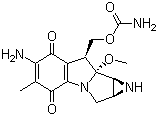 |
| Molecular Formula | C15H18N4O5 |
| Molecular Weight | 334.33 |
| CAS Registry Number | 50-07-7 |
| EC Number | 200-008-6 |
| SMILES | CC1=C(C(=O)C2=C(C1=O)N3C[C@H]4[C@@H]([C@@]3([C@@H]2COC(=O)N)OC)N4)N |
| Water solubility | soluble |
|---|---|
| Density | 1.6±0.1 g/cm3, Calc.* |
| Melting point | 360 °C |
| Index of Refraction | 1.680, Calc.* |
| Boiling Point | 581.8±50.0 °C (760 mmHg), Calc.* |
| Flash Point | 305.6±30.1 °C, Calc.* |
| * | Calculated using Advanced Chemistry Development (ACD/Labs) Software. |
| Hazard Symbols |   GHS06;GHS08 Dander Details GHS06;GHS08 Dander Details | ||||||||||||||||||||||||||||||||||||||||||||||||||||||||||||||||||||
|---|---|---|---|---|---|---|---|---|---|---|---|---|---|---|---|---|---|---|---|---|---|---|---|---|---|---|---|---|---|---|---|---|---|---|---|---|---|---|---|---|---|---|---|---|---|---|---|---|---|---|---|---|---|---|---|---|---|---|---|---|---|---|---|---|---|---|---|---|---|
| Risk Statements | H300-H301-H351 Details | ||||||||||||||||||||||||||||||||||||||||||||||||||||||||||||||||||||
| Safety Statements | P203-P264-P270-P280-P301+P316-P318-P321-P330-P405-P501 Details | ||||||||||||||||||||||||||||||||||||||||||||||||||||||||||||||||||||
| Hazard Classification | |||||||||||||||||||||||||||||||||||||||||||||||||||||||||||||||||||||
| |||||||||||||||||||||||||||||||||||||||||||||||||||||||||||||||||||||
| SDS | Available | ||||||||||||||||||||||||||||||||||||||||||||||||||||||||||||||||||||
 chemBlink Chemical Story
|
Mitomycin C is an antineoplastic agent that has been widely used in the treatment of various cancers, including breast cancer, gastric cancer, and bladder cancer. It is a naturally occurring compound originally isolated from the bacterium *Streptomyces caespitosus* in the early 1950s. Mitomycin C is classified as an antibiotic, but its primary use is in cancer therapy due to its ability to inhibit DNA synthesis. The drug functions by forming covalent bonds with DNA, leading to strand breaks and the inhibition of replication and transcription, which ultimately induces cell death. The discovery of Mitomycin C can be traced back to the efforts of researchers studying the secondary metabolites produced by microorganisms. The compound was first isolated from *Streptomyces caespitosus* in 1956 by Japanese researchers who were conducting a systematic investigation of the chemical potential of soil bacteria. After initial studies revealed its potent antimicrobial activity, further research demonstrated its efficacy as an anticancer agent. The compound underwent extensive preclinical and clinical testing in the following decades, leading to its approval for use in cancer therapy in the 1970s. Mitomycin C’s mechanism of action involves the inhibition of DNA synthesis through the formation of covalent bonds between the drug and DNA strands. This results in cross-linking, which prevents the separation of the DNA strands, effectively blocking DNA replication and transcription. This action is particularly effective against rapidly proliferating cells, such as cancer cells, making Mitomycin C a potent chemotherapy agent. In addition to its DNA-interacting properties, Mitomycin C can generate reactive oxygen species, which further contribute to its cytotoxic effects. Clinically, Mitomycin C has been used to treat a variety of cancers, including but not limited to breast cancer, gastric cancer, colorectal cancer, and non-small cell lung cancer. It is often used in combination with other chemotherapy agents to improve efficacy and reduce the risk of resistance. In particular, Mitomycin C is commonly employed in the treatment of bladder cancer, where it is administered intravesically (directly into the bladder) to treat superficial bladder cancer. This localized delivery helps to minimize systemic side effects while delivering a high concentration of the drug to the tumor site. Mitomycin C is also used in the treatment of other malignancies, including esophageal, pancreatic, and cervical cancers, where it is often combined with other chemotherapeutic agents to enhance its effectiveness. The drug is typically administered intravenously, although other methods of delivery may be used depending on the type of cancer and treatment protocol. While Mitomycin C is highly effective, it is associated with a number of side effects. One of the most significant adverse effects is myelosuppression, which leads to a decrease in the production of blood cells and increases the risk of infection and bleeding. Other common side effects include nausea, vomiting, and gastrointestinal distress. More serious side effects include pulmonary toxicity, which can cause long-term damage to the lungs, and renal toxicity, which can lead to kidney damage. These side effects necessitate careful monitoring of patients undergoing treatment with Mitomycin C. Despite its effectiveness, research has continued to explore ways to mitigate the side effects associated with Mitomycin C. Various strategies, such as modifying the structure of the compound or using combination therapies, aim to reduce toxicity while maintaining or improving the drug's anticancer efficacy. In conclusion, Mitomycin C is a potent chemotherapy agent with significant applications in the treatment of various cancers. Its discovery from a soil bacterium marked a significant breakthrough in cancer therapy, and its ability to target and destroy rapidly proliferating cells has made it a valuable drug in oncology. However, its use is accompanied by potential side effects, which require careful management to ensure the safety and effectiveness of the treatment. References 1990. Mitomycin C cross-resistance induced by Adriamycin in human ovarian cancer cells in vitro. Cancer Chemotherapy and Pharmacology. DOI: 10.1007/bf02897288 1987. Potent effects of the monoclonal antibody-mitomycin C conjugate on human colon cancers. The Japanese journal of surgery. DOI: 10.1007/bf02470585 1969. The effect of UV light and mitomycin C on the transfection of Bacillus subtilis 168 I-. Folia Microbiologica. DOI: 10.1007/bf02872777 |
| Market Analysis Reports |