Online Database of Chemicals from Around the World

Actinomycin D
[CAS# 50-76-0]

List of Suppliers
Discovery Fine Chemicals Ltd. UK Inquire
www.discofinechem.com
+44 (1202) 874-517
+44 (845) 094-4385
pjc@discofinechem.com
Chemical manufacturer
chemBlink Standard supplier since 2009
Taizhou Crene Biotechnology Co., Ltd. China Inquire
www.pharm-intermediates.com
+86 (576) 8881-3233
8820-5808
+86 13396860566
+86 (576) 8822-9589
sales@pharm-intermediates.com
QQ Chat
Chemical manufacturer since 2011
chemBlink Standard supplier since 2009
BOC Sciences USA Inquire
www.bocsci.com
+1 (631) 485-4226
+1 (631) 614-7828
info@bocsci.com
Chemical manufacturer
chemBlink Standard supplier since 2010
Shanghai Hohance Chemical Co., Ltd. China Inquire
www.hohance.com
+86 (21) 3111-5312
+86 (21) 3111-5317
info@hohance.com
Chemical manufacturer
chemBlink Standard supplier since 2011
Apexbio Technology LLC USA Inquire
www.apexbt.com
+1 (832) 696-8203
+1 (855) 527-3928
info@apexbt.com
Chemical manufacturer since 2012
chemBlink Standard supplier since 2013
Hangzhou Leap Chem Co., Ltd. China Inquire
www.leapchem.com
+86 (571) 8771-1850
market19@leapchem.com
QQ Chat
Chemical manufacturer since 2006
chemBlink Standard supplier since 2015
Ningbo Easun Biological Technology Co., Ltd. China Inquire
www.easunbiotech.com
+86 (574) 6208-9878
+86 18657120662
+86 (574) 6208-9877
sales@easunbiotech.com
QQ Chat
Chemical manufacturer since 2015
chemBlink Standard supplier since 2015
Shanghai Yingrui Biopharm Co., Ltd. China Inquire
www.shyrchem.com
+86 (21) 3358-5366
3466-6753
+86 13311639313
+86 (21) 3497-9012
sales02@shyrchem.com
QQ Chat
Skype Chat
Chemical manufacturer since 2009
chemBlink Standard supplier since 2017
Shanghai Fuxin Pharmaceutical Co., Ltd. China Inquire
www.fuxinpharm.com
+86 (21) 3130-0828
+86 18645121291
+86 (21) 3130-0828
contact@fuxinpharm.com
Chemical manufacturer since 2016
chemBlink Standard supplier since 2018
Tecoland Corporation USA Inquire
www.tecoland.com
+1 (732) 603-9577
+1 (732) 906-1522
info@tecoland.com
Chemical distributor since 2001
chemBlink Standard supplier since 2019
Cfm Oskar Tropitzsch GmbH Germany Inquire
www.cfmot.de
+49 (9231) 9619-0
+49 (9231) 9619-60
info@cfmot.de
Chemical distributor since 1985
chemBlink Standard supplier since 2022
Zhejiang Hisun Pharmaceutical Co., Ltd. China Inquire
www.hisunpharm.com
+86 13651899693
yiwen.sun@hisunpharm.com
Chemical manufacturer since 1956
chemBlink Standard supplier since 2024
Chemos GmbH & Co. KG Germany Inquire
www.chemos.de
+49 871-966346-0
+49 871-966346-13
chemos@chemos.de
Chemical distributor
Enzo Life Sciences International Inc. USA Inquire
www.enzolifesciences.com
+1 (610) 941-0430
+1 (610) 941-9252
info-usa@enzolifesciences.com
Chemical manufacturer
LKT Laboratories, Inc. USA Inquire
www.lktlabs.com
+1 (888) 558-5227
+1 (651) 644-8357
peacerli@mbolin-lktlabs.com
Chemical manufacturer
Melford Laboratories Limited UK Inquire
www.melford.co.uk
+44 (1449) 741-178
+44 (1449) 741-217
pfranklin@melford.co.uk
sales@melford.co.uk
Chemical manufacturer since 1985
Indofine Chemical Company, Inc. USA Inquire
www.indofinechemical.com
+1 (888) 463-6346
+1 (908) 359-1179
info@indofinechemical.com
Chemical manufacturer since 1981
VDM Biochemicals USA Inquire
www.vdmbio.com
+1 (330) 252-8181
+1 (330) 252-8171
sales@vdmbio.com
info@vdmbio.com
Chemical manufacturer
Santa Cruz Biotechnology, Inc. USA Inquire
www.scbt.com
+1 (831) 457-3800
+1 (831) 457-3801
scbt@scbt.com
Chemical manufacturer
Apollo Scientific Ltd. UK Inquire
www.apolloscientific.co.uk
+44 (161) 406-0505
+44 (161) 406-0506
sales@apolloscientific.co.uk
Chemical manufacturer
Toronto Research Chemicals Inc. Canada Inquire
www.trc-canada.com
+1 (416) 665-9696
+1 (416) 665-4439
info@trc-canada.com
Chemical manufacturer since 1982

Identification
ClassificationAPI >> Antineoplastic agents >> Antibiotic antineoplastic agents
NameActinomycin D
SynonymsDactinomycin; 2-Amino-N,N'-bis[hexadecahydro-2,5,9-trimethyl-6,13-bis(1-methylethyl)-1,4,7,11,14-pentaoxo-1H-pyrrolo[2,1-i][1,4,7,10,13]oxatetraazacyclohexadecin-10-yl]-4,6-dimethyl-3-oxo-3H-phenoxazine-1,9-dicarboxamide
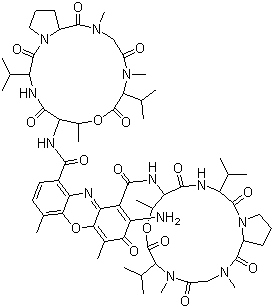
Molecular StructureCAS # 50-76-0, Actinomycin D
Molecular FormulaC62H86N12O16
Molecular Weight1255.43
CAS Registry Number50-76-0
EC Number200-063-6
SMILESC[C@@H]1[C@@H](C(=O)N[C@@H](C(=O)N2CCC[C@H]2C(=O)N(CC(=O)N([C@H](C(=O)O1)C(C)C)C)C)C(C)C)NC(=O)C3=C4C(=C(C=C3)C)OC5=C(C(=O)C(=C(C5=N4)C(=O)N[C@H]6[C@H](OC(=O)[C@@H](N(C(=O)CN(C(=O)[C@@H]7CCCN7C(=O)[C@H](NC6=O)C(C)C)C)C)C(C)C)C)N)C
Properties
Solubility10 mM (DMSO) (Expl.)
Density1.4±0.1 g/cm3, Calc.*
Melting point241-243 °C
Index of Refraction1.656, Calc.*
Boiling Point1386.0±65.0 °C (760 mmHg), Calc.*
Flash Point792.1±34.3 °C, Calc.*
*Calculated using Advanced Chemistry Development (ACD/Labs) Software.
Safety Data
Hazard Symbolssymbol symbol   GHS06;GHS08 Dander  Details
Risk StatementsH300-H350-H360  Details
Safety StatementsP203-P264-P270-P280-P301+P316-P318-P321-P330-P405-P501  Details
Hazard Classification
up    Details
HazardClassCategory CodeHazard Statement
Acute toxicityAcute Tox.1H300
CarcinogenicityCarc.1AH350
Reproductive toxicityRepr.1AH360
Acute toxicityAcute Tox.2H300
CarcinogenicityCarc.1BH350
Respiratory sensitizationResp. Sens.1H334
Skin sensitizationSkin Sens.1H317
Reproductive toxicityRepr.2H361
SDSAvailable
up Discovery and Applications
Actinomycin D is a potent antibiotic and anticancer agent that was first discovered in the 1950s. It was isolated from the bacterium *Streptomyces parvullus*, a soil microorganism, by researchers at Merck & Co. in 1956. The compound belongs to a class of drugs known as actinomycins, which are characterized by their ability to inhibit DNA transcription by binding to the DNA template. This discovery was a significant milestone in the development of chemotherapeutic agents and provided new opportunities for the treatment of various cancers and other diseases.

The chemical structure of actinomycin D consists of a chromophore, which is a light-absorbing group, and a polypeptide chain that enables the compound to interact with DNA. The chromophore is responsible for its potent biological activity, while the polypeptide chain aids in its attachment to the DNA molecule. Actinomycin D works by intercalating between the base pairs of DNA, thereby preventing the proper functioning of RNA polymerase. This inhibition of RNA synthesis prevents the transcription of essential genes, leading to the suppression of protein production and ultimately, cell death. This mechanism of action makes actinomycin D a powerful agent against rapidly proliferating cells, such as cancer cells.

The primary application of actinomycin D is in the treatment of cancer, particularly in pediatric oncology. It has been used in the treatment of a variety of cancers, including Wilms' tumor, a type of kidney cancer that primarily affects children, and rhabdomyosarcoma, a cancer of the soft tissue. The drug is typically administered intravenously and is often used in combination with other chemotherapy agents to enhance its effectiveness. Actinomycin D has been shown to be highly effective in treating these cancers, particularly when used in early-stage or localized cases. Its ability to inhibit cell division and growth has made it a valuable tool in chemotherapy regimens.

Actinomycin D is also used in the treatment of certain rare cancers, such as Kaposi's sarcoma, which is commonly associated with HIV/AIDS, and trophoblastic tumors, which originate from placental tissue. Its ability to target rapidly dividing cells makes it a suitable treatment for cancers that are characterized by aggressive cell proliferation. In addition to its use in oncology, actinomycin D has been studied for its potential in the treatment of certain infectious diseases, although its primary use remains in cancer therapy.

While actinomycin D has proven to be an effective anticancer agent, it is associated with several side effects due to its toxicity. Common side effects include nausea, vomiting, suppression of bone marrow activity (leading to reduced blood cell counts), and potential damage to organs such as the liver and kidneys. These side effects can limit the drug’s use, particularly in patients with pre-existing organ dysfunction. However, the drug is often used in a carefully controlled setting, where the benefits of its potent anticancer activity outweigh the risks associated with its toxicity.

Researchers have also investigated the use of actinomycin D in combination with other therapeutic agents to improve its efficacy and reduce its side effects. For example, its combination with other chemotherapy drugs, such as vincristine and cyclophosphamide, has been shown to improve the overall outcomes of cancer treatments. The combination approach aims to target cancer cells through multiple mechanisms, potentially reducing the chances of resistance to the treatment.

Despite its usefulness, actinomycin D is not without limitations. One of the key challenges in its use is the development of resistance in cancer cells. Over time, cancer cells may evolve mechanisms to evade the effects of the drug, making it less effective. Researchers continue to explore ways to overcome this resistance, including the development of new formulations of actinomycin D or the discovery of additional compounds that can act synergistically with it.

In conclusion, actinomycin D is a critical drug in the field of chemotherapy, with a significant impact on the treatment of various cancers, particularly pediatric malignancies. Its discovery marked an important advancement in cancer therapy, and its ability to target DNA transcription has made it a valuable tool in the fight against cancer. However, its toxicity and the potential for resistance continue to present challenges, underscoring the need for ongoing research and the development of complementary therapeutic strategies.

References

1979. Acid ribonuclease activation in the chick oviduck by tissue damage, actinomycin D and progesterone. Journal of Steroid Biochemistry, 11(1).
DOI: 10.1016/0022-4731(79)90515-6

1979. Effect of liposome-entrapped methotrexate on ehrlich ascites tumor cells and uptake in primary liver cell tumor. Journal of Cancer Research and Clinical Oncology, 94(2).
DOI: 10.1007/bf00405346

1979. Studies on the efficiency of translation and on the stability of actin messenger ribonucleic acid in mouse sarcoma ascites cells. Biochemistry, 18(13).
DOI: 10.1021/bi00581a037
Market Analysis Reports
List of Reports Available for Actinomycin D
Related Products
Actinobolin Sul...  Actinodaphine  Actinoidin  Actinomycin  Actinomycin E2  Actinomycin D1  Actinomycin P 1  Actinomycin C  Actinomycin C3  Actinomycin D, ...  Actinomycin D2  Actinomycin V  Actinoplanone C  Actinoplanone D  Actinoplanone E  Actinoplanone F  Actinoplanone G  Actinopyrone A  Actinopyrone B  Actinopyrone C