
Online Database of Chemicals from Around the World
| Wuhan Kemi-works Chemical Co., Ltd. | China | |||
|---|---|---|---|---|
 | www.kemiworks.net | |||
 | +86 (27) 8573-6489 | |||
 | +86 (27) 8573-6485 | |||
 | info@kemiworks.net sales@kemiworks.com | |||
| Chemical manufacturer | ||||
| chemBlink Premium supplier since 2011 | ||||
| Classification | Organic raw materials >> Carboxylic compounds and derivatives >> Carboxylic esters and their derivatives |
|---|---|
| Name | Triethylene glycol dibenzoate |
| Synonyms | 2-[2-(2-benzoyloxyethoxy)ethoxy]ethyl benzoate |
| Molecular Structure | 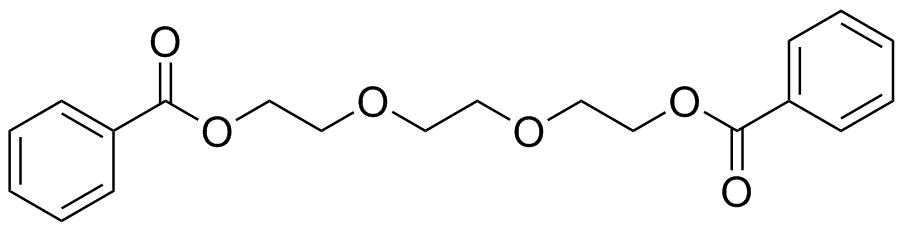 |
| Molecular Formula | C20H22O6 |
| Molecular Weight | 358.39 |
| CAS Registry Number | 51747-38-7 |
| EC Number | 204-408-1 |
| SMILES | C1=CC=C(C=C1)C(=O)OCCOCCOCCOC(=O)C2=CC=CC=C2 |
| Density | 1.2±0.1 g/cm3 Calc.* |
|---|---|
| Boiling point | 443.1±25.0 °C 760 mmHg (Calc.)* |
| Flash point | 191.8±23.2 °C (Calc.)* |
| Index of refraction | 1.543 (Calc.)* |
| * | Calculated using Advanced Chemistry Development (ACD/Labs) Software. |
| Hazard Symbols |   GHS07;GHS09 Warning Details GHS07;GHS09 Warning Details |
|---|---|
| Risk Statements | H302-H315-H319-H335 Details |
| Safety Statements | P280-P305+P351+P338 Details |
| SDS | Available |
 chemBlink Chemical Story
|
Triethylene glycol dibenzoate is an aromatic diester formed by the esterification of both terminal hydroxyl groups of triethylene glycol with benzoic acid. It belongs to the family of benzoate ester compounds that are widely used in industrial chemistry as plasticizers, solvents, and formulation additives in polymers, coatings, adhesives, and related materials. The molecular structure consists of three main components: two benzoate groups and a triethylene glycol backbone. The triethylene glycol segment is a linear polyether chain containing repeating ethylene oxide units, which introduces flexibility and multiple ether oxygen atoms. These oxygen atoms contribute polarity and the ability to accept hydrogen bonds, although they are not hydrogen bond donors. At each end of this chain, esterification with benzoic acid produces aromatic benzoate groups, which add hydrophobic character and increase molecular weight. The ester functional groups are the most chemically reactive sites in the molecule. They contain polarized carbonyl bonds that can undergo hydrolysis under strongly acidic or strongly basic conditions, regenerating triethylene glycol and benzoic acid. Under normal storage and use conditions, however, these ester bonds are relatively stable, which is important for industrial applications requiring long-term performance. The combination of a flexible ether backbone and bulky aromatic end groups gives triethylene glycol dibenzoate a balanced set of physicochemical properties. The ether chain provides conformational mobility and compatibility with polar systems, while the aromatic benzoate groups enhance compatibility with hydrophobic polymer matrices. This dual character makes the compound effective as a plasticizer in a variety of polymer systems. Plasticizers function by reducing intermolecular interactions between polymer chains, thereby increasing flexibility, lowering glass transition temperature, and improving processing characteristics. Triethylene glycol dibenzoate is particularly valued because it offers low volatility compared with smaller molecular weight plasticizers. This reduces loss through evaporation and improves long-term stability in finished materials. The presence of multiple ether oxygen atoms increases polarity relative to purely hydrocarbon-based plasticizers. This allows improved compatibility with polar resins such as polyvinyl chloride and certain acrylic systems. At the same time, the aromatic benzoate groups maintain sufficient hydrophobicity to ensure miscibility with organic polymer phases. Physically, triethylene glycol dibenzoate is typically a viscous liquid at room temperature. Its viscosity arises from the combination of aromatic ring interactions and the flexible but relatively heavy polyether chain. The absence of free hydroxyl groups reduces intermolecular hydrogen bonding between molecules, contributing to lower crystallinity and improved liquid behavior. In addition to plasticization, this compound can function as a solvent or co-solvent for resins, dyes, and other organic additives. Its ability to dissolve a range of organic compounds makes it useful in coatings and adhesive formulations where controlled evaporation rates and compatibility with multiple components are important. Like other ester-based plasticizers, triethylene glycol dibenzoate is generally resistant to hydrolysis under neutral conditions but may undergo breakdown in strongly acidic or alkaline environments. Such hydrolysis yields triethylene glycol and benzoic acid, both of which are relatively well-characterized and industrially relevant compounds. Overall, triethylene glycol dibenzoate is a bifunctional aromatic diester composed of a flexible polyether backbone terminated by two benzoate groups. Its significance lies in its role as a low-volatility, high-compatibility plasticizer and formulation additive, where the combination of ether flexibility and aromatic stabilization provides desirable performance in polymer and industrial applications. References 2026. Assessing the environmental impact of disposable polymer gloves: AGREEMIP criteria evaluations. Clean Technologies and Environmental Policy. DOI: 10.1007/s10098-026-03415-w |
| Market Analysis Reports |