
Online Database of Chemicals from Around the World
| Jinan Chenghui-Shuangda Chemical Co., Ltd. | China | |||
|---|---|---|---|---|
 | www.jnchsd.com | |||
 | +86 (531) 5889-7051 +86 15053146086 | |||
 | +86 (531) 5889-7093 | |||
 | jnchsd@qq.com | |||
 | QQ Chat | |||
| Chemical manufacturer since 2002 | ||||
| chemBlink Standard supplier since 2007 | ||||
| Simagchem Corporation | China | |||
|---|---|---|---|---|
| www.simagchem.com | |||
| +86 13806087780 | |||
| +86 (592) 268-0237 | |||
| sale@simagchem.com | |||
| Chemical manufacturer since 2002 | ||||
| chemBlink Standard supplier since 2008 | ||||
| Changzhou Tianhua Pharmaceutical Co., Ltd. | China | |||
|---|---|---|---|---|
| www.tianhuachem.com | |||
| +86 (519) 8289-1186 | |||
| +86 (519) 8289-9734 | |||
| tianhua@tianhuachem.com ctianhua@hotmail.com | |||
| QQ Chat | |||
| Chemical manufacturer since 1995 | ||||
| chemBlink Standard supplier since 2008 | ||||
| BOC Sciences | USA | |||
|---|---|---|---|---|
| www.bocsci.com | |||
| +1 (631) 485-4226 | |||
| +1 (631) 614-7828 | |||
| info@bocsci.com | |||
| Chemical manufacturer | ||||
| chemBlink Standard supplier since 2010 | ||||
| Neostar United (Changzhou) Industrial Co., Ltd. | China | |||
|---|---|---|---|---|
| www.neostarunited.com | |||
| +86 (519) 8555-7386 +86 18015025600 | |||
| +86 (519) 8555-7389 | |||
| marketing1@neostarunited.com | |||
| Chemical distributor since 2014 | ||||
| chemBlink Standard supplier since 2020 | ||||
| Shanghai Worldyang Chemical Co., Ltd. | China | |||
|---|---|---|---|---|
| www.worldyachem.com | |||
| +86 13651600618 +86 (21) 5679-5779 | |||
| +86 (21) 5679-5266 | |||
| sales7777@worldyachem.com | |||
| QQ Chat | |||
 | WeChat: 13651600618 | |||
 | WhatsApp:+86 13651600618 | |||
| Chemical manufacturer since 2012 | ||||
| Classification | API >> Anesthetic agents >> Local anesthetics |
|---|---|
| Name | Dyclonine hydrochloride |
| Synonyms | 4'-Butoxy-3-piperidinopropiophenone hydrochloride |
| Molecular Structure | 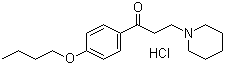 |
| Molecular Formula | C18H27NO2.HCl |
| Molecular Weight | 325.87 |
| CAS Registry Number | 536-43-6 |
| EC Number | 208-633-6 |
| SMILES | CCCCOC1=CC=C(C=C1)C(=O)CCN2CCCCC2.Cl |
| Solubility | S15 mg/mL (DMSO), 36 mg/mL (ethanol), 6 mg/mL (water) |
|---|---|
| Hazard Symbols |    GHS05;GHS06;GHS07 Danger Details GHS05;GHS06;GHS07 Danger Details | ||||||||||||||||||||||||
|---|---|---|---|---|---|---|---|---|---|---|---|---|---|---|---|---|---|---|---|---|---|---|---|---|---|
| Risk Statements | H301-H315-H318-H335 Details | ||||||||||||||||||||||||
| Safety Statements | P261-P264-P264+P265-P270-P271-P280-P301+P316-P302+P352-P304+P340-P305+P354+P338-P317-P319-P321-P330-P332+P317-P362+P364-P403+P233-P405-P501 Details | ||||||||||||||||||||||||
| Hazard Classification | |||||||||||||||||||||||||
| |||||||||||||||||||||||||
| SDS | Available | ||||||||||||||||||||||||
 chemBlink Chemical Story
|
Dyclonine hydrochloride is a local anesthetic that is widely used in medicine and dentistry. Dyclonine hydrochloride, chemically known as 1-(4-butoxyphenyl)-3-(1-piperidinyl)-1-propanone hydrochloride, was first synthesized in the mid-20th century. It was developed as a local anesthetic for providing local analgesia and anesthesia in various medical and dental procedures. The synthesis generally involves the reaction of butoxybenzoyl chloride with piperidine in the presence of a base followed by conversion to the hydrochloride salt to enhance solubility and stability. Dyclonine hydrochloride belongs to the aminoketone family, characterized by its aromatic ring structure with p-butoxyphenyl and piperidine rings. The hydrochloride form enhances its water solubility, making it suitable for topical application. Dyclonine hydrochloride exerts its anesthetic effects by reversibly blocking nerve conduction. It works primarily by inhibiting the influx of sodium ions through voltage-gated sodium channels on the neuronal cell membrane, thereby preventing the generation and propagation of action potentials. This blockade results in local anesthesia and temporary loss of sensation in the treated area. Dyclonine hydrochloride is commonly used for local anesthesia of the oral mucosa in dentistry. It is fast-acting and effective in relieving pain and discomfort during dental examinations, cleanings, and minor dental procedures. In addition to dentistry, dyclonine hydrochloride can be used for local anesthesia for minor surgeries, diagnostic tests, and treatments involving the skin and mucous membranes. Its use extends to ENT surgery and dermatology. Dyclonine hydrochloride is used in a variety of over-the-counter (OTC) and prescription topical preparations for pain relief from minor burns, insect bites, abrasions, and irritation of the skin and mucous membranes. It is also used to relieve symptoms of sore throat and oral pain caused by conditions such as pharyngitis, tonsillitis, and canker sores. Lozenges and sprays containing dyclonine hydrochloride can provide temporary relief by numbing the affected area. Dyclonine hydrochloride is generally well tolerated. The potential for systemic toxicity is low due to minimal absorption through intact skin and mucous membranes. However, caution is advised with use or ingestion, especially in sensitive individuals or children. The compound is formulated into a variety of topical preparations, including creams, ointments, gels, sprays, and lozenges. These formulations are designed to optimize drug delivery and ensure effective local anesthesia while minimizing systemic absorption. References 2021. Therapeutic inhibition of keratinocyte TRPV3 sensory channel by local anesthetic dyclonine. eLife, 10. DOI: 10.7554/eLife.68128 2024. MASCC/ISOO Clinical Practice Statement: Management of oral complications of targeted therapy. Supportive Care in Cancer, 32(8). DOI: 10.1007/s00520-024-08689-8 1956. Antimicrobial Properties of Dyclonine Hydrochloride, A New Topical Anesthetic. Journal of the American Pharmaceutical Association, 45(5). DOI: 10.1002/jps.3030450514 |
| Market Analysis Reports |