
Online Database of Chemicals from Around the World
| INA Pharmaceuticals Pvt. Ltd. | India | |||
|---|---|---|---|---|
 | inapharma.in | |||
 | +91 7815933367 | |||
 | rd@inapharma.in | |||
| Chemical manufacturer since 2018 | ||||
| chemBlink Standard supplier since 2026 | ||||
| Classification | Chemical reagent >> Organic reagent >> Olefins (cyclic and non-cyclic) |
|---|---|
| Name | cis-3,5-Diacetoxy-1-cyclopentene |
| Synonyms | [(1S,4R)-4-acetyloxycyclopent-2-en-1-yl] acetate |
| Molecular Structure | 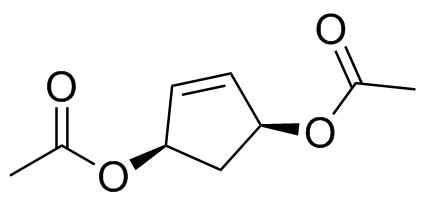 |
| Molecular Formula | C9H12O4 |
| Molecular Weight | 184.19 |
| CAS Registry Number | 54664-61-8 |
| EC Number | 860-765-9 |
| SMILES | CC(=O)O[C@@H]1C[C@@H](C=C1)OC(=O)C |
| Density | 1.1±0.1 g/cm3 Calc.* |
|---|---|
| Boiling point | 227.1±40.0 °C 760 mmHg (Calc.)* |
| Flash point | 105.2±25.7 °C (Calc.)* |
| Index of refraction | 1.477 (Calc.)* |
| * | Calculated using Advanced Chemistry Development (ACD/Labs) Software. |
| Hazard Symbols |  GHS07 Warning Details GHS07 Warning Details |
|---|---|
| Risk Statements | H302 Details |
| Safety Statements | P280-P305+P351+P338 Details |
| SDS | Available |
 chemBlink Chemical Story
|
cis-3,5-Diacetoxy-1-cyclopentene, CAS 54664-61-8, is a small functionalized cyclopentene used primarily as an intermediate in organic and pharmaceutical synthesis. It has the molecular formula C9H12O4 and a molecular weight of 184.19. Its structure contains a five-membered carbon ring with one carbon-carbon double bond and two acetate-protected hydroxyl groups arranged on the same face of the ring. This apparently simple combination makes the molecule useful for an important task in synthetic chemistry: converting a symmetrical starting material into a chiral building block. The stereochemical feature is particularly important. The two acetate-bearing positions are related by symmetry, so the molecule can be treated as a meso or prochiral substrate. At first sight, the two acetate groups appear chemically equivalent. If a reaction can selectively transform only one of them, however, that symmetry is broken and a molecule with defined stereochemical information can be produced. This process is known as desymmetrization. Desymmetrization provides an elegant solution to one of the central problems of modern synthesis. Many pharmaceuticals and biologically active molecules are chiral, meaning that their three-dimensional structures can exist in mirror-image forms. Biological systems can distinguish between these forms, so chemists often need methods that selectively produce one stereochemical arrangement rather than an uncontrolled mixture. One way to accomplish this is with enzymes. Lipases are best known for their biological role in processing fats, but in organic synthesis they can act as highly selective catalysts for ester hydrolysis and transesterification. Because an enzyme itself is chiral, its active site can distinguish between two groups that appear equivalent in an achiral environment. cis-3,5-Diacetoxy-1-cyclopentene has therefore been used as a substrate for enzyme-catalyzed desymmetrization. In such a reaction, a lipase can selectively remove or transform one acetate group while leaving the other intact. The symmetrical diacetate is thereby converted into a chiral monoacetate containing both a free hydroxyl group and a remaining acetate group. Published synthetic procedures describe the preparation of (1R,4S)-4-hydroxy-2-cyclopentenyl acetate from cis-3,5-diacetoxycyclopentene through this type of stereoselective transformation. Organic Syntheses also documents the relationship between the diacetate and optically active cyclopentenyl monoacetates in practical preparative chemistry. The cyclopentene framework itself is another reason these compounds are useful. Five-membered carbocyclic rings occur in numerous biologically active compounds and pharmaceutical intermediates. The double bond provides a site for further chemical modification, while hydroxyl and acetate functionality can be manipulated independently. Once stereochemistry has been established, chemists can therefore use the resulting cyclopentene as a platform for constructing considerably more elaborate structures. Commercial pharmaceutical-intermediate suppliers also identify cis-3,5-diacetoxycyclopentene as an intermediate associated with ticagrelor manufacturing. Ticagrelor is an antiplatelet medicine with a structurally complex triazolotriazine nucleoside-like framework containing a substituted cyclopentane unit. The connection illustrates how a relatively simple cyclopentene building block can participate upstream in the manufacture of a much more complicated active pharmaceutical ingredient. The intermediate itself, however, should not be confused with ticagrelor or assigned the drug's pharmacological activity. The chemistry also demonstrates why protecting groups are so useful. The acetate groups temporarily mask hydroxyl functionality. A hydroxyl group can sometimes interfere with reactions occurring elsewhere in a molecule, so converting it into an ester can change its reactivity and make a multistep synthesis easier to control. Later, an acetate can be removed when the hydroxyl group is needed again. In this molecule, protection and stereochemistry work together: the two acetate groups provide not only protected alcohols but also sites at which selective enzymatic chemistry can break molecular symmetry. This is a recurring theme in pharmaceutical synthesis. Complex molecules are rarely assembled simply by connecting atoms in their final form. Functional groups may be protected and uncovered, symmetrical molecules may be converted into asymmetric ones, and relatively simple intermediates may pass through many transformations before the final active ingredient emerges. cis-3,5-Diacetoxy-1-cyclopentene is therefore more than an obscure five-membered-ring intermediate. It provides a compact illustration of stereochemistry, protecting-group strategy, biocatalysis, and pharmaceutical manufacturing. Most importantly, it demonstrates a particularly elegant idea: rather than constructing chirality from the beginning, chemists can sometimes start with a symmetrical molecule and persuade an enzyme to recognize a difference that ordinary chemical surroundings cannot see. References 1. PubChem. cis-3,5-Diacetoxy-1-cyclopentene, CID 10192610. CAS 54664-61-8. 2. Organic Syntheses. (1R,4S)-(+)-4-Hydroxy-2-cyclopentenyl acetate. Preparative procedure involving cis-3,5-diacetoxycyclopentene. https://www.orgsyn.org/demo.aspx?prep=CV9P0487 3. Putta, S.; Reddy, A. M.; Sheelu, G.; Reddy, B. V. S.; Kumaraguru, T. (2018). Preparation of (1R,4S)-4-hydroxycyclopent-2-en-1-yl acetate via lipase-catalyzed desymmetrization of cis-3,5-diacetoxy-1-cyclopentene. 4. Organic Syntheses. Synthetic procedures involving optically active cyclopentenyl derivatives and cis-3,5-diacetoxycyclopent-1-ene. https://orgsyn.org/demo.aspx?prep=CV9P0132 |
| Market Analysis Reports |