
Online Database of Chemicals from Around the World
| Topscience Co. Ltd. | China | |||
|---|---|---|---|---|
 | www.tsbiochem.com | |||
 | +86 (400) 820-0310 | |||
 | +86 (021) 3469-2979 | |||
 | sales@tsbiochem.com | |||
| Chemical manufacturer since 2013 | ||||
| chemBlink Standard supplier since 2012 | ||||
| Selleck Chemicals LLC | USA | |||
|---|---|---|---|---|
| www.selleckchem.com | |||
| +1 (713) 535-9129 | |||
| +1 (832) 582-8590 | |||
| info@selleckchem.com | |||
| Chemical manufacturer | ||||
| chemBlink Standard supplier since 2014 | ||||
| Fermentek Ltd. | Israel | |||
|---|---|---|---|---|
| www.fermentek.com | |||
| +972 (2) 585-3953 | |||
| +972 (2) 585-3943 | |||
| fermentek@fermentek.com | |||
| Chemical manufacturer since 1994 | ||||
| chemBlink Standard supplier since 2016 | ||||
| Cfm Oskar Tropitzsch GmbH | Germany | |||
|---|---|---|---|---|
| www.cfmot.de | |||
| +49 (9231) 9619-0 | |||
| +49 (9231) 9619-60 | |||
| info@cfmot.de | |||
| Chemical distributor since 1985 | ||||
| chemBlink Standard supplier since 2022 | ||||
| HuNan Huibaiyi New Materials Co; Ltd. | China | |||
|---|---|---|---|---|
| www.hbsjxcl.com | |||
| +86 13319523173 | |||
| ivy@hnhbsj.com | |||
 | QQ Chat | |||
 | WeChat: 13319523173 | |||
| Chemical manufacturer since 2014 | ||||
| chemBlink Standard supplier since 2026 | ||||
| LKT Laboratories, Inc. | USA | |||
|---|---|---|---|---|
| www.lktlabs.com | |||
| +1 (888) 558-5227 | |||
| +1 (651) 644-8357 | |||
| peacerli@mbolin-lktlabs.com | |||
| Chemical manufacturer | ||||
| Chemos GmbH & Co. KG | Germany | |||
|---|---|---|---|---|
| www.chemos.de | |||
| +49 871-966346-0 | |||
| +49 871-966346-13 | |||
| chemos@chemos.de | |||
| Chemical distributor | ||||
| Acros Organics | Belgium | |||
|---|---|---|---|---|
| www.acros.com | |||
| +86 (21) 5258-1100 | |||
| +86 (21) 5258-0119 | |||
| info@acros.com | |||
| Chemical manufacturer | ||||
| Classification | API >> Antibiotics >> Other antibiotics |
|---|---|
| Name | Puromycin dihydrochloride |
| Synonyms | (S)-3'-[[2-Amino-3-(4-methoxyphenyl)-1-oxopropyl]amino]-3'-deoxy-N,N-dimethyladenosine dihydrochloride |
| Molecular Structure | 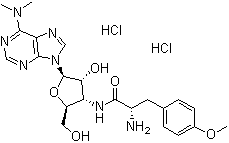 |
| Molecular Formula | C22H29N7O5.2(HCl) |
| Molecular Weight | 544.43 |
| CAS Registry Number | 58-58-2 |
| EC Number | 200-387-8 |
| SMILES | CN(C)C1=NC=NC2=C1N=CN2[C@H]3[C@@H]([C@@H]([C@H](O3)CO)NC(=O)[C@H](CC4=CC=C(C=C4)OC)N)O.Cl.Cl |
| Solubility | Soluble 100 mM in water, 100 mM in DMSO (Expl.) |
|---|---|
| Hazard Symbols |  GHS07 Warning Details GHS07 Warning Details | ||||||||
|---|---|---|---|---|---|---|---|---|---|
| Risk Statements | H302 Details | ||||||||
| Safety Statements | P264-P270-P301+P317-P330-P501 Details | ||||||||
| Hazard Classification | |||||||||
| |||||||||
| SDS | Available | ||||||||
 chemBlink Chemical Story
|
Puromycin dihydrochloride is a well-characterized aminonucleoside antibiotic derived from the bacterium Streptomyces alboniger. It is structurally related to the 3'-end of aminoacylated transfer RNA (tRNA) and acts as a potent inhibitor of protein synthesis in both prokaryotic and eukaryotic cells. Puromycin dihydrochloride consists of puromycin, the active antibiotic molecule, combined with two hydrochloride ions to improve its stability and solubility in aqueous solutions. The discovery of puromycin dates back to the 1950s during the search for new antimicrobial agents produced by soil bacteria. Puromycin was isolated and identified as a structural analog of aminoacyl-tRNA, which led to the understanding of its mechanism as a premature chain terminator in protein translation. Its potent activity against a broad range of organisms made it a valuable tool for biological and pharmacological research. Puromycin dihydrochloride functions by mimicking the 3'-end of aminoacylated tRNA and entering the ribosomal A site during translation. Once incorporated into the growing polypeptide chain, puromycin forms a peptide bond but lacks the necessary structure to be extended further, causing premature termination of protein synthesis. This results in the release of incomplete polypeptides and effective inhibition of protein production, which is lethal to cells. This mechanism is highly conserved, allowing puromycin to inhibit translation in diverse organisms. In molecular biology and biomedical research, puromycin dihydrochloride is extensively used as a selection agent for genetically engineered cells. Cells that have been transfected with a puromycin resistance gene can survive puromycin treatment, allowing researchers to isolate and maintain stable cell lines expressing genes of interest. This selection process is common in studies involving gene function, protein expression, and drug screening. Puromycin dihydrochloride also serves as a valuable reagent for studying translation and protein synthesis. It is employed in assays to measure global or specific protein synthesis rates by incorporating puromycin into nascent peptides, which can then be detected by specific antibodies in techniques such as western blotting or immunofluorescence. This approach has advanced understanding of cellular responses to stress, disease states, and regulatory mechanisms of translation. In addition to research uses, puromycin has been studied for its cytotoxic properties with potential therapeutic applications, particularly in cancer research. Its ability to inhibit protein synthesis can induce apoptosis in rapidly dividing cells, although its clinical use is limited by toxicity and side effects. Puromycin dihydrochloride is typically supplied as a stable, water-soluble salt, facilitating its use in cell culture and biochemical assays. Proper storage and handling are essential to maintain its activity, usually under refrigerated and light-protected conditions. In summary, puromycin dihydrochloride is a widely used antibiotic and molecular biology reagent known for its capacity to inhibit protein synthesis by mimicking aminoacyl-tRNA and causing premature termination of polypeptide chains. Its discovery from Streptomyces alboniger has led to significant advances in genetic engineering, translation studies, and cell biology. Its well-defined mechanism and broad applications make it an indispensable tool in scientific research. References 1979. Peptidyl-puromycin synthesis by free and membrane-bound ribosomes. Biochimica et Biophysica Acta (BBA) - Nucleic Acids and Protein Synthesis, 563(2). DOI: 10.1016/0005-2787(79)90064-9 1979. The cross-resistance of mouse blasticidin S-resistant cell lines to puromycin and sparsomycin, inhibitors of ribosome function. Biochimica et Biophysica Acta (BBA) - Nucleic Acids and Protein Synthesis, 563(2). DOI: 10.1016/0005-2787(79)90066-2 2024. Modulation of endogenous opioid signaling by inhibitors of puromycin-sensitive aminopeptidase. European Journal of Medicinal Chemistry, 275. DOI: 10.1016/j.ejmech.2024.116604 |
| Market Analysis Reports |