
Online Database of Chemicals from Around the World
| Wuhan Kemi-works Chemical Co., Ltd. | China | |||
|---|---|---|---|---|
 | www.kemiworks.net | |||
 | +86 (27) 8573-6489 | |||
 | +86 (27) 8573-6485 | |||
 | info@kemiworks.net sales@kemiworks.com | |||
| Chemical manufacturer | ||||
| chemBlink Premium supplier since 2011 | ||||
| Changzhou Ditong Chemical Co., Ltd. | China | |||
|---|---|---|---|---|
| www.edengenechem.com | |||
| +86 (519) 8829-8848 +86 18118010980 | |||
| info@edengenechem.com sale@edengenechem.com | |||
 | QQ Chat | |||
 | WeChat: 18118010980 | |||
| Chemical manufacturer since 2006 | ||||
| chemBlink Premium supplier since 2026 | ||||
| Classification | Chemical reagent >> Organic reagent >> Ester >> Other ester compounds |
|---|---|
| Name | Isobornyl acrylate |
| Synonyms | Acrylic acid isobornyl ester; (1,7,7-Trimethyltricyclo[2.2.1]hepten-2-yl)-2-propenoate |
| Molecular Structure | 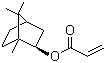 |
| Molecular Formula | C13H20O2 |
| Molecular Weight | 208.30 |
| CAS Registry Number | 5888-33-5 |
| EC Number | 227-561-6 |
| SMILES | C[C@@]12CC[C@@H](C1(C)C)C[C@H]2OC(=O)C=C |
| Density | 1.00 |
|---|---|
| Boiling point | 245 °C |
| Refractive index | 1.474 |
| Flash point | 95 °C |
| Hazard Symbols |   GHS07;GHS09 Warning Details GHS07;GHS09 Warning Details | ||||||||||||||||||||||||||||||||||||||||||||||||
|---|---|---|---|---|---|---|---|---|---|---|---|---|---|---|---|---|---|---|---|---|---|---|---|---|---|---|---|---|---|---|---|---|---|---|---|---|---|---|---|---|---|---|---|---|---|---|---|---|---|
| Risk Statements | H315-H317-H319-H335-H400-H410-H411 Details | ||||||||||||||||||||||||||||||||||||||||||||||||
| Safety Statements | P261-P264-P264+P265-P271-P272-P273-P280-P302+P352-P304+P340-P305+P351+P338-P319-P321-P332+P317-P333+P317-P337+P317-P362+P364-P391-P403+P233-P405-P501 Details | ||||||||||||||||||||||||||||||||||||||||||||||||
| Hazard Classification | |||||||||||||||||||||||||||||||||||||||||||||||||
| |||||||||||||||||||||||||||||||||||||||||||||||||
| SDS | Available | ||||||||||||||||||||||||||||||||||||||||||||||||
 chemBlink Chemical Story
|
Isobornyl acrylate is a notable chemical compound used extensively in polymer chemistry and materials science. Its chemical formula is C12H18O2, and it is recognized for its unique properties and versatile applications. The discovery of isobornyl acrylate dates back to the mid-20th century, when researchers were exploring new monomers for polymer synthesis. It is derived from isoborneol, a bicyclic alcohol, which is reacted with acrylic acid to produce isobornyl acrylate. This compound is part of a broader class of acrylate esters, which are known for their role in the formation of various polymers and copolymers. Isobornyl acrylate is valued in the polymer industry due to its ability to impart specific characteristics to polymers. It is primarily used as a monomer in the production of high-performance polymers and resins. When incorporated into polymer matrices, isobornyl acrylate contributes to the overall mechanical strength, chemical resistance, and thermal stability of the final product. This makes it particularly useful in applications requiring robust and durable materials. One of the key applications of isobornyl acrylate is in the manufacture of coatings and adhesives. In coatings, it provides excellent adhesion to various substrates, including metals, glass, and plastics. The addition of isobornyl acrylate to coating formulations enhances the film's hardness, scratch resistance, and weatherability. This results in coatings that are suitable for use in harsh environmental conditions, such as those encountered in automotive and industrial applications. In adhesives, isobornyl acrylate is used to improve the bonding strength and flexibility of the adhesive formulations. Its presence in adhesive formulations enhances the adhesive's performance on different surfaces and under varying conditions. This makes it a valuable component in pressure-sensitive adhesives, structural adhesives, and sealants used in a range of industries, including construction, automotive, and electronics. Isobornyl acrylate is also employed in the production of optical materials, such as lenses and optical fibers. Its optical clarity and resistance to UV degradation make it suitable for applications where high optical quality and durability are essential. The compound's ability to form clear and stable polymers is advantageous in the production of optical components used in telecommunications and imaging technologies. Furthermore, isobornyl acrylate finds use in the development of specialty polymers, including those used in the creation of functionalized materials with specific properties. These materials are employed in various advanced applications, such as in the aerospace and electronics industries, where tailored polymer characteristics are required. In summary, isobornyl acrylate is a significant chemical compound with a wide range of applications in polymer chemistry, coatings, adhesives, and optical materials. Its ability to enhance the properties of polymers makes it a valuable component in the development of high-performance materials used in diverse industrial and technological applications. References 2013 Two decades of occupational (meth)acrylate patch test results and focus on isobornyl acrylate. Contact Dermatitis, 68(3). DOI: 10.1111/cod.12023 2020 Contact dermatitis caused by glucose sensors-15 adult patients tested with a medical device patch test series. Contact Dermatitis, 83(4). DOI: 10.1111/cod.13649 2024 Allergic contact dermatitis to isobornyl acrylate in a home nail glue. Contact Dermatitis, 90(4). DOI: 10.1111/cod.14541 |
| Market Analysis Reports |