
Online Database of Chemicals from Around the World
| Jinan Chenghui-Shuangda Chemical Co., Ltd. | China | |||
|---|---|---|---|---|
 | www.jnchsd.com | |||
 | +86 (531) 5889-7051 +86 15053146086 | |||
 | +86 (531) 5889-7093 | |||
 | jnchsd@qq.com | |||
 | QQ Chat | |||
| Chemical manufacturer since 2002 | ||||
| chemBlink Standard supplier since 2007 | ||||
| Simagchem Corporation | China | |||
|---|---|---|---|---|
| www.simagchem.com | |||
| +86 13806087780 | |||
| +86 (592) 268-0237 | |||
| sale@simagchem.com | |||
| Chemical manufacturer since 2002 | ||||
| chemBlink Standard supplier since 2008 | ||||
| BOC Sciences | USA | |||
|---|---|---|---|---|
| www.bocsci.com | |||
| +1 (631) 485-4226 | |||
| +1 (631) 614-7828 | |||
| info@bocsci.com | |||
| Chemical manufacturer | ||||
| chemBlink Standard supplier since 2010 | ||||
| Shanghai Hohance Chemical Co., Ltd. | China | |||
|---|---|---|---|---|
| www.hohance.com | |||
| +86 (21) 3111-5312 | |||
| +86 (21) 3111-5317 | |||
| info@hohance.com | |||
| Chemical manufacturer | ||||
| chemBlink Standard supplier since 2011 | ||||
| Hangzhou Leap Chem Co., Ltd. | China | |||
|---|---|---|---|---|
| www.leapchem.com | |||
| +86 (571) 8771-1850 | |||
| market19@leapchem.com | |||
| QQ Chat | |||
| Chemical manufacturer since 2006 | ||||
| chemBlink Standard supplier since 2015 | ||||
| Typu Group | China | |||
|---|---|---|---|---|
| www.typugroup.com | |||
| +86 85220966 | |||
| order@typugroup.com | |||
| Chemical distributor since 2008 | ||||
| chemBlink Standard supplier since 2021 | ||||
| Shandong Chenghui Shuangda Pharmaceutical Co., Ltd. | China | |||
|---|---|---|---|---|
| www.chsdpharma.com | |||
| +86-531-58897029 | |||
| ericqiao@jnchsd.com | |||
| QQ Chat | |||
 | WeChat: 15550412551 | |||
 | WhatsApp:15550412551 | |||
| Chemical manufacturer since 2014 | ||||
| chemBlink Standard supplier since 2025 | ||||
| Alsachim SAS | France | |||
|---|---|---|---|---|
| www.alsachim.com | |||
| +33 (0) 390 402 200 | |||
| +33 (0) 390 402 199 | |||
| contact@alsachim.com | |||
| Chemical manufacturer | ||||
| Actylis | USA | |||
|---|---|---|---|---|
| actylis.com | |||
| +1 (516) 627-6000 | |||
| +1 (516) 627-6093 | |||
| info@actylis.com | |||
| Chemical manufacturer | ||||
| Classification | Analytical chemistry >> Analytical reagent >> Ion chromatography reagent |
|---|---|
| Name | Pramoxine hydrochloride |
| Synonyms | 4-n-Butoxyphenyl gamma-morpholinopropyl ether hydrochloride |
| Molecular Structure | 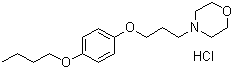 |
| Molecular Formula | C17H27NO3.HCl |
| Molecular Weight | 329.87 |
| CAS Registry Number | 637-58-1 |
| EC Number | 211-293-1 |
| SMILES | CCCCOC1=CC=C(C=C1)OCCCN2CCOCC2.Cl |
| Hazard Symbols |  GHS07 Warning Details GHS07 Warning Details | ||||||||||||||||||||
|---|---|---|---|---|---|---|---|---|---|---|---|---|---|---|---|---|---|---|---|---|---|
| Risk Statements | H302-H315-H319-H335 Details | ||||||||||||||||||||
| Safety Statements | P261-P264-P264+P265-P270-P271-P280-P301+P317-P302+P352-P304+P340-P305+P351+P338-P319-P321-P330-P332+P317-P337+P317-P362+P364-P403+P233-P405-P501 Details | ||||||||||||||||||||
| Hazard Classification | |||||||||||||||||||||
| |||||||||||||||||||||
| SDS | Available | ||||||||||||||||||||
 chemBlink Chemical Story
|
Pramoxine hydrochloride is a topical local anesthetic commonly used to relieve itching, pain, and discomfort associated with minor skin irritations, insect bites, burns, hemorrhoids, and other dermatological conditions. It belongs to the class of anesthetics that act by blocking nerve signal transmission to reduce sensation in the applied area. Pramoxine hydrochloride was first introduced in the mid-20th century as an alternative to other local anesthetics, with the goal of providing effective topical anesthesia while minimizing the risk of allergic reactions and systemic toxicity. Its chemical structure includes an ether linkage, which distinguishes it from other common local anesthetics and contributes to its low allergenic potential. The mechanism of action of pramoxine hydrochloride involves reversible blockade of sodium channels on the neuronal cell membranes. By inhibiting sodium ion influx, pramoxine prevents depolarization and propagation of nerve impulses, leading to a localized numbing effect. This action helps reduce the sensation of pain and itching when applied topically. Pharmacologically, pramoxine hydrochloride is characterized by rapid onset of action, typically within minutes after topical application, and a duration of effect lasting from 30 minutes to several hours depending on the formulation and site of application. It is commonly formulated as creams, lotions, gels, sprays, or wipes, often combined with other agents such as corticosteroids or antiseptics to enhance therapeutic outcomes. Pramoxine hydrochloride has minimal systemic absorption when used topically, which contributes to a favorable safety profile. Adverse reactions are generally rare and mild, mainly limited to local skin irritation or allergic contact dermatitis in sensitive individuals. Unlike some other topical anesthetics, pramoxine hydrochloride has a low incidence of sensitization and is less likely to cause methemoglobinemia. Clinically, pramoxine hydrochloride is used to manage symptoms associated with a variety of conditions including eczema, psoriasis, poison ivy exposure, anal and genital itching, and minor wounds. It is also found in many over-the-counter products formulated for itch relief and minor skin discomfort. In summary, pramoxine hydrochloride is a topical local anesthetic with a rapid onset of action and low allergenic potential. It acts by blocking sodium channels to reduce nerve impulse conduction, providing effective relief from pain and itching in a variety of dermatological conditions. Its minimal systemic absorption and favorable safety profile support its widespread use in topical formulations. References 1954. Tronothane Hydrochloride (Pramoxine Hydrochloride) in the Control of Pruritus. Postgraduate Medicine, 16(5). DOI: 10.1080/00325481.1954.11711718 1981. Allergy to pramoxine (pramocaine). Contact Dermatitis, 7(2). DOI: 10.1111/j.1600-0536.1981.tb03964.x 2023. β‐Lactoglobulin variants as potential carriers of pramoxine: Comprehensive structural and biophysical studies. Journal of Molecular Recognition, 36(11). DOI: 10.1002/jmr.3052 |
| Market Analysis Reports |