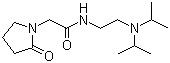
Pramiracetam is a synthetic compound belonging to the racetam class of nootropic agents, structurally derived from the 2-pyrrolidone (lactam) core common to this family. It is one of the more lipophilic racetams, distinguished by the presence of a bulky dipropan-2-ylaminoethyl side chain that significantly alters its physicochemical properties compared with earlier members such as piracetam.
The central structural motif of pramiracetam is the 2-oxo-pyrrolidine ring, a five-membered cyclic amide (lactam). This ring is chemically stable due to resonance between the nitrogen lone pair and the carbonyl group, which reduces reactivity and maintains a rigid heterocyclic framework. The lactam carbonyl serves as a hydrogen-bond acceptor, while the ring nitrogen is engaged in resonance stabilization and is not strongly basic.
Attached to the lactam nitrogen is an acetamide linker connected to a dipropan-2-ylaminoethyl substituent. This side chain contains a tertiary amine and multiple branched alkyl groups. The tertiary amine can be protonated under acidic conditions, introducing a cationic site that influences solubility and ionic interactions. The branched isopropyl groups contribute substantial hydrophobic character and steric bulk, increasing lipophilicity relative to more polar racetam derivatives.
The combination of a polar lactam core and a highly hydrophobic side chain gives pramiracetam an amphiphilic character. This structural balance influences its partitioning behavior between aqueous and lipid environments. Compared with simpler racetams, pramiracetam is significantly more lipophilic, which is reflected in its reduced water solubility and increased membrane affinity.
From a stereoelectronic perspective, the molecule contains multiple conformationally flexible single bonds in the side chain, allowing adoption of several low-energy conformations. The lactam ring remains relatively rigid, while the amide linkage between the core and substituent introduces partial double-bond character that restricts rotation to some degree.
The tertiary amine in the side chain is a key functional feature. In its unprotonated form, it is nucleophilic and can participate in hydrogen bonding as an acceptor. Upon protonation, it becomes positively charged, significantly increasing polarity. This acid–base behavior contributes to the compound’s pH-dependent solubility profile.
Chemically, pramiracetam is stable under neutral conditions. The amide and lactam bonds are resistant to hydrolysis in mild environments due to resonance stabilization. However, under strongly acidic or basic conditions, amide bond cleavage or degradation of the side chain could occur, although such processes are not typical under normal handling or physiological conditions.
The racetam scaffold as a whole is defined by the 2-pyrrolidone ring, and pramiracetam represents a heavily modified member of this class designed to increase lipophilicity. Compared with earlier racetams, its structure reflects a shift toward enhancing membrane permeability through hydrophobic substitution while retaining the polar lactam functionality.
Overall, pramiracetam is a synthetic pyrrolidone-based compound characterized by a stable cyclic amide core and a bulky, lipophilic tertiary amine-containing side chain. Its key structural features include a balance between a polar lactam ring and a hydrophobic substituted aminoalkyl group, resulting in a compound with distinct amphiphilic properties within the racetam family.
References
2023. TTD: Therapeutic Target Database describing target druggability information. Nucleic Acids Research.
DOI: https://www.ncbi.nlm.nih.gov/pmc/articles/PMC10767903
2023. Drug combinations identified by high-throughput screening promote cell cycle transition and upregulate Smad pathways in myeloma. Cancer Letters.
DOI: https://www.ncbi.nlm.nih.gov/pmc/articles/PMC10408729
|




 GHS07 Warning Details
 chemBlink Chemical Story