
Online Database of Chemicals from Around the World
| Wuhan Kemi-works Chemical Co., Ltd. | China | |||
|---|---|---|---|---|
 | www.kemiworks.net | |||
 | +86 (27) 8573-6489 | |||
 | +86 (27) 8573-6485 | |||
 | info@kemiworks.net sales@kemiworks.com | |||
| Chemical manufacturer | ||||
| chemBlink Premium supplier since 2011 | ||||
| Classification | Organic raw materials >> Carboxylic compounds and derivatives >> Salt of carboxylic acid ester and its derivatives |
|---|---|
| Name | Potassium sodium tartrate tetrahydrate |
| Synonyms | Potassium sodium tartrate; Rochelle salt; Seignette salt |
| Molecular Structure | 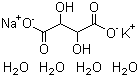 |
| Molecular Formula | C4H4KNaO6.4(H2O) |
| Molecular Weight | 282.22 |
| CAS Registry Number | 6381-59-5 |
| EC Number | 613-385-0 |
| SMILES | [C@@H]([C@H](C(=O)[O-])O)(C(=O)[O-])O.O.O.O.O.[Na+].[K+] |
| Density | 1.77 g/mL (Expl.) |
|---|---|
| Melting point | 70-80 °C (Expl.) |
| alpha | 22.1 ° (c=10, water) (Expl.) |
| Water solubility | 630 g/L (20 °C) |
| Hazard Symbols |  GHS07 Warning Details GHS07 Warning Details |
|---|---|
| Risk Statements | H302-H315-H319-H335 Details |
| Safety Statements | P261-P305+P351+P338 Details |
| SDS | Available |
 chemBlink Chemical Story
|
Potassium sodium tartrate tetrahydrate, with the chemical formula KNaC4H4O6·4H2O, is a crystalline compound derived from tartaric acid. This salt is formed by neutralizing tartaric acid with potassium hydroxide and sodium hydroxide, resulting in a tetrahydrate where four water molecules are associated with each formula unit. It is also known as Rochelle salt, a name historically linked to its production from wine cask residues. Potassium sodium tartrate has various applications in both historical and modern industries. The discovery of potassium sodium tartrate traces back to early studies on tartaric acid and its salts, particularly in the context of wine production. Over time, its crystallization properties and ability to form stable salts made it an important compound in both chemistry and medicine. The tetrahydrate form of the compound was found to be particularly stable, facilitating its use in various applications. Historically, potassium sodium tartrate was used as a laxative, owing to its effects on electrolyte balance in the body. It was an important compound in early pharmacology for treating constipation. Although it has been largely replaced by more effective treatments, its role in medical history remains notable. In analytical chemistry, potassium sodium tartrate is used as a reagent in the preparation of solutions for metal ion determination. It serves as a stable source of both potassium and sodium ions, aiding in chemical analyses. In electronics, potassium sodium tartrate tetrahydrate has been utilized in the creation of piezoelectric devices. The compound’s crystal structures possess piezoelectric properties, generating an electrical charge when subjected to mechanical stress. Although synthetic piezoelectric materials have largely replaced this compound in many applications, potassium sodium tartrate continues to be studied for its unique crystal growth and piezoelectric behavior. In the food industry, potassium sodium tartrate is primarily known for its role in winemaking. It can precipitate from wine during fermentation, forming crystals that are removed through cold stabilization. This process ensures that the wine remains clear and free of crystalline deposits. The presence of potassium sodium tartrate in wine is harmless, but its removal is essential for maintaining wine quality. The compound is also used in industrial processes such as textile dyeing, where it functions as a mordant to improve dye retention on fabrics. Its ability to form stable complexes with certain dyes helps ensure color permanence. In addition, potassium sodium tartrate has been employed in cleaning agents to remove mineral deposits from industrial equipment, capitalizing on its water solubility and capacity to interact with metal ions. Despite being less prominent in some applications today, potassium sodium tartrate tetrahydrate remains valuable in various fields due to its versatile properties. From its medicinal use to its role in chemical analysis and industrial applications, it continues to be a compound of interest in both research and practical use. References 1964. Reversible dissociation of l-tartaric acid dehydrase into subunits. Biochimica et Biophysica Acta (BBA) - Specialized Section on Enzymological Subjects, 92(2). DOI: 10.1016/0926-6569(64)90298-6 2013. Enantioseparation of tartaric acid by ligand-exchange capillary electrophoresis using contactless conductivity detection. Journal of Separation Science, 36(17). DOI: 10.1002/jssc.201300507 2024. A tartaric acid (TA)-coated iron-based biochar as heterogeneous fenton catalyst for enhanced degradation of dibutyl phthalate. Environmental pollution (Barking, Essex : 1987), 360. DOI: 10.1016/j.envpol.2024.124976 |
| Market Analysis Reports |