
Online Database of Chemicals from Around the World
| Simagchem Corporation | China | |||
|---|---|---|---|---|
 | www.simagchem.com | |||
 | +86 13806087780 | |||
 | +86 (592) 268-0237 | |||
 | sale@simagchem.com | |||
| Chemical manufacturer since 2002 | ||||
| chemBlink Standard supplier since 2008 | ||||
| Sinocompound Catalysts Co., Ltd. | China | |||
|---|---|---|---|---|
| www.sinocompound.com | |||
| +86 (512) 6721-6630 | |||
| +86 (512) 5631-6689 | |||
| sales@sinocompound.com | |||
| Chemical manufacturer since 2008 | ||||
| chemBlink Standard supplier since 2010 | ||||
| BOC Sciences | USA | |||
|---|---|---|---|---|
| www.bocsci.com | |||
| +1 (631) 485-4226 | |||
| +1 (631) 614-7828 | |||
| info@bocsci.com | |||
| Chemical manufacturer | ||||
| chemBlink Standard supplier since 2010 | ||||
| Hangzhou Leap Chem Co., Ltd. | China | |||
|---|---|---|---|---|
| www.leapchem.com | |||
| +86 (571) 8771-1850 | |||
| market19@leapchem.com | |||
 | QQ Chat | |||
| Chemical manufacturer since 2006 | ||||
| chemBlink Standard supplier since 2015 | ||||
| Carbosynth China Ltd. | China | |||
|---|---|---|---|---|
| www.carbosynth.cn | |||
| +86 (512) 6260-5585 | |||
| +86 (512) 6260-5576 | |||
| sales@carbosynth.com | |||
| QQ Chat | |||
| Chemical manufacturer since 2006 | ||||
| chemBlink Standard supplier since 2016 | ||||
| Yangzhou Model Electronics Materials Co., Ltd. | China | |||
|---|---|---|---|---|
| www.modeltemol.com | |||
| +86 13761402923 | |||
| 245662540@qq.com | |||
| Chemical manufacturer since 2018 | ||||
| chemBlink Standard supplier since 2021 | ||||
| AK Scientific, Inc | USA | |||
|---|---|---|---|---|
| www.aksci.com | |||
| +1 (510) 429-8835 | |||
| +1 (510) 429-8836 | |||
| sales@aksci.com | |||
| Chemical manufacturer | ||||
| Strem Chemicals, Inc. | USA | |||
|---|---|---|---|---|
| www.strem.com | |||
| +1 (978) 499-1600 | |||
| +1 (978) 465-3104 | |||
| info@strem.com | |||
| Chemical manufacturer | ||||
| Classification | Organic raw materials >> Organic phosphine compound |
|---|---|
| Name | Triphenylphosphine-3,3',3''-trisulfonic acid trisodium salt |
| Synonyms | Trisodium triphenylphosphine-3,3',3''-trisulfonate |
| Molecular Structure | 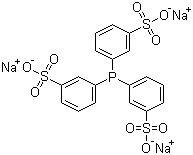 |
| Molecular Formula | C18H12Na3O9PS3 |
| Molecular Weight | 568.42 |
| CAS Registry Number | 63995-70-0 |
| EC Number | 264-596-6 |
| SMILES | C1=CC(=CC(=C1)S(=O)(=O)[O-])P(C2=CC(=CC=C2)S(=O)(=O)[O-])C3=CC(=CC=C3)S(=O)(=O)[O-].[Na+].[Na+].[Na+] |
| Hazard Symbols |  GHS07 Warning Details GHS07 Warning Details | ||||||||||||||||
|---|---|---|---|---|---|---|---|---|---|---|---|---|---|---|---|---|---|
| Risk Statements | H315-H319-H335 Details | ||||||||||||||||
| Safety Statements | P261-P264-P264+P265-P271-P280-P302+P352-P304+P340-P305+P351+P338-P319-P321-P332+P317-P337+P317-P362+P364-P403+P233-P405-P501 Details | ||||||||||||||||
| Hazard Classification | |||||||||||||||||
| |||||||||||||||||
| SDS | Available | ||||||||||||||||
 chemBlink Chemical Story
|
Triphenylphosphine-3,3',3''-trisulfonic acid trisodium salt, commonly abbreviated as TPPTS, is a water-soluble derivative of triphenylphosphine. It features three sulfonic acid groups, each substituted at the meta-position (3-position) of the phenyl rings of triphenylphosphine, and is present as a trisodium salt. Its molecular formula is C18H12Na3O9P·S3. This compound is significant in both homogeneous catalysis and aqueous-phase organometallic chemistry, where its solubility in water and retained electronic properties have made it a valuable ligand in many catalytic processes. TPPTS was developed in the 1980s as part of efforts to create phosphine ligands that combine the strong donating abilities of traditional triphenylphosphine with enhanced water solubility. This innovation was largely driven by the growing interest in biphasic catalytic systems, where water-insoluble substrates are transformed using catalysts dissolved in water, allowing easy phase separation and catalyst recycling. The sulfonation of triphenylphosphine at the 3-positions of the aromatic rings produces a ligand that retains the electron-donating phosphine center while achieving high solubility in aqueous media due to the presence of the sulfonate groups. One of the most prominent applications of TPPTS is in the Rh-catalyzed hydroformylation of alkenes. In this process, TPPTS serves as the ligand for rhodium to form a water-soluble catalytic complex. When the substrate is an alkene soluble in an organic phase and the rhodium complex is dissolved in water, the system forms a biphasic mixture. This allows the reaction to occur at the interface or within the organic phase while the catalyst remains in the aqueous phase. After completion, the organic product can be separated, and the aqueous catalyst phase can be recycled for multiple reaction cycles. This system has been industrially applied in the Ruhrchemie–Rhône-Poulenc process for the hydroformylation of long-chain alkenes, demonstrating the practical value of TPPTS in green chemistry and sustainable catalysis. TPPTS has also been employed in hydrogenation, carbonylation, and isomerization reactions. In hydrogenation, TPPTS-ligated metal complexes such as Ru-TPPTS or Rh-TPPTS can catalyze the reduction of functional groups like ketones or alkenes under aqueous conditions. In carbonylation chemistry, especially for the production of acetic acid and esters, TPPTS provides a means of forming stable, active catalytic species that function efficiently in water-based media. The sulfonic acid groups in TPPTS not only confer water solubility but also influence the electronic and steric properties of the phosphine center. Compared to triphenylphosphine, TPPTS exhibits slightly reduced electron-donating ability due to the electron-withdrawing effect of the sulfonate groups. However, this is often counterbalanced by the benefits of aqueous-phase compatibility and improved ligand-catalyst interactions in polar media. TPPTS has proven to be a versatile ligand in studies of transition metal coordination complexes. It forms stable complexes with rhodium, ruthenium, iridium, palladium, and other metals, often allowing for fine-tuning of reactivity through control of ligand-to-metal ratios and reaction medium. The ligand’s ability to act in aqueous environments has also facilitated mechanistic investigations of catalytic cycles using techniques like NMR spectroscopy and kinetic studies conducted in water. In addition to catalysis, TPPTS has been examined in the development of water-soluble organometallic drugs, especially those involving platinum and ruthenium. Its sulfonate groups improve biocompatibility and allow for potential interactions with biological molecules. While its primary use remains in synthetic and industrial chemistry, its broader relevance in coordination chemistry and aqueous-phase reactivity continues to be explored. TPPTS is typically obtained through sulfonation of triphenylphosphine using oleum or chlorosulfonic acid under controlled conditions, followed by neutralization with sodium hydroxide to give the trisodium salt. The purification and handling of TPPTS require care to avoid decomposition or oxidation, especially in the presence of air or moisture. The introduction of TPPTS marked a significant advancement in the development of water-soluble ligands and contributed to more sustainable approaches in catalysis. Its use in biphasic systems exemplifies the principles of green chemistry by facilitating catalyst recovery, reducing solvent waste, and enabling efficient industrial-scale transformations. References 1995. Organometallic Catalysis in Water and in a Two-Phase System, Aqueous Organometallic Chemistry and Catalysis (10) DOI: 10.1007/978-94-011-0355-8_22 2021. Hydroformylation, ChemTexts (13) DOI: 10.1007/s40828-021-00154-x 1991. Immobilization of HRh(CO)(P(m-C6H4SO3Na)3)3 on an anion exchange resin for the hydroformylation of higher olefins, Catalysis Letters (9) DOI: 10.1007/bf00764118 |
| Market Analysis Reports |