
Online Database of Chemicals from Around the World
| Aajiang Jiuzhou Chem Co., Ltd. | China | |||
|---|---|---|---|---|
 | www.jiuzhou-chem.com | |||
 | +86 13454675544 | |||
 | jamie@jiuzhou-chem.com | |||
 | QQ Chat | |||
 | WeChat: +86 18632988332 | |||
 | WhatsApp:+86 18632988332 | |||
| Chemical manufacturer since 2007 | ||||
| chemBlink Standard supplier since 2023 | ||||
| LTW (Jiangsu) LLC | China | |||
|---|---|---|---|---|
| www.ltwfood.com | |||
| +86 18505187090 | |||
| sales9@ltwfood.com | |||
| QQ Chat | |||
| Chemical manufacturer since 2016 | ||||
| chemBlink Standard supplier since 2024 | ||||
| Classification | API >> Synthetic anti-infective drugs >> Antifungal drugs |
|---|---|
| Name | Calcium gluconate monohydrate |
| Synonyms | Calcium (2R,3S,4R,5R)-2,3,4,5,6-pentahydroxyhexanoate hydrate |
| Molecular Structure | 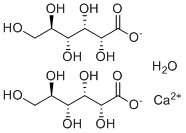 |
| Molecular Formula | C12H24CaO15 |
| Molecular Weight | 448.39 |
| CAS Registry Number | 66905-23-5 |
| SMILES | C([C@H]([C@H]([C@@H]([C@H](C(=O)[O-])O)O)O)O)O.C([C@H]([C@H]([C@@H]([C@H](C(=O)[O-])O)O)O)O)O.O.[Ca+2] |
| Hazard Symbols |  GHS07 Warning Details GHS07 Warning Details |
|---|---|
| Risk Statements | H315-H319-H335 Details |
| Safety Statements | P261-P305+P351+P338 Details |
| SDS | Available |
 chemBlink Chemical Story
|
Calcium gluconate monohydrate was first synthesized in the late 19th century by reacting gluconic acid with calcium carbonate or calcium hydroxide. The compound's discovery was pivotal in addressing calcium deficiencies because it provided a more soluble and less irritating form of calcium for oral and intravenous administration. Early pharmacological research highlighted its effectiveness in treating hypocalcemia and conditions associated with low calcium levels. By the 1920s, calcium gluconate was integrated into medical practice for its role in supplementing calcium without the gastrointestinal discomfort often caused by other calcium salts. Calcium gluconate monohydrate is widely used in treating hypocalcemia (low calcium levels in the blood), a condition that can arise due to various causes such as hypoparathyroidism, vitamin D deficiency, or renal disease. In emergency settings, calcium gluconate is often administered intravenously to quickly restore calcium levels and stabilize cardiac and neuromuscular function. Its relatively high solubility makes it effective for rapid calcium replenishment. One of the critical applications of calcium gluconate is in managing hyperkalemia-induced cardiac toxicity. Hyperkalemia, characterized by high potassium levels in the blood, can lead to dangerous cardiac arrhythmias. Calcium gluconate acts as a stabilizing agent for the cardiac cell membranes, reducing the risk of arrhythmias until the underlying potassium levels can be corrected. This use in acute care underscores the compound’s importance in critical care medicine. Calcium gluconate is an essential antidote in cases of calcium channel blocker overdose, a class of drugs used to treat hypertension and heart disease. Overdose can lead to severe hypotension, bradycardia, and heart failure. Intravenous calcium gluconate helps counteract these effects by increasing calcium availability to the heart muscles, thereby supporting cardiac contractility and vascular tone. Calcium gluconate monohydrate is also utilized in dermatology, particularly in the treatment of hydrofluoric acid (HF) burns. HF burns are hazardous due to their potential to cause severe tissue damage and systemic toxicity by depleting calcium ions in tissues. Topical application of calcium gluconate gel or injection into the affected area helps neutralize the acid and replenish local calcium levels, thereby mitigating the toxic effects and promoting healing. In the context of bone health, calcium gluconate monohydrate is used as a dietary supplement to support the management of osteoporosis and other conditions requiring increased calcium intake. It is often included in formulations alongside vitamin D to enhance calcium absorption. This use is particularly beneficial for individuals with dietary restrictions or those who have difficulty absorbing calcium from food sources. Beyond medical applications, calcium gluconate monohydrate finds use in the food industry as a firming agent and in pharmaceutical formulations as an excipient due to its stabilizing properties. It helps improve the texture of canned vegetables and fruits, and in pharmaceuticals, it ensures the stability and bioavailability of calcium in various supplement forms. |
| Market Analysis Reports |