
Online Database of Chemicals from Around the World
| Shandong Boyuan Pharmaceutical Co., Ltd. | China | |||
|---|---|---|---|---|
 | www.boyuanpharm.com | |||
 | +86 (531) 6995-4981 8896-3280 +86 15806417970 | |||
 | +86 (531) 8896-4879 | |||
 | Jeffrey.Liu@boyuanpharm.com boyuanchem@126.com | |||
 | QQ Chat | |||
| Chemical manufacturer since 2005 | ||||
| chemBlink Standard supplier since 2011 | ||||
| Zhejiang Boxiao Biopharmaceutical Co., Ltd. | China | |||
|---|---|---|---|---|
| www.bx-biopharm.com | |||
| +86 (571) 6328-0982 | |||
| helena_huang@bx-biopharm.com | |||
| QQ Chat | |||
| Chemical manufacturer since 2020 | ||||
| chemBlink Standard supplier since 2023 | ||||
| Shandong Chenghui Shuangda Pharmaceutical Co., Ltd. | China | |||
|---|---|---|---|---|
| www.chsdpharma.com | |||
| +86-531-58897029 | |||
| ericqiao@jnchsd.com | |||
| QQ Chat | |||
 | WeChat: 15550412551 | |||
 | WhatsApp:15550412551 | |||
| Chemical manufacturer since 2014 | ||||
| chemBlink Standard supplier since 2025 | ||||
| Classification | API >> Anesthetic agents >> Local anesthetics |
|---|---|
| Name | Bupivacaine Hydrochloride |
| Synonyms | 1-Butyl-N-(2,6-dimethylphenyl)-2-piperidinecarboxamide monohydrochloride monohydrate |
| Molecular Structure | 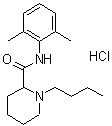 |
| Molecular Formula | C18H29ClN2O |
| Molecular Weight | 324.89 |
| CAS Registry Number | 73360-54-0 |
| EC Number | 642-205-3 |
| SMILES | CCCCN1CCCCC1C(=O)NC2=C(C=CC=C2C)C.O.Cl |
| Melting point | 255 - 258 °C (Expl.) |
|---|---|
| Hazard Symbols |  GHS06 Danger Details GHS06 Danger Details | ||||||||||||||||||||||||||||
|---|---|---|---|---|---|---|---|---|---|---|---|---|---|---|---|---|---|---|---|---|---|---|---|---|---|---|---|---|---|
| Risk Statements | H300+H310+H330-H300-H310-H330 Details | ||||||||||||||||||||||||||||
| Safety Statements | P260-P262-P264-P270-P271-P280-P284-P301+P316-P302+P352-P304+P340-P316-P320-P321-P330-P361+P364-P403+P233-P405-P501 Details | ||||||||||||||||||||||||||||
| Hazard Classification | |||||||||||||||||||||||||||||
| |||||||||||||||||||||||||||||
| SDS | Available | ||||||||||||||||||||||||||||
 chemBlink Chemical Story
|
Bupivacaine hydrochloride is a widely used local anesthetic belonging to the amide class of anesthetics. It was first introduced in the 1960s as an alternative to earlier local anesthetics, offering a longer duration of action and greater potency. The compound is commonly used for regional anesthesia, including epidural, spinal, and peripheral nerve blocks, as well as for infiltration anesthesia during surgical procedures. Bupivacaine hydrochloride acts by blocking voltage-gated sodium channels in nerve cell membranes. This blockade inhibits the initiation and propagation of nerve impulses, leading to reversible loss of sensation in the targeted area. The drug’s high lipid solubility contributes to its potency and prolonged duration compared to other local anesthetics. Pharmacodynamically, bupivacaine produces sensory and motor nerve blockade. The onset of anesthesia typically occurs within 5 to 10 minutes after administration, and the duration of action can last from 2 to 8 hours depending on the dose, concentration, and route of administration. Bupivacaine’s longer duration makes it suitable for surgical anesthesia and postoperative pain management. Bupivacaine hydrochloride is usually supplied as a sterile aqueous solution of the hydrochloride salt to enhance solubility and stability. It can be administered by various routes, including epidural, spinal, peripheral nerve block, and local infiltration. Pharmacokinetically, after local administration, bupivacaine is absorbed into the systemic circulation at rates dependent on the site of injection and the presence of vasoconstrictors such as epinephrine. It is extensively bound to plasma proteins, primarily alpha-1 acid glycoprotein. Metabolism occurs primarily in the liver through enzymatic amide hydrolysis. The metabolites and unchanged drug are eliminated mainly by renal excretion. The elimination half-life averages between 2.7 and 3.5 hours. Adverse effects related to bupivacaine hydrochloride include local and systemic reactions. Local toxicity can manifest as tissue irritation or nerve damage if improperly administered. Systemic toxicity, though rare when used correctly, can involve central nervous system symptoms such as dizziness, tinnitus, seizures, and cardiovascular effects including hypotension, arrhythmias, and in severe cases, cardiac arrest. The drug’s cardiotoxic potential is greater than that of many other local anesthetics, necessitating careful dosing and monitoring during use. Bupivacaine hydrochloride is frequently combined with vasoconstrictors like epinephrine to prolong its effect and reduce systemic absorption. It is used extensively in a variety of clinical settings including surgical anesthesia, labor analgesia, and pain control following orthopedic, dental, and other procedures. In summary, bupivacaine hydrochloride is a potent, long-acting local anesthetic widely employed for regional anesthesia and pain management. Its mechanism of sodium channel blockade results in effective sensory and motor nerve blockade, with pharmacokinetic properties supporting prolonged anesthesia. Careful clinical use is essential to minimize the risk of systemic toxicity and ensure patient safety. References 1979. Blood bupivacaine levels in standard and segmental epidural blockade in obstetrics. South African Medical Journal, 55(23). PMID: 472928 1991. The Effect of Age on Systemic Absorption and Systemic Disposition of Bupivacaine after Subarachnoid Administration. Anesthesiology, 74(2). DOI: 10.1097/00000542-199102000-00010 2000. Bupivacaine Release from Biopolymeric Depots for the Alleviation of Postoperative Pain. Biomaterials Engineering and Devices: Human Applications. DOI: 10.1007/978-1-59259-196-1_19 |
| Market Analysis Reports |