
Online Database of Chemicals from Around the World
| Hangzhou Zentra Bio-Chemical Co., Ltd. | China | |||
|---|---|---|---|---|
 | www.zentrachem.com | |||
 | +86 18321999949 | |||
 | steven@zentrachem.com | |||
 | QQ Chat | |||
 | WeChat: Hangzhou Zentra Bio-Chemical Co., Ltd. | |||
| Chemical distributor since 2025 | ||||
| chemBlink Standard supplier since 2025 | ||||
| Classification | Pharmaceutical intermediate >> Heterocyclic compound intermediate >> Pyrimidine compound >> Ketones |
|---|---|
| Name | 1-(4-Bromo-5-fluoro-2-hydroxyphenyl)ethanone |
| Molecular Structure | 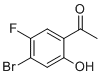 |
| Molecular Formula | C8H6BrFO2 |
| Molecular Weight | 233.03 |
| CAS Registry Number | 865449-63-4 |
| SMILES | CC(=O)C1=CC(=C(C=C1O)Br)F |
| Density | 1.7±0.1 g/cm3 Calc.* |
|---|---|
| Boiling point | 302.7±42.0 °C 760 mmHg (Calc.)* |
| Flash point | 136.9±27.9 °C (Calc.)* |
| Index of refraction | 1.57 (Calc.)* |
| * | Calculated using Advanced Chemistry Development (ACD/Labs) Software. |
| Hazard Symbols |  GHS07 Warning Details GHS07 Warning Details |
|---|---|
| Risk Statements | H302-H315-H319 Details |
| Safety Statements | P261-P305+P351+P338 Details |
| SDS | Available |
 chemBlink Chemical Story
|
1-(4-Bromo-5-fluoro-2-hydroxyphenyl)ethanone is an aromatic ketone compound with the molecular formula C8H6BrFO2. It consists of a substituted phenyl ring bearing a hydroxyl group at position 2, a bromine atom at position 4, a fluorine atom at position 5, and an ethanone (acetyl) group at position 1. This substitution pattern results in a molecule that is both electron-rich (due to the hydroxyl group) and electron-deficient (due to the electronegative bromine and fluorine substituents), making it of interest in synthetic and medicinal chemistry. The compound belongs to the class of halogenated hydroxyaryl ketones, which are commonly used as intermediates in the synthesis of more complex organic molecules. The presence of both bromo and fluoro groups on the aromatic ring enables selective functionalization through various cross-coupling reactions, such as Suzuki-Miyaura, Buchwald-Hartwig, or Sonogashira reactions. These methodologies allow chemists to construct diverse substituted aromatic systems by replacing the halogen atoms with a wide range of carbon- or nitrogen-containing moieties. The hydroxyl group at the ortho-position relative to the ketone allows for potential intramolecular hydrogen bonding, which can influence both the compound’s conformation and its reactivity. Additionally, this hydroxyl group can serve as a site for esterification or etherification, enabling further derivatization. The combination of substituents contributes to its potential as a building block in the design of bioactive compounds. 1-(4-Bromo-5-fluoro-2-hydroxyphenyl)ethanone has been used in the synthesis of pharmaceutical candidates, agrochemicals, and materials science applications. For example, halogenated acetophenone derivatives are often found as intermediates in the synthesis of kinase inhibitors, anti-inflammatory agents, and antimicrobial compounds. The ability to modify the aromatic ring through cross-coupling reactions while maintaining or altering functional groups like the hydroxyl or ketone increases the compound’s synthetic value. In chemical synthesis, this compound is typically prepared by halogenation of hydroxyacetophenone derivatives. Controlled bromination and fluorination steps are used to install the substituents at the correct positions on the aromatic ring. Purification is generally accomplished through recrystallization or chromatography, depending on the specific reaction route. The characterization of 1-(4-bromo-5-fluoro-2-hydroxyphenyl)ethanone is typically conducted using a combination of spectroscopic techniques. Proton nuclear magnetic resonance (²H NMR) and carbon-13 NMR (³C NMR) reveal the environment of the aromatic, methyl, and hydroxyl protons and carbons. Fluorine-19 NMR may also be employed to assess the position and environment of the fluorine atom. Infrared (IR) spectroscopy provides information on the hydroxyl (O–H) and carbonyl (C=O) stretching vibrations. Mass spectrometry confirms the molecular weight and fragmentation pattern, useful for structural confirmation. From a safety standpoint, the compound should be handled with care, particularly due to the presence of the bromine and fluorine substituents, which can be reactive under certain conditions. Standard precautions including gloves, goggles, and proper ventilation should be used during handling and synthesis. In conclusion, 1-(4-bromo-5-fluoro-2-hydroxyphenyl)ethanone is a synthetically valuable aromatic ketone with multiple reactive sites that can be exploited for the preparation of more complex organic molecules. Its combination of electron-withdrawing halogens and an electron-donating hydroxyl group makes it a versatile intermediate in medicinal and synthetic organic chemistry. |
| Market Analysis Reports |