
Online Database of Chemicals from Around the World
| Wuhan Kemi-works Chemical Co., Ltd. | China | |||
|---|---|---|---|---|
 | www.kemiworks.net | |||
 | +86 (27) 8573-6489 | |||
 | +86 (27) 8573-6485 | |||
 | info@kemiworks.net sales@kemiworks.com | |||
| Chemical manufacturer | ||||
| chemBlink Premium supplier since 2011 | ||||
| Classification | Flavors and spices >> Synthetic spice >> Phenols, ethers and epoxides >> Phenolic flavors |
|---|---|
| Name | 2,6-Di-tert-Butyl-4-(dimethylamino)methylphenol |
| Molecular Structure | 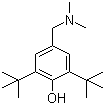 |
| Molecular Formula | C17H29NO |
| Molecular Weight | 263.42 |
| CAS Registry Number | 88-27-7 |
| EC Number | 201-816-1 |
| SMILES | CC(C)(C)C1=CC(=CC(=C1O)C(C)(C)C)CN(C)C |
| Density | 1.6±0.1 g/cm3, Calc.* |
|---|---|
| Melting point | 93-94 °C |
| Index of Refraction | 1.650, Calc.* |
| Boiling Point | 561.6±50.0 °C (760 mmHg), Calc.*, 172 °C (30 mmHg) |
| Flash Point | 293.4±30.1 °C, Calc.*, 138 °C |
| Hazard Symbols |   GHS07;GHS09 Warning Details GHS07;GHS09 Warning Details | ||||||||||||||||||||||||||||||||||||||||
|---|---|---|---|---|---|---|---|---|---|---|---|---|---|---|---|---|---|---|---|---|---|---|---|---|---|---|---|---|---|---|---|---|---|---|---|---|---|---|---|---|---|
| Risk Statements | H302-H317-H319-H400-H410 Details | ||||||||||||||||||||||||||||||||||||||||
| Safety Statements | P261-P264-P264+P265-P270-P272-P273-P280-P301+P317-P302+P352-P305+P351+P338-P321-P330-P333+P317-P337+P317-P362+P364-P391-P501 Details | ||||||||||||||||||||||||||||||||||||||||
| Hazard Classification | |||||||||||||||||||||||||||||||||||||||||
| |||||||||||||||||||||||||||||||||||||||||
| SDS | Available | ||||||||||||||||||||||||||||||||||||||||
 chemBlink Chemical Story
|
2,6-Di-tert-Butyl-4-(dimethylamino)methylphenol, commonly known as DBM, is a chemical compound that has gained attention for its unique properties and various applications, particularly in the fields of chemistry and materials science. This compound is categorized as a phenolic antioxidant and is widely utilized in various industries due to its effectiveness in stabilizing materials and preventing degradation. The discovery of DBM dates back to the mid-20th century when researchers were investigating new antioxidants to enhance the stability of plastics and rubber products. The search for compounds that could effectively inhibit oxidative degradation led to the synthesis of DBM, which was identified for its ability to donate hydrogen atoms to free radicals, thus interrupting the chain reactions that lead to polymer degradation. The structural features of DBM, including its bulky tert-butyl groups, contribute to its steric hindrance, which is essential in reducing the reactivity of free radicals. DBM has found numerous applications across various sectors. In the polymer industry, it is primarily used as a stabilizer to protect plastics, rubbers, and coatings from thermal oxidation. The presence of DBM in these materials significantly extends their service life and maintains their physical properties over time, making it a valuable additive in the formulation of products that are exposed to high temperatures or oxidative environments. Moreover, its effectiveness in preventing discoloration and loss of mechanical strength has made it a preferred choice among manufacturers. In addition to its role in polymer stabilization, DBM is also employed in the formulation of lubricants and greases, where it serves to enhance thermal stability and reduce wear in machinery. The compound's ability to scavenge free radicals and neutralize oxidative agents ensures that lubricants maintain their viscosity and performance under extreme conditions. This characteristic is particularly important in automotive and industrial applications, where equipment longevity and reliability are crucial. Another significant application of DBM is in the field of pharmaceuticals, where it is utilized as a stabilizer for active pharmaceutical ingredients (APIs). The oxidative stability of APIs is essential for their efficacy and shelf life, and DBM plays a crucial role in preventing degradation during storage and formulation processes. Its compatibility with various excipients further enhances its utility in drug formulation, allowing for the development of stable and effective pharmaceutical products. Research continues to explore new potential applications for DBM, including its use in cosmetic formulations where antioxidant properties can protect sensitive ingredients from oxidative damage. The ongoing investigation into the environmental impact and safety of DBM also remains a key focus, as the industry seeks to balance performance with sustainability. In summary, the discovery of 2,6-Di-tert-Butyl-4-(dimethylamino)methylphenol has led to significant advancements in the fields of polymer science, lubricants, and pharmaceuticals. Its effectiveness as an antioxidant and stabilizer makes it a valuable compound across various industries, contributing to the enhancement of product performance and longevity. The continued exploration of its applications reflects the importance of chemical innovation in addressing the challenges of modern materials and formulations. References 2007. 2,6-Di-tert-butyl-4-(dimethylaminomethyl)phenol. Acta Crystallographica. Section E, Structure Reports Online. DOI: 10.1107/s1600536807065117 2022. Synthesis and Structure of Quaternary Phosphonium Salts Based on Phosphorylated Sterically Hindered Phenols. Russian Journal of General Chemistry. DOI: 10.1134/s1070363222070040 2022. Synthesis, Structure of Phosphorylated Sterically Hindered Methylene Quinones and Ylides Thereof. Russian Journal of Organic Chemistry. DOI: 10.1134/s1070428022080036 |
| Market Analysis Reports |