Online Database of Chemicals from Around the World

Phenothiazine
[CAS# 92-84-2]

List of Suppliers
Wuxi Rchun Technology Co., Ltd. China Inquire
www.rchun.cn
+86 (510) 8829-7505
+86 (510) 8525-9689
ycxm_chem@hotmail.com
Chemical manufacturer
chemBlink Standard supplier since 2006
Simagchem Corporation China Inquire
www.simagchem.com
+86 13806087780
+86 (592) 268-0237
sale@simagchem.com
Chemical manufacturer since 2002
chemBlink Standard supplier since 2008
Tianjin Zhongxin Chem-tech Co., Ltd. China Inquire
www.tjzxchem.com
+86 (22) 6688-0623
+86 (22) 8988-0739 ex 8030
sales@tjzxchem.com
Chemical manufacturer since 2007
chemBlink Standard supplier since 2009
Hefei TNJ Chemical Industry Co., Ltd. China Inquire
www.tnjchem.com
+86 (551) 6541-8684
+86 (551) 6541-8697
sales@tnjchem.com
Chemical manufacturer since 2001
chemBlink Standard supplier since 2010
BOC Sciences USA Inquire
www.bocsci.com
+1 (631) 485-4226
+1 (631) 614-7828
info@bocsci.com
Chemical manufacturer
chemBlink Standard supplier since 2010
Henan Tianfu Chemical Co., Ltd. China Inquire
www.tianfuchem.com
+86 (371) 5517-0693
+86 (371) 5517-0975
leon@tianfuchem.com
Chemical distributor since 2009
chemBlink Standard supplier since 2014
Hangzhou Leap Chem Co., Ltd. China Inquire
www.leapchem.com
+86 (571) 8771-1850
market19@leapchem.com
QQ Chat
Chemical manufacturer since 2006
chemBlink Standard supplier since 2015
Amadis Chemical Co., Ltd. China Inquire
www.amadischem.com
+86 (571) 8992-5085
+86 (571) 8992-5065
sales@amadischem.com
Chemical manufacturer since 2010
chemBlink Standard supplier since 2015
Riverland Trading LLC. USA Inquire
www.riverlandtrading.com
+1 (336).944-2293
bens@riverlandtrading.com
Chemical distributor
chemBlink Standard supplier since 2023
Anvia Chemicals, LLC USA Inquire
www.anviachem.com
+1 (414) 534-7845
+1 (414) 762-5539
sales@anviachem.com
Chemical manufacturer
Santa Cruz Biotechnology, Inc. USA Inquire
www.scbt.com
+1 (831) 457-3800
+1 (831) 457-3801
scbt@scbt.com
Chemical manufacturer
AccuStandard Inc. USA Inquire
www.accustandard.com
+1 (203) 786-5290
+1 (203) 786-5287
orders@accustandard.com
Chemical manufacturer since 1986
Whyte Chemicals UK Inquire
www.whytechemicals.co.uk
+44 (20) 8346-5946
+44 (20) 8349-4589
sales@whytechemicals.co.uk
Chemical distributor
Wako Pure Chemical Industries, Ltd. Japan Inquire
www.wako-chem.co.jp
+81 (6) 6203-3741
+81 (6) 6201-5964
wkhk.info@fujifilm.com
Chemical manufacturer since 1922
Kingchem Inc. USA Inquire
www.kingchem.com
+1 (800) 211-4330
(201) 825-9988
+1 (201) 825-9148
customer-service@kingchem.com
Chemical manufacturer since 1994

Identification
ClassificationAPI >> Antiparasitic drug >> Antiprotozoal
NamePhenothiazine
SynonymsThiodiphenylamine; Dibenzo-p-thiazine; Dibenzo-1,4-thiazine
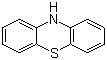
Molecular StructureCAS # 92-84-2, Phenothiazine
Molecular FormulaC12H9NS
Molecular Weight199.27
CAS Registry Number92-84-2
EC Number202-196-5
SMILESC1=CC=C2C(=C1)NC3=CC=CC=C3S2
Properties
Water solubility2 mg/L (25 °C)
Density1.2±0.1 g/cm3, Calc.*, 1.362 g/mL
Melting point182-187 °C
Index of Refraction1.675, Calc.*, 1.6353
Boiling Point371.0±12.0 °C (760 mmHg), Calc.*, 371 °C
Flash Point178.2±19.6 °C, Calc.*
*Calculated using Advanced Chemistry Development (ACD/Labs) Software.
Safety Data
Hazard Symbolssymbol symbol symbol   GHS07;GHS08;GHS09 Warning  Details
Risk StatementsH302-H317-H373-H400-H410-H412  Details
Safety StatementsP260-P261-P264-P270-P272-P273-P280-P301+P317-P302+P352-P319-P321-P330-P333+P317-P362+P364-P391-P501  Details
Hazard Classification
up    Details
HazardClassCategory CodeHazard Statement
Acute toxicityAcute Tox.4H302
Specific target organ toxicity - repeated exposureSTOT RE2H373
Skin sensitizationSkin Sens.1H317
Chronic hazardous to the aquatic environmentAquatic Chronic3H412
Chronic hazardous to the aquatic environmentAquatic Chronic1H410
Acute hazardous to the aquatic environmentAquatic Acute1H400
Eye irritationEye Irrit.2H319
Skin sensitizationSkin Sens.1BH317
Skin irritationSkin Irrit.2H315
Specific target organ toxicity - single exposureSTOT SE3H335
Chronic hazardous to the aquatic environmentAquatic Chronic2H411
Acute toxicityAcute Tox.4H312
Acute toxicityAcute Tox.4H332
CarcinogenicityCarc.2H351
Specific target organ toxicity - single exposureSTOT SE1H370
Chronic hazardous to the aquatic environmentAquatic Chronic4H413
Skin sensitizationSkin Sens.1AH317
SDSAvailable
up Discovery and Applications
Phenothiazine is an organic compound with a unique structure that consists of a sulfur atom and two nitrogen atoms incorporated into a three-ring system. This compound has been the subject of significant research since its discovery in the late 19th century. Initially synthesized in 1883 by the German chemist August Wilhelm von Hofmann, phenothiazine was discovered as a byproduct of coal tar distillation. Its structure was elucidated later, and it was recognized for its potential biological activity, leading to extensive studies on its applications.

The primary application of phenothiazine lies in the pharmaceutical industry, particularly as an antipsychotic agent. In the 1950s, phenothiazine derivatives were developed as tranquilizers, revolutionizing the treatment of mental disorders. Compounds such as chlorpromazine, which is a phenothiazine derivative, were among the first medications used to treat schizophrenia and other psychotic disorders. These compounds work by blocking dopamine receptors in the brain, which helps to alleviate symptoms such as hallucinations and agitation. The introduction of phenothiazine derivatives marked a significant advancement in psychiatric medicine, leading to more humane treatments for mental health conditions.

In addition to its role in psychiatry, phenothiazine is also used as an antiemetic, helping to prevent nausea and vomiting associated with various medical conditions and treatments, such as chemotherapy. Its efficacy in this area is attributed to its ability to block receptors in the brain that trigger these responses. This dual functionality as both an antipsychotic and an antiemetic has made phenothiazine and its derivatives valuable in clinical settings.

Beyond its medicinal uses, phenothiazine has found applications in other fields, including agriculture. It is utilized as a veterinary drug to treat parasitic infections in livestock and pets. Phenothiazine acts as an anthelmintic, effectively combating worms and other parasites, thereby promoting better health in animals. The use of phenothiazine in veterinary medicine highlights its versatility and importance beyond human health.

Phenothiazine also serves as a dye intermediate in the textile industry. It can be chemically modified to produce various dyes, which are known for their vibrant colors and excellent stability. These dyes are used in a wide range of applications, from fabric dyeing to printing inks. The compound's ability to act as a precursor for dyes demonstrates its significance in industrial chemistry.

Safety considerations are important when handling phenothiazine, as it may pose health risks, including skin irritation and respiratory issues. Proper safety measures, including the use of personal protective equipment and adherence to regulatory guidelines, are crucial to minimize potential hazards.

Recent research has focused on developing new phenothiazine derivatives with enhanced therapeutic properties and reduced side effects. The exploration of novel synthesis routes and modifications aims to improve the efficacy and safety profiles of these compounds, paving the way for future advancements in pharmaceuticals and agriculture.

In summary, phenothiazine is a versatile compound with significant applications in medicine, agriculture, and industrial chemistry. Its discovery has led to groundbreaking treatments for mental health disorders and continues to influence various fields. Ongoing research into its derivatives holds promise for further innovations in health and industry.

References

2022. Medicinal chemistry aspects and synthetic strategies of coumarin as aromatase inhibitors: an overview. Medical oncology (Northwood, London, England), 40(1).
DOI: 10.1007/s12032-022-01916-4

1986. Postsynaptic inhibitory effects of phenothiazines at cholinergic synapses may not involve calmodulin. Naunyn-Schmiedeberg's Archives of Pharmacology, 333(4).
DOI: 10.1007/bf00500024

1991. The discovery of antidepressants: A winding path. Cellular and Molecular Life Sciences, 47(1).
DOI: 10.1007/bf02041242
Market Analysis Reports
List of Reports Available for Phenothiazine
Related Products
Phenomorphan  Phenomorphan Hy...  Phenonip  Phenoperidine  Phenoprolamine-...  Phenoro  Phenosafranin  10H-Phenoselena...  Phenosmolin  Phenosulfazole  10H-Phenothiazi...  10H-Phenothiazi...  10H-Phenothiazi...  10H-Phenothiazi...  Phenothiazine-1...  Phenothiazine-1...  10H-Phenothiazi...  10H-Phenothiazi...  10H-Phenothiazi...  10H-Phenothiazi...