
Online Database of Chemicals from Around the World
| SL Drugs and Pharmaceuticals Pvt. Ltd. | India | |||
|---|---|---|---|---|
 | www.sldrugs.com | |||
 | +91 (40) 6661-1133 | |||
 | +91 (40) 2375-1130 | |||
 | enquiry@sldrugs.com | |||
| Chemical distributor since 1999 | ||||
| chemBlink Standard supplier since 2010 | ||||
| Glentham Life Sciences | UK | |||
|---|---|---|---|---|
| www.glenthamls.com | |||
| +44 (2033) 978-798 | |||
| +44 (2033) 978-909 | |||
| info@glenthamls.com | |||
| Chemical distributor since 2013 | ||||
| chemBlink Standard supplier since 2013 | ||||
| Biosynth AG. | Switzerland | |||
|---|---|---|---|---|
| www.biosynth.com | |||
| +41 (71) 858-2020 | |||
| +41 (71) 858-2030 | |||
| welcome@biosynth.ch | |||
| Chemical manufacturer | ||||
| chemBlink Standard supplier since 2014 | ||||
| Carbosynth China Ltd. | China | |||
|---|---|---|---|---|
| www.carbosynth.cn | |||
| +86 (512) 6260-5585 | |||
| +86 (512) 6260-5576 | |||
| sales@carbosynth.com | |||
 | QQ Chat | |||
| Chemical manufacturer since 2006 | ||||
| chemBlink Standard supplier since 2016 | ||||
| Kemystery Chemicals Private Limited | India | |||
|---|---|---|---|---|
| www.kemystery.com | |||
| +91 9963066966 | |||
| sales@kemystery.com | |||
| Chemical manufacturer since 2019 | ||||
| chemBlink Standard supplier since 2019 | ||||
| Shenzhen Geneseqtools Bioscience & Technology Co. Ltd. | China | |||
|---|---|---|---|---|
| geneseqtools.com | |||
| +86 (0755) 2325-1735 | |||
| sales@geneseqtools.com | |||
| QQ Chat | |||
 | WeChat: 13302967066 | |||
| Chemical manufacturer since 2015 | ||||
| chemBlink Standard supplier since 2025 | ||||
| Apollo Scientific Ltd. | UK | |||
|---|---|---|---|---|
| www.apolloscientific.co.uk | |||
| +44 (161) 406-0505 | |||
| +44 (161) 406-0506 | |||
| sales@apolloscientific.co.uk | |||
| Chemical manufacturer | ||||
| Classification | Biochemical >> Carbohydrate >> Monosaccharide |
|---|---|
| Name | 5-Bromo-6-chloro-1H-indol-3-yl beta-D-glucopyranoside |
| Synonyms | 5-Bromo-6-chloro-3-(beta-D-glucopyranosyloxy)indole; Magenta glucoside |
| Molecular Structure | 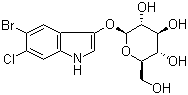 |
| Molecular Formula | C14H15BrClNO6 |
| Molecular Weight | 408.63 |
| CAS Registry Number | 93863-89-9 |
| SMILES | C1=C2C(=CC(=C1Br)Cl)NC=C2O[C@H]3[C@@H]([C@H]([C@@H]([C@H](O3)CO)O)O)O |
| Density | 1.9±0.1 g/cm3 Calc.* |
|---|---|
| Boiling point | 673.9±55.0 °C 760 mmHg (Calc.)* |
| Flash point | 361.3±31.5 °C (Calc.)* |
| Index of refraction | 1.732 (Calc.)* |
| * | Calculated using Advanced Chemistry Development (ACD/Labs) Software. |
| Hazard Symbols |  GHS07 Warning Details GHS07 Warning Details |
|---|---|
| Risk Statements | H315-H319-H335 Details |
| Safety Statements | P261-P264-P271-P280-P302+P352-P304+P340+P312-P305+P351+P338-P332+P313-P337+P313-P362-P403+P233-P405-P501 Details |
| SDS | Available |
 chemBlink Chemical Story
|
5-Bromo-6-chloro-1H-indol-3-yl β-D-glucopyranoside is a chromogenic substrate widely used for the detection of β-glucosidase enzyme activity. This compound belongs to a class of halogenated indoxyl glycosides that have been developed and utilized to provide a visual indication of enzymatic hydrolysis through the generation of a colored precipitate. The discovery of such substrates was driven by the need for sensitive, reliable, and convenient methods to detect glycosidase activities in various biological, microbiological, and biochemical applications. The chemical structure consists of an indole ring system substituted with bromine at the 5-position and chlorine at the 6-position, which is glycosidically linked to a β-D-glucopyranose unit at the 3-position of the indole. The halogen substituents contribute to the unique spectral properties of the molecule and enhance the colorimetric response upon enzymatic cleavage. When β-glucosidase catalyzes the hydrolysis of the glycosidic bond, it releases the aglycone 5-bromo-6-chloro-1H-indol-3-ol. This aglycone is unstable in the presence of oxygen and undergoes spontaneous oxidative dimerization to form an insoluble indigoid dye with a characteristic blue color. This blue precipitate forms at the site of enzymatic activity, allowing for direct visual identification. The discovery and development of 5-bromo-6-chloro-1H-indol-3-yl β-D-glucopyranoside were part of broader research into halogenated indoxyl derivatives as substrates for enzymatic assays. Similar compounds, such as 5-bromo-4-chloro-3-indolyl β-D-galactoside (X-Gal), have been widely used for detecting β-galactosidase activity. However, substrates like the 5-bromo-6-chloro variant were designed to target β-glucosidase specifically, enabling expanded applications in molecular biology and microbial diagnostics. These chromogenic substrates have significantly improved the sensitivity and ease of enzyme detection compared to traditional colorless substrates, facilitating rapid and clear results without the need for complex instrumentation. The primary application of 5-bromo-6-chloro-1H-indol-3-yl β-D-glucopyranoside is in enzymatic assays where β-glucosidase is expressed or active. In molecular biology, it serves as a reporter substrate for gene expression systems employing β-glucosidase genes, enabling researchers to monitor gene activity through colorimetric readouts. In microbiology, this substrate is commonly used to identify β-glucosidase-producing microorganisms by the appearance of blue colonies on agar plates supplemented with the compound. This visual marker is particularly valuable in screening libraries of bacterial or fungal strains for enzymatic traits. In addition to its use in microbial assays, the substrate is employed in histochemical and cytochemical studies to detect β-glucosidase activity in tissue sections and cell samples. The ability to localize enzymatic activity spatially within biological samples aids in understanding physiological and pathological processes involving glycosidases. The colorimetric detection method is simple, cost-effective, and compatible with standard laboratory protocols. The synthesis of 5-bromo-6-chloro-1H-indol-3-yl β-D-glucopyranoside involves glycosylation of the halogenated indole derivative with protected glucose donors under controlled conditions to ensure the β-anomeric configuration. The process requires careful handling to prevent oxidation of the indole ring and to achieve high purity and yield. The final product is typically stored in dry form, protected from light and moisture to maintain stability, and dissolved in suitable solvents immediately before use. The compound’s stability and predictable color development make it a reliable reagent for various analytical and preparative purposes. It has become a standard tool in enzymology and genetic engineering laboratories, complementing other chromogenic and fluorogenic substrates for glycosidases. Its use has enhanced the understanding of enzyme distribution, function, and regulation in biological systems. Overall, 5-bromo-6-chloro-1H-indol-3-yl β-D-glucopyranoside exemplifies the successful application of chemical modification of natural substrates to develop sensitive and specific enzymatic probes. Its discovery and utilization reflect significant progress in analytical biochemistry, with broad implications for research, diagnostics, and biotechnology. References 2010. Characterization of a heat resistant beta-glucosidase as a new reporter in cells and mice. BMC Biology, 8(1). DOI: 10.1186/1741-7007-8-89 2011. Bioprospecting metagenomics of decaying wood: mining for new glycoside hydrolases. Biotechnology for Biofuels and Bioproducts, 4(1). DOI: 10.1186/1754-6834-4-23 2016. Imaging the mammary gland and mammary tumours in 3D: optical tissue clearing and immunofluorescence methods. Breast Cancer Research, 18(1). DOI: 10.1186/s13058-016-0754-9 |
| Market Analysis Reports |