
Online Database of Chemicals from Around the World
| Discovery Fine Chemicals Ltd. | UK | |||
|---|---|---|---|---|
 | www.discofinechem.com | |||
 | +44 (1202) 874-517 | |||
 | +44 (845) 094-4385 | |||
 | pjc@discofinechem.com | |||
| Chemical manufacturer | ||||
| chemBlink Standard supplier since 2009 | ||||
| Biosynth AG. | Switzerland | |||
|---|---|---|---|---|
| www.biosynth.com | |||
| +41 (71) 858-2020 | |||
| +41 (71) 858-2030 | |||
| welcome@biosynth.ch | |||
| Chemical manufacturer | ||||
| chemBlink Standard supplier since 2014 | ||||
| Shenzhen Geneseqtools Bioscience & Technology Co. Ltd. | China | |||
|---|---|---|---|---|
| geneseqtools.com | |||
| +86 (0755) 2325-1735 | |||
| sales@geneseqtools.com | |||
 | QQ Chat | |||
 | WeChat: 13302967066 | |||
| Chemical manufacturer since 2015 | ||||
| chemBlink Standard supplier since 2025 | ||||
| Apollo Scientific Ltd. | UK | |||
|---|---|---|---|---|
| www.apolloscientific.co.uk | |||
| +44 (161) 406-0505 | |||
| +44 (161) 406-0506 | |||
| sales@apolloscientific.co.uk | |||
| Chemical manufacturer | ||||
| IRIS Biotech GmbH | Germany | |||
|---|---|---|---|---|
| www.iris-biotech.de | |||
| +49 (9231) 961-973 | |||
| +49 (9231) 961-999 | |||
| info@iris-biotech.de | |||
| Chemical manufacturer since 1788 | ||||
| Melford Laboratories Limited | UK | |||
|---|---|---|---|---|
| www.melford.co.uk | |||
| +44 (1449) 741-178 | |||
| +44 (1449) 741-217 | |||
| pfranklin@melford.co.uk sales@melford.co.uk | |||
| Chemical manufacturer since 1985 | ||||
| SBS Genetech Co., Ltd. | China | |||
|---|---|---|---|---|
| www.sbsbio.com | |||
| +86 (10) 8278-4296 8278-4292 6296-9345 | |||
| +86 (10) 8278-4290 | |||
| info@sbsbio.com | |||
| Chemical manufacturer | ||||
| Santa Cruz Biotechnology, Inc. | USA | |||
|---|---|---|---|---|
| www.scbt.com | |||
| +1 (831) 457-3800 | |||
| +1 (831) 457-3801 | |||
| scbt@scbt.com | |||
| Chemical manufacturer | ||||
| Classification | Biochemical >> Carbohydrate >> Monosaccharide |
|---|---|
| Name | 5-Bromo-4-chloro-3-indolyl-alpha-D-galactopyranoside |
| Synonyms | X-alpha-Gal |
| Molecular Structure | 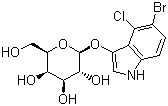 |
| Molecular Formula | C14H15BrClNO6 |
| Molecular Weight | 408.63 |
| CAS Registry Number | 107021-38-5 |
| EC Number | 805-241-2 |
| SMILES | C1=CC(=C(C2=C1NC=C2O[C@@H]3[C@@H]([C@H]([C@H]([C@H](O3)CO)O)O)O)Cl)Br |
| Hazard Symbols |  GHS07 Warning Details GHS07 Warning Details |
|---|---|
| Risk Statements | H302-H315-H319-H335 Details |
| Safety Statements | P261-P264-P270-P271-P280-P301+P312-P302+P352-P304+P340-P305+P351+P338-P330-P332+P313-P337+P313-P362-P403+P233-P405-P501 Details |
| SDS | Available |
 chemBlink Chemical Story
|
5-Bromo-4-chloro-3-indolyl-α-D-galactopyranoside is a synthetic chromogenic substrate widely utilized in molecular biology and biochemistry, particularly for the detection of β-galactosidase activity. The compound is structurally related to indole derivatives and includes a galactose moiety glycosidically linked to a substituted indole ring. It belongs to the class of X-gal analogs and is commonly abbreviated as X-α-Gal to distinguish it from the more widely known X-β-Gal, which serves as a substrate for β-galactosidase in prokaryotic systems. The compound was developed in the context of expanding tools for enzymatic detection in various reporter gene assays. The design and synthesis of such galactopyranosides were guided by efforts to detect α-galactosidase activity in diverse biological systems, particularly in the study of lysosomal storage disorders and microbial enzymology. Unlike X-β-Gal, which is cleaved by β-galactosidase, 5-Bromo-4-chloro-3-indolyl-α-D-galactopyranoside is specifically cleaved by α-galactosidase enzymes, leading to a chromogenic reaction that produces a blue precipitate under suitable assay conditions. Upon enzymatic hydrolysis by α-galactosidase, the glycosidic bond is cleaved to release the substituted indole. This free indolyl compound undergoes oxidative dimerization in the presence of oxygen to form a blue indigo-like dye, which is insoluble in water and precipitates out of solution. This visible reaction allows researchers to monitor α-galactosidase activity qualitatively and quantitatively using spectrophotometric or histochemical techniques. The clear and intense blue coloration has made it particularly useful in colony screening, tissue staining, and microplate-based assays. Applications of 5-Bromo-4-chloro-3-indolyl-α-D-galactopyranoside span across enzymology, diagnostics, and molecular biology. In microbial screening, the compound is employed to identify microorganisms capable of expressing α-galactosidase, either through endogenous gene expression or recombinant constructs. In clinical diagnostics, it has served as a substrate in assays designed to detect enzyme deficiencies, such as Fabry disease, a genetic disorder resulting from the absence of α-galactosidase A in human lysosomes. The substrate enables the visualization of enzymatic activity in patient-derived cells or tissues, providing a tool for phenotypic characterization and screening. In biotechnology and synthetic biology, the substrate has found utility in recombinant expression systems where genes encoding α-galactosidase are used as reporter genes. This application is analogous to the use of lacZ and X-β-Gal in blue/white screening systems, although X-α-Gal is tailored to systems where α-galactosidase is the desired enzymatic output. The compound has also been adapted for use in microplate assays for high-throughput screening, where its chromogenic properties facilitate rapid and scalable enzyme activity measurements. Chemically, 5-Bromo-4-chloro-3-indolyl-α-D-galactopyranoside is stable under dry conditions and can be stored as a powder or in solution under controlled temperatures. The molecule’s indole-based structure with halogen substitutions enhances its chromogenic potential and stability during storage and use. In aqueous solutions, the substrate is typically used at concentrations optimized to balance enzymatic turnover and background signal. Assay conditions often include buffers adjusted for pH and cofactors that favor optimal enzymatic activity and dye development. The development of 5-Bromo-4-chloro-3-indolyl-α-D-galactopyranoside reflects broader efforts to create chromogenic substrates tailored to specific enzyme classes. It has enabled precise detection of α-galactosidase activity in complex biological samples and contributed to the advancement of diagnostic tools and enzyme assays. Its continued use in research and diagnostic laboratories highlights its reliability and specificity as a molecular tool. References 1995. Production of secreted guar α-galactosidase by Lactococcus lactis. Applied Microbiology and Biotechnology, 44(3-4). DOI: 10.1007/bf00164483 2008. Ability of Lactobacillus fermentum to overcome host alpha-galactosidase deficiency, as evidenced by reduction of hydrogen excretion in rats consuming soya alpha-galacto-oligosaccharides. BMC Microbiology, 8(22). DOI: 10.1186/1471-2180-8-22 2016. Acidic alpha galactosidase during the maturation and cold storage of cherry tomatoes. Acta Physiologiae Plantarum, 38(3). DOI: 10.1007/s11738-016-2075-0 |
| Market Analysis Reports |