
Online Database of Chemicals from Around the World
| INA Pharmaceuticals Pvt. Ltd. | India | |||
|---|---|---|---|---|
 | inapharma.in | |||
 | +91 7815933367 | |||
 | rd@inapharma.in | |||
| Chemical manufacturer since 2018 | ||||
| chemBlink Standard supplier since 2026 | ||||
| Classification | Pharmaceutical intermediate >> Heterocyclic compound intermediate >> Pyridine compound >> Chloropyridine |
|---|---|
| Name | 2-Amino-5-bromo-4-chloropyridine |
| Synonyms | 5-bromo-4-chloropyridin-2-amine |
| Molecular Structure | 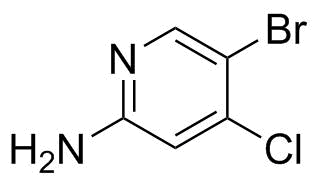 |
| Molecular Formula | C5H4BrClN2 |
| Molecular Weight | 207.46 |
| CAS Registry Number | 942947-94-6 |
| EC Number | 807-141-4 |
| SMILES | C1=C(C(=CN=C1N)Br)Cl |
| Density | 1.8±0.1 g/cm3 Calc.* |
|---|---|
| Boiling point | 271.6±35.0 °C 760 mmHg (Calc.)* |
| Flash point | 118.0±25.9 °C (Calc.)* |
| Index of refraction | 1.648 (Calc.)* |
| * | Calculated using Advanced Chemistry Development (ACD/Labs) Software. |
| Hazard Symbols |  GHS07 Warning Details GHS07 Warning Details | ||||||||||||||||||||||||||||||||
|---|---|---|---|---|---|---|---|---|---|---|---|---|---|---|---|---|---|---|---|---|---|---|---|---|---|---|---|---|---|---|---|---|---|
| Risk Statements | H302-H312-H315-H319-H332-H335 Details | ||||||||||||||||||||||||||||||||
| Safety Statements | P261-P264-P264+P265-P270-P271-P280-P301+P317-P302+P352-P304+P340-P305+P351+P338-P317-P319-P321-P330-P332+P317-P337+P317-P362+P364-P403+P233-P405-P501 Details | ||||||||||||||||||||||||||||||||
| Hazard Classification | |||||||||||||||||||||||||||||||||
| |||||||||||||||||||||||||||||||||
| SDS | Available | ||||||||||||||||||||||||||||||||
 chemBlink Chemical Story
|
2-Amino-5-bromo-4-chloropyridine, CAS 942947-94-6, is a halogenated aminopyridine used primarily as a building block in organic and medicinal chemistry. It is also known as 5-bromo-4-chloropyridin-2-amine and has the molecular formula C5H4BrClN2 and a molecular weight of 207.45. Although the molecule is small, its combination of an amino group, bromine, chlorine, and a ring nitrogen creates several chemically distinct positions that can be exploited in multistep synthesis. The central framework is pyridine, one of the most familiar heteroaromatic rings in medicinal chemistry. Pyridine resembles benzene but contains one nitrogen atom in place of a carbon-hydrogen unit. This nitrogen changes the electronic character of the aromatic ring and can participate in interactions with acids, metal ions, and biological targets. Pyridine rings consequently occur in numerous pharmaceuticals, agrochemicals, and research compounds. CAS 942947-94-6 adds another nitrogen-containing group and two different halogens to this framework. The amino group at the 2-position can participate directly in bond-forming reactions or help construct fused nitrogen heterocycles. Bromine at the 5-position provides a particularly useful site for palladium-catalyzed cross-coupling chemistry, while chlorine at the neighboring 4-position can often be retained for later transformations. The result is a molecule with more than one possible route for further elaboration. This ability to distinguish among reactive positions is an important concept in modern synthesis. Chemists frequently want to modify one location of a molecule while leaving another intact. Bromine and chlorine may look like similar substituents, but carbon-bromine and carbon-chlorine bonds can behave differently under appropriately selected catalytic conditions. Medicinal chemists can exploit such differences to perform reactions sequentially rather than modifying every halogenated position at once. A well-documented example is conversion of the 5-bromo substituent into a boron-containing group. Patent literature from Novartis describes treatment of 5-bromo-4-chloro-2-pyridylamine with bis(pinacolato)diboron, potassium acetate, and a palladium catalyst. The reaction transforms the brominated position into a boronate ester while retaining the chlorine substituent. The resulting 4-chloro-5-boronate pyridin-2-amine can then participate in Suzuki cross-coupling reactions. This sequence illustrates an interesting feature of synthetic chemistry: a halogen can serve as a temporary molecular address. The bromine identifies the position where one transformation should occur. After that position has been converted into an organoboron functionality, another carbon fragment can be attached through Suzuki-Miyaura chemistry. Meanwhile, the chlorine and amino group remain available for other operations. The amino group gives the molecule another route into structural complexity. 2-Aminopyridines can react with suitable bifunctional reagents to construct fused heterocyclic systems. Published patent chemistry, for example, describes reaction of 5-bromo-4-chloropyridin-2-amine with chloroacetaldehyde to form 6-bromo-7-chloroimidazo[1,2-a]pyridine. In this transformation, the original amino group and pyridine nitrogen become part of a new fused bicyclic heteroaromatic system. This is important because fused nitrogen heterocycles are widely explored in medicinal chemistry. Their relatively rigid structures allow functional groups to be presented in defined spatial arrangements, while ring nitrogens can contribute useful electronic and hydrogen-bonding properties. A simple aminopyridine can therefore serve as the entry point to molecular frameworks that look considerably more complicated than the original starting material. The usefulness of CAS 942947-94-6 is reflected in the variety of published synthetic transformations in which it appears. It has been converted into boronate derivatives, iodinated derivatives, alkoxy-substituted pyridines, fused imidazopyridines, and other intermediates. These reactions do not imply that the starting material itself possesses the biological activities of molecules eventually prepared from it. Its importance lies instead in the flexibility it gives synthetic chemists. This compound therefore illustrates why medicinal chemistry relies heavily on highly functionalized building blocks. A molecule does not have to be large or biologically active to be valuable. What matters may be the number of useful choices it offers: one position for cross-coupling, another that can be preserved for later chemistry, and an amino group capable of constructing an entirely new ring system. 2-Amino-5-bromo-4-chloropyridine is essentially a small molecular intersection. Several synthetic roads can begin from the same five-carbon heteroaromatic framework. By choosing catalysts, reagents, and reaction sequences carefully, chemists decide which road to take first and which reactive feature to save for later. That controlled choice is one of the principles that makes the efficient construction of increasingly complex molecules possible. References 1. PubChem. 2-Amino-5-bromo-4-chloropyridine, CID 44181812. CAS 942947-94-6. https://pubchem.ncbi.nlm.nih.gov/compound/44181812 2. WO 2007/084786 A1. Synthetic preparation of 4-chloro-5-(4,4,5,5-tetramethyl-1,3,2-dioxaborolan-2-yl)-2-pyridylamine from 5-bromo-4-chloro-2-pyridylamine. 3. Burger, M. T. et al. (2011). Medicinal chemistry involving functionalized aminopyridine building blocks. ACS Medicinal Chemistry Letters, 2, 774-779. 4. EP 3481824 B1. 2-Phenylimidazo[4,5-b]pyridin-7-amine derivatives useful as inhibitors of mammalian tyrosine kinase ROR1 activity. Preparation and characterization of 5-bromo-4-chloropyridin-2-amine. |
| Market Analysis Reports |