
Online Database of Chemicals from Around the World
| Sinocompound Catalysts Co., Ltd. | China | |||
|---|---|---|---|---|
 | www.sinocompound.com | |||
 | +86 (512) 6721-6630 | |||
 | +86 (512) 5631-6689 | |||
 | sales@sinocompound.com | |||
| Chemical manufacturer since 2008 | ||||
| chemBlink Standard supplier since 2010 | ||||
| BOC Sciences | USA | |||
|---|---|---|---|---|
| www.bocsci.com | |||
| +1 (631) 485-4226 | |||
| +1 (631) 614-7828 | |||
| info@bocsci.com | |||
| Chemical manufacturer | ||||
| chemBlink Standard supplier since 2010 | ||||
| Auspai Pty Lty | Australia | |||
|---|---|---|---|---|
| www.auspai.com.au | |||
| +61 (426) 886-972 | |||
| frankquy@gmail.com | |||
| Chemical distributor since 2013 | ||||
| chemBlink Standard supplier since 2013 | ||||
| Hangzhou Leap Chem Co., Ltd. | China | |||
|---|---|---|---|---|
| www.leapchem.com | |||
| +86 (571) 8771-1850 | |||
| market19@leapchem.com | |||
 | QQ Chat | |||
| Chemical manufacturer since 2006 | ||||
| chemBlink Standard supplier since 2015 | ||||
| Beijing Guofang Dingsheng Technology Co., Ltd. | China | |||
|---|---|---|---|---|
| www.gfdschem.com | |||
| +86 (10) 8904-9254 5909-2859 +86 18610472091 +86 18031679351 | |||
| +86 (10) 5909-2859 | |||
| gfdskj@163.com | |||
| QQ Chat | |||
| Chemical manufacturer since 2012 | ||||
| chemBlink Standard supplier since 2016 | ||||
| Xinxiang Runyu Material Co., Ltd. | China | |||
|---|---|---|---|---|
| www.runvmat.com | |||
| +86 (373) 775-9608 | |||
| +86 (373) 775-9608 | |||
| sales@runvmat.com | |||
| QQ Chat | |||
| Chemical manufacturer since 2017 | ||||
| chemBlink Standard supplier since 2019 | ||||
| Huzhou Zhuorui Chemical Technology Co., Ltd. | China | |||
|---|---|---|---|---|
| www.zrchemtech.com | |||
| +86 189 6805 0179 | |||
| sales@zrchemtech.com | |||
| Chemical distributor | ||||
| chemBlink Standard supplier since 2020 | ||||
| Nanjing Qiangshan New Material Co., Ltd. | China | |||
|---|---|---|---|---|
| www.njqschem.com | |||
| +86 (25) 5702-7223 | |||
| dols80@163.com | |||
| Chemical distributor since 2011 | ||||
| chemBlink Standard supplier since 2020 | ||||
| Wu Han Taiyu Kaishang Technology Co., Ltd. | China | |||
|---|---|---|---|---|
| www.taiyuchem.com | |||
| +86 13657232893 | |||
| 13657232893@163.com | |||
 | WhatsApp:+86 13657232893 | |||
| Chemical manufacturer since 2018 | ||||
| chemBlink Standard supplier since 2025 | ||||
| Shanghai Worldyang Chemical Co., Ltd. | China | |||
|---|---|---|---|---|
| www.worldyachem.com | |||
| +86 13651600618 +86 (21) 5679-5779 | |||
| +86 (21) 5679-5266 | |||
| sales7777@worldyachem.com | |||
| QQ Chat | |||
 | WeChat: 13651600618 | |||
| WhatsApp:+86 13651600618 | |||
| Chemical manufacturer since 2012 | ||||
| Colonial Metals, Inc. | USA | |||
|---|---|---|---|---|
| www.colonialmetals.com | |||
| +1 (410) 398-7200 (800) 962-1537 | |||
| +1 (410) 398-2918 | |||
| sales@colonialmetals.com | |||
| Chemical manufacturer | ||||
| Classification | Chemical reagent >> Organic reagent >> Phosphine ligand |
|---|---|
| Name | 1,1'-Bis(di-tert-butylphosphino)ferrocene palladium dichloride |
| Synonyms | [1,1'-Bis(di-tert-butylphosphino)ferrocene]dichloropalladium(II) |
| Molecular Structure | 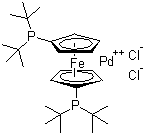 |
| Molecular Formula | C26H44Cl2FeP2Pd |
| Molecular Weight | 651.75 |
| CAS Registry Number | 95408-45-0 |
| EC Number | 664-483-5 |
| SMILES | CC(C)(C)P(C1=CC=C[CH-]1)C(C)(C)C.CC(C)(C)P(C1=CC=C[CH-]1)C(C)(C)C.Cl[Pd]Cl.[Fe+2] |
| Melting point | 203-208 °C |
|---|---|
| Hazard Symbols |  GHS07 Warning Details GHS07 Warning Details | ||||||||||||||||||||||||||||||||
|---|---|---|---|---|---|---|---|---|---|---|---|---|---|---|---|---|---|---|---|---|---|---|---|---|---|---|---|---|---|---|---|---|---|
| Risk Statements | H302-H312-H315-H319-H332-H335-H413 Details | ||||||||||||||||||||||||||||||||
| Safety Statements | P261-P264-P264+P265-P270-P271-P273-P280-P301+P317-P302+P352-P304+P340-P305+P351+P338-P317-P319-P321-P330-P332+P317-P337+P317-P362+P364-P403+P233-P405-P501 Details | ||||||||||||||||||||||||||||||||
| Hazard Classification | |||||||||||||||||||||||||||||||||
| |||||||||||||||||||||||||||||||||
| SDS | Available | ||||||||||||||||||||||||||||||||
 chemBlink Chemical Story
|
1,1'-Bis(di-tert-butylphosphino)ferrocene palladium dichloride, often abbreviated as Pd(dtbpf)Cl2, is a well-established organopalladium complex that plays a crucial role in modern catalytic organic synthesis. This complex is composed of a palladium center coordinated by two di-tert-butylphosphino groups and one ferrocene ligand, along with two chloride ions. It is widely recognized for its utility in a variety of palladium-catalyzed reactions, especially in cross-coupling and carbon-carbon bond formation processes. The discovery of Pd(dtbpf)Cl2 stems from the ongoing efforts in the late 20th century to develop highly effective and stable palladium catalysts for organic transformations. The di-tert-butylphosphino ligands, which are bulky and electron-donating, were incorporated into the complex to enhance the stability and reactivity of the palladium center. The ferrocene unit, a metallocene, provides an additional layer of stability and electronic tuning to the complex, making it a versatile catalyst precursor in many reactions. Pd(dtbpf)Cl2 has found broad application in various catalytic processes, particularly in the context of cross-coupling reactions, where it is used to catalyze the formation of carbon-carbon bonds. One of the most significant applications is in the Suzuki-Miyaura coupling reaction, where it catalyzes the reaction between aryl or vinyl boronic acids and aryl or vinyl halides. This reaction is widely used to synthesize biaryl compounds, which are important intermediates in the pharmaceutical, agrochemical, and materials industries. In addition to the Suzuki reaction, Pd(dtbpf)Cl2 is also effective in the Heck reaction, a type of cross-coupling that involves the reaction of aryl or vinyl halides with alkenes to form substituted alkenes. The Heck reaction is a powerful method for the synthesis of a wide variety of organic molecules, and Pd(dtbpf)Cl2’s high stability and reactivity make it an ideal catalyst for this transformation. Moreover, Pd(dtbpf)Cl2 has been utilized in other important reactions, such as the Stille coupling, where it facilitates the coupling of organotin reagents with halides, and the Sonogashira coupling, which involves the reaction of terminal alkynes with aryl or vinyl halides to form substituted alkynes. These reactions are critical in the synthesis of complex molecules, including fine chemicals, pharmaceuticals, and materials used in electronics and optoelectronics. The robustness of Pd(dtbpf)Cl2 is largely attributed to the bulky di-tert-butylphosphino ligands, which provide steric protection to the palladium center and prevent unwanted side reactions. The ferrocene unit also plays a key role in stabilizing the palladium catalyst, contributing to its effectiveness under various reaction conditions. The combination of these features enables Pd(dtbpf)Cl2 to function well in a wide range of solvents and temperatures, making it highly versatile for laboratory and industrial applications. In addition to its use in cross-coupling reactions, Pd(dtbpf)Cl2 has been employed in other catalytic processes, such as C-H activation, oxidative coupling, and asymmetric catalysis, where the palladium center facilitates the activation of bonds and the formation of new chemical structures. Its stability and reactivity have made it a valuable tool for synthetic chemists seeking to develop efficient and selective catalytic systems. In conclusion, 1,1'-Bis(di-tert-butylphosphino)ferrocene palladium dichloride is a key organopalladium complex with significant applications in catalytic organic synthesis. It is primarily used in cross-coupling reactions such as the Suzuki, Heck, and Stille reactions, where it enables the formation of carbon-carbon bonds in a variety of organic molecules. Its stability, high reactivity, and versatility make it a valuable catalyst in the synthesis of pharmaceuticals, agrochemicals, and advanced materials. Pd(dtbpf)Cl2 remains an indispensable tool for synthetic chemists, contributing to advancements in both academic research and industrial applications. References (2024). Saponin: a green and efficient natural surfactant for Suzuki-Miyaura cross-couplings of heteroaryl substrates in aqueous media at ambient conditions. Green Chemistry, 26(3). DOI: https://doi.org/10.1039/d3gc03611a (2024). Geometric deep learning-guided Suzuki reaction conditions assessment for applications in medicinal chemistry. RSC Medicinal Chemistry, 15(7). DOI: https://doi.org/10.1039/d3md00697f (2017). Regioselective synthesis of difluoroalkyl/perfluoroalkyl enones via Pd-catalyzed four-component carbonylative coupling reactions. Chemical Communications, 53(19). DOI: https://doi.org/10.1039/c6cc10230g |
| Market Analysis Reports |