
Online Database of Chemicals from Around the World
| Beijing Guofang Dingsheng Technology Co., Ltd. | China | |||
|---|---|---|---|---|
 | www.gfdschem.com | |||
 | +86 (10) 8904-9254 5909-2859 +86 18610472091 +86 18031679351 | |||
 | +86 (10) 5909-2859 | |||
 | gfdskj@163.com | |||
 | QQ Chat | |||
| Chemical manufacturer since 2012 | ||||
| chemBlink Standard supplier since 2016 | ||||
| Wu Han Taiyu Kaishang Technology Co., Ltd. | China | |||
|---|---|---|---|---|
| www.taiyuchem.com | |||
| +86 13657232893 | |||
| 13657232893@163.com | |||
 | WhatsApp:+86 13657232893 | |||
| Chemical manufacturer since 2018 | ||||
| chemBlink Standard supplier since 2025 | ||||
| Classification | Organic raw materials >> Aryl compounds >> Biphenyl compounds |
|---|---|
| Name | PCy3 Pd G2 |
| Synonyms | Chloro[(tricyclohexylphosphine)-2-(2'-aminobiphenyl)]palladium(II), Tricyclohexylphosphine Pd G2; (SP-4-3)-[2'-(Amino)[1,1'-biphenyl]-2-yl]chloro(tricyclohexylphosphine)palladium |
| Molecular Structure | 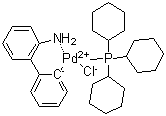 |
| Molecular Formula | C30H43ClNPPd |
| Molecular Weight | 590.52 |
| CAS Registry Number | 1353658-81-7 |
| SMILES | C1CCC(P(C2CCCCC2)C2CCCCC2)CC1.Nc1ccccc1-c1ccccc1[Pd]Cl |
| Melting point | 244-246 °C (Expl.) |
|---|---|
| Hazard Symbols |  GHS07 Warning Details GHS07 Warning Details |
|---|---|
| Risk Statements | H315-H319-H335 Details |
| Safety Statements | P261-P305+P351+P338 Details |
| SDS | Available |
 chemBlink Chemical Story
|
PCy3 Pd G2, also known as tris(cyclohexyl)phosphine palladium(II) acetate, is a palladium-based catalyst complex that has found significant application in organic synthesis, particularly in catalytic reactions such as cross-coupling reactions, including the Heck and Suzuki reactions. The complex consists of a palladium(II) center coordinated to a tris(cyclohexyl)phosphine (PCy3) ligand, which serves to stabilize the metal center and provide the necessary steric and electronic properties to facilitate catalytic transformations. The development of PCy3 Pd G2 was part of a broader effort to improve the efficiency and selectivity of palladium-catalyzed reactions. The use of phosphine ligands, especially bulky ones like PCy3, was recognized as a way to increase the catalyst's stability and control the reaction pathway by influencing the electronic properties of the palladium center. The introduction of the cyclohexyl groups in PCy3 provides steric protection around the palladium atom, which enhances the catalyst's ability to undergo certain types of reactions while minimizing side reactions. One of the most important applications of PCy3 Pd G2 is in the field of cross-coupling chemistry. In particular, this complex is widely used in the Suzuki-Miyaura and Heck coupling reactions, which are key methods for forming carbon-carbon bonds. The Suzuki reaction involves the coupling of an aryl or vinyl boronic acid with an aryl or vinyl halide in the presence of a palladium catalyst, producing biaryl or polyaryl compounds. The Heck reaction, on the other hand, involves the coupling of an aryl halide with an alkene, forming styrene derivatives or other vinyl-substituted products. The application of PCy3 Pd G2 in these reactions has allowed for greater versatility and efficiency in the formation of carbon-carbon bonds. For example, in the Suzuki reaction, the use of this catalyst complex has been shown to improve yields, reduce by-products, and extend the scope of substrates that can be used, including those that are more challenging in traditional catalytic systems. Similarly, in the Heck reaction, the steric bulk of the PCy3 ligand contributes to better regioselectivity and fewer side reactions, which is particularly important when working with sensitive or complex substrates. In addition to cross-coupling reactions, PCy3 Pd G2 has also been used in other catalytic processes, such as in the carbonylation of aryl halides. The ability to carry out these reactions under mild conditions, with good tolerance to various functional groups, has made PCy3 Pd G2 a valuable catalyst in the synthesis of complex molecules, including pharmaceuticals, agrochemicals, and specialty materials. Another key feature of PCy3 Pd G2 is its stability. The use of bulky phosphine ligands like PCy3 contributes to the overall stability of the palladium complex, which is essential for its reusability in catalytic processes. This stability makes the complex more practical for large-scale applications, where catalyst recovery and reusability are important considerations. Overall, PCy3 Pd G2 represents a significant advancement in palladium-catalyzed reactions, particularly in the field of cross-coupling chemistry. Its versatility, stability, and ability to promote selective reactions under mild conditions have made it a widely used catalyst in both academic research and industrial applications. Its contributions to synthetic chemistry, especially in the efficient formation of carbon-carbon bonds, continue to be of great importance in the development of new materials and active pharmaceutical ingredients. |
| Market Analysis Reports |