
Online Database of Chemicals from Around the World
| Tianjin Zhongxin Chem-tech Co., Ltd. | China | |||
|---|---|---|---|---|
 | www.tjzxchem.com | |||
 | +86 (22) 6688-0623 | |||
 | +86 (22) 8988-0739 ex 8030 | |||
 | sales@tjzxchem.com | |||
| Chemical manufacturer since 2007 | ||||
| chemBlink Premium supplier since 2009 | ||||
| Classification | Organic raw materials >> Inorganic acid ester |
|---|---|
| Name | Tris(1-chloro-2-propyl) phosphate |
| Synonyms | Phosphoric acid tris(2-chloro-1-methylethyl) ester |
| Molecular Structure | 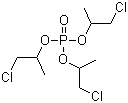 |
| Molecular Formula | C9H18Cl3O4P |
| Molecular Weight | 327.57 |
| CAS Registry Number | 13674-84-5 |
| EC Number | 237-158-7 |
| SMILES | CC(CCl)OP(=O)(OC(C)CCl)OC(C)CCl |
| Water solubility | <0.1 g/100 mL at 19.5 °C |
|---|---|
| Hazard Symbols |  GHS07 Warning Details GHS07 Warning Details | ||||||||||||||||||||||||
|---|---|---|---|---|---|---|---|---|---|---|---|---|---|---|---|---|---|---|---|---|---|---|---|---|---|
| Risk Statements | H302-H412 Details | ||||||||||||||||||||||||
| Safety Statements | P264-P270-P273-P301+P312-P330-P501 Details | ||||||||||||||||||||||||
| Hazard Classification | |||||||||||||||||||||||||
| |||||||||||||||||||||||||
| SDS | Available | ||||||||||||||||||||||||
 chemBlink Chemical Story
|
Tris(1-chloro-2-propyl) phosphate, often abbreviated as TCPP, is a chemical compound widely recognized for its role as a flame retardant. This substance is characterized by its phosphate ester structure, with three 1-chloro-2-propyl groups attached to a central phosphorus atom. The compound's chemical formulation makes it an effective agent in enhancing the fire resistance of various materials. The discovery of TCPP dates back to research on phosphorus-containing flame retardants conducted in the mid-20th century. Scientists were exploring ways to improve the flame resistance of materials, particularly in response to increasing fire safety regulations and the demand for safer consumer products. TCPP emerged as a notable compound due to its ability to provide effective flame retardancy while being relatively stable and versatile in application. TCPP is primarily used as a flame retardant in a range of materials, including plastics, textiles, and coatings. Its mechanism of action involves the release of phosphoric acid when exposed to high temperatures. This acid forms a protective layer on the surface of the material, which helps to inhibit the spread of flames and reduce the release of flammable gases. This property is particularly valuable in applications where fire safety is a critical concern. In the plastics industry, TCPP is added to polymers to enhance their fire resistance. It is used in various types of plastics, including polyurethane foams, which are commonly employed in furniture and insulation materials. The compound's effectiveness in preventing or slowing down the combustion of these materials makes it an essential component in improving the safety of consumer products. In addition to plastics, TCPP is also used in textiles and coatings. It is incorporated into fabrics to improve their flame resistance, which is especially important in applications such as upholstery and protective clothing. The compound's ability to maintain its flame retardant properties over time contributes to the durability and safety of treated textiles. Despite its advantages, there are environmental and health concerns associated with TCPP. Research has shown that, like many flame retardants, TCPP can be persistent in the environment and may have potential health effects. As a result, there is ongoing research into its safety profile and efforts to develop alternatives with improved environmental and health considerations. Overall, Tris(1-chloro-2-propyl) phosphate is a significant chemical compound used primarily as a flame retardant in various applications. Its role in enhancing fire safety in materials underscores its importance in both industrial and consumer products. References 1991. Multispectral Identification of Alkyl and Chloroalkyl Phosphates from an Industrial Effluent. Journal of the American Society for Mass Spectrometry, 2(5). DOI: 10.1016/1044-0305(91)85008-t 2024. A critical review of wastewater-based epidemiology as a tool to evaluate the unintentional human exposure to potentially harmful chemicals. Analytical and Bioanalytical Chemistry, 416(24). DOI: 10.1007/s00216-024-05596-z 2009. Determination of organophosphate flame retardants in sediments by microwave-assisted extraction and gas chromatography-mass spectrometry with electron impact and chemical ionization. Analytical and Bioanalytical Chemistry, 395(6). DOI: 10.1007/s00216-009-3139-4 |
| Market Analysis Reports |