
Online Database of Chemicals from Around the World
| Shanghai Worldyang Chemical Co., Ltd. | China | |||
|---|---|---|---|---|
 | www.worldyachem.com | |||
 | +86 13651600618 +86 (21) 5679-5779 | |||
 | +86 (21) 5679-5266 | |||
 | sales7777@worldyachem.com | |||
 | QQ Chat | |||
 | WeChat: 13651600618 | |||
 | WhatsApp:+86 13651600618 | |||
| Chemical manufacturer since 2012 | ||||
| Classification | Organic raw materials >> Heterocyclic compound >> Indoles |
|---|---|
| Name | 2-(2,6-Dioxopiperidin-3-yl)-5,6-difluoroisoindoline-1,3-dione |
| Molecular Structure | 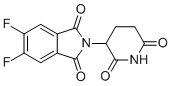 |
| Molecular Formula | C13H8F2N2O4 |
| Molecular Weight | 294.21 |
| CAS Registry Number | 1496997-41-1 |
| EC Number | 868-656-8 |
| SMILES | C1CC(=O)NC(=O)C1N2C(=O)C3=CC(=C(C=C3C2=O)F)F |
| Density | 1.6±0.1 g/cm3, Calc.* |
|---|---|
| Index of Refraction | 1.609, Calc.* |
| Boiling Point | 534.6±50.0 °C (760 mmHg), Calc.* |
| Flash Point | 277.1±30.1 °C, Calc.* |
| * | Calculated using Advanced Chemistry Development (ACD/Labs) Software. |
| Hazard Symbols |  GHS07 Warning Details GHS07 Warning Details | ||||||||||||||||||||
|---|---|---|---|---|---|---|---|---|---|---|---|---|---|---|---|---|---|---|---|---|---|
| Risk Statements | H302-H315-H319-H335 Details | ||||||||||||||||||||
| Safety Statements | P261-P264-P270-P271-P280-P301+P312-P302+P352-P304+P340-P305+P351+P338-P330-P332+P313-P337+P313-P362-P403+P233-P405-P501 Details | ||||||||||||||||||||
| Hazard Classification | |||||||||||||||||||||
| |||||||||||||||||||||
| SDS | Available | ||||||||||||||||||||
 chemBlink Chemical Story
|
2-(2,6-Dioxopiperidin-3-yl)-5,6-difluoroisoindoline-1,3-dione is an interesting compound in medicinal chemistry and drug development. This molecule, often abbreviated as difluoroisoindolinedione (DFID), has a unique structure. The discovery of DFID stems from the development of isoindolinedione derivatives with improved pharmacological properties. The compound has a piperidine ring and a difluoro-substituted isoindolinedione core. The difluoro groups at the 5- and 6-positions of the isoindoline ring enhance the stability and reactivity of the compound, making it suitable for a variety of applications. The 2,6-dioxopiperidinyl group introduces additional functionality, allowing for a variety of chemical interactions and modifications. DFID is synthesized via a multistep organic process involving cyclization to form the isoindoline core, followed by fluorination and addition of the dioxopiperidinyl group. This synthetic route highlights the complexity of the compound and the precision required for modern organic synthesis. The difluoro group imparts chemical stability and increases the lipophilicity of the molecule, enhancing its ability to cross biological membranes. DFID is presented as a crystalline solid with remarkable reactivity, suitable for further derivatization and functionalization. DFID is an important scaffold in drug design. Its structure provides multiple sites for chemical modification, enabling the creation of analogs and derivatives with improved therapeutic properties. Researchers have used DFID to design compounds against a variety of diseases, including cancer and inflammatory diseases. Its ability to interact with a variety of biological targets makes it a key component in the development of new drugs. The molecule is used to develop enzyme inhibitors. Its rigid structure and the presence of a dioxopiperidinyl group enable DFID derivatives to bind effectively to enzyme active sites. This property is particularly useful in designing inhibitors of proteases and other enzymes involved in disease pathways, providing potential treatments for diseases such as cancer and viral infections. DFID derivatives show potential as anticancer agents. They can interfere with cellular processes that are critical for tumor growth and survival, such as cell cycle regulation and apoptosis. The difluoro group enhances the ability of the compounds to interact with biological targets, improving their efficacy against cancer cells. Research on these derivatives focuses on optimizing their activity and minimizing side effects to develop effective cancer therapies. DFID is used as an intermediate in organic synthesis. Its reactive difluoroisoindolinedione core facilitates a variety of chemical transformations, making it useful for building complex molecules. Chemists exploit the reactivity and stability of its structure to develop drugs and other high-value compounds. The compound can serve as a building block for the synthesis of complex molecules, including natural product analogs and bioactive compounds. Its unique structural features enable the creation of a wide variety of molecular structures, facilitating advances in synthetic chemistry and drug discovery. The current study explores the potential of DFID for the development of new therapeutics and for expanding its use in chemical synthesis. The focus is on understanding its interactions with biological targets and optimizing its properties for specific applications. This research aims to leverage the versatility of DFID to address unmet medical needs and formulate innovative chemical solutions. |
| Market Analysis Reports |