
Online Database of Chemicals from Around the World
| Shanghai Worldyang Chemical Co., Ltd. | China | |||
|---|---|---|---|---|
 | www.worldyachem.com | |||
 | +86 13651600618 +86 (21) 5679-5779 | |||
 | +86 (21) 5679-5266 | |||
 | sales7777@worldyachem.com | |||
 | QQ Chat | |||
 | WeChat: 13651600618 | |||
 | WhatsApp:+86 13651600618 | |||
| Chemical manufacturer since 2012 | ||||
| Classification | Organic raw materials >> Heterocyclic compound >> Indoles |
|---|---|
| Name | 2-(2,6-Dioxopiperidin-3-yl)-5-fluoroisoindoline-1,3-dione |
| Molecular Structure | 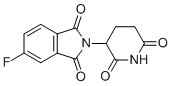 |
| Molecular Formula | C13H9FN2O4 |
| Molecular Weight | 276.22 |
| CAS Registry Number | 835616-61-0 |
| EC Number | 831-704-3 |
| SMILES | C1CC(=O)NC(=O)C1N2C(=O)C3=C(C2=O)C=C(C=C3)F |
| Hazard Symbols |    GHS06;GHS07;GHS08 Danger Details GHS06;GHS07;GHS08 Danger Details | ||||||||||||||||||||||||||||||||||||
|---|---|---|---|---|---|---|---|---|---|---|---|---|---|---|---|---|---|---|---|---|---|---|---|---|---|---|---|---|---|---|---|---|---|---|---|---|---|
| Risk Statements | H301-H302-H312-H315-H319-H332-H335-H361 Details | ||||||||||||||||||||||||||||||||||||
| Safety Statements | P203-P261-P264-P264+P265-P270-P271-P280-P301+P316-P301+P317-P302+P352-P304+P340-P305+P351+P338-P317-P318-P319-P321-P330-P332+P317-P337+P317-P362+P364-P403+P233-P405-P501 Details | ||||||||||||||||||||||||||||||||||||
| Hazard Classification | |||||||||||||||||||||||||||||||||||||
| |||||||||||||||||||||||||||||||||||||
| SDS | Available | ||||||||||||||||||||||||||||||||||||
 chemBlink Chemical Story
|
2-(2,6-dioxopiperidin-3-yl)-5-fluoroisoindoline-1,3-dione, commonly known as 5-fluoro lenalidomide, is a synthetic compound. The development of 5-fluoro lenalidomide built on the success of thalidomide and its analog lenalidomide. Thalidomide was originally developed in the 1950s and was later found to have immunomodulatory and antiangiogenic properties, although it has well-known teratogenic effects. Researchers synthesized lenalidomide to improve safety and efficacy. Subsequently, 5-fluoro lenalidomide was developed with modifications designed to enhance anticancer activity and reduce side effects. The introduction of fluorine atoms in the isoindoline ring was a strategic move to improve the biological potency and metabolic stability of the compound. The chemical structure of 5-fluoro lenalidomide consists of 2,6-dioxopiperidin-3-yl linked to 5-fluoroisoindoline-1,3-dione. 5-Fluorine lenalidomide exerts its effects through multiple mechanisms: it modulates the immune system by promoting T-cell activation and enhancing the activity of natural killer (NK) cells. This results in a more robust immune response against cancer cells; the compound inhibits the formation of new blood vessels that supply nutrients to tumors, thereby starving cancer cells and inhibiting tumor growth; and it directly affects cancer cell proliferation by inducing apoptosis (programmed cell death) and arresting cell cycle progression. 5-Fluorine lenalidomide is particularly effective in treating multiple myeloma, a type of blood cancer. It can be used alone or in combination with other drugs to enhance the efficacy of treatment, reduce tumor burden, and prolong patient survival. The compound has been intensively studied for its potential in treating various lymphomas, where its immunomodulatory effects can help control cancer progression and improve patient outcomes. Studies are currently underway to evaluate its use in leukemias, particularly when standard treatments have failed. Its ability to modulate immune responses and induce cancer cell death offers a promising avenue for treatment. Due to its immunomodulatory properties, 5-Fluorine lenalidomide is used to treat autoimmune diseases. By modulating immune activity, it helps reduce inflammation and control autoimmune responses in diseases such as systemic lupus erythematosus (SLE) and rheumatoid arthritis. Its role in regulating cytokine production and immune cell function makes it a candidate for the treatment of chronic inflammatory diseases, where excessive immune activation leads to tissue damage and disease progression. 5-Fluorenalidomide is a lead compound in drug discovery efforts aimed at developing new immunomodulatory and anticancer drugs. Its structure provides insights into the design of molecules with enhanced efficacy and reduced side effects. It has also been used to study the mechanisms underlying immunomodulation and cancer cell death, helping to understand the complex biological processes involved in disease. References 2018. Plasticity in binding confers selectivity in ligand induced protein degradation. Nature Chemical Biology, 14(7). DOI: 10.1038/s41589-018-0055-y 2023. Proteolysis-targeting chimeras with reduced off-targets. Nature Chemistry, 16(3). DOI: 10.1038/s41557-023-01379-8 |
| Market Analysis Reports |