
Online Database of Chemicals from Around the World
| BrightGene Bio-medical Technology Co., Ltd. | China | |||
|---|---|---|---|---|
 | www.bright-gene.com | |||
 | +86 (512) 6255-1801 6255-1767 +86 13812696362 | |||
 | +86 (512) 6255-1799 | |||
 | kevinwan@bright-gene.com kevinwan0203@gmail.com | |||
 | QQ Chat | |||
 | Skype Chat | |||
| Chemical manufacturer since 2001 | ||||
| chemBlink Standard supplier since 2009 | ||||
| BOC Sciences | USA | |||
|---|---|---|---|---|
| www.bocsci.com | |||
| +1 (631) 485-4226 | |||
| +1 (631) 614-7828 | |||
| info@bocsci.com | |||
| Chemical manufacturer | ||||
| chemBlink Standard supplier since 2010 | ||||
| Hangzhou Leap Chem Co., Ltd. | China | |||
|---|---|---|---|---|
| www.leapchem.com | |||
| +86 (571) 8771-1850 | |||
| market19@leapchem.com | |||
| QQ Chat | |||
| Chemical manufacturer since 2006 | ||||
| chemBlink Standard supplier since 2015 | ||||
| Classification | API >> Synthetic anti-infective drugs >> Antiviral drugs |
|---|---|
| Name | Emodepside |
| Synonyms | Cyclo[D-2-hydroxypropanoyl-N-methyl-L-leucyl-3-[4-(4-morpholinyl)phenyl]-D-2-hydroxypropanoyl-N-methyl-L-leucyl-D-2-hydroxypropanoyl-N-methyl-L-leucyl-3-[4-(4-morpholinyl)phenyl]-D-2-hydroxypropanoyl-N-methyl-L-leucyl]; PF 1022-221 |
| Molecular Structure | 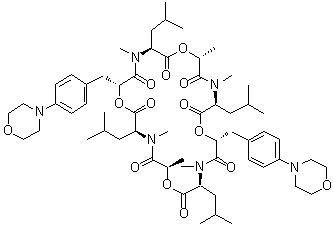 |
| Molecular Formula | C60H90N6O14 |
| Molecular Weight | 1119.39 |
| CAS Registry Number | 155030-63-0 |
| EC Number | 604-993-7 |
| SMILES | C[C@@H]1C(=O)N([C@H](C(=O)O[C@@H](C(=O)N([C@H](C(=O)O[C@@H](C(=O)N([C@H](C(=O)O[C@@H](C(=O)N([C@H](C(=O)O1)CC(C)C)C)CC2=CC=C(C=C2)N3CCOCC3)CC(C)C)C)C)CC(C)C)C)CC4=CC=C(C=C4)N5CCOCC5)CC(C)C)C |
| Solubility | Freely soluble (410 g/L) (25 °C), Calc.* |
|---|---|
| Density | 1.104±0.06 g/cm3 (20 °C 760 Torr), Calc.* |
| Boiling point | 1219.3±65.0 °C 760 mmHg (Calc.)* |
| Flash point | 691.2±34.3 °C (Calc.)* |
| Index of refraction | 1.504 (Calc.)* |
| * | Calculated using Advanced Chemistry Development (ACD/Labs) Software. |
| Hazard Symbols |    GHS07;GHS08;GHS09 Danger Details GHS07;GHS08;GHS09 Danger Details | ||||||||||||||||||||
|---|---|---|---|---|---|---|---|---|---|---|---|---|---|---|---|---|---|---|---|---|---|
| Risk Statements | H302-H372-H400-H410 Details | ||||||||||||||||||||
| Safety Statements | P260-P264-P270-P273-P301+P317-P319-P330-P391-P501 Details | ||||||||||||||||||||
| Hazard Classification | |||||||||||||||||||||
| |||||||||||||||||||||
| SDS | Available | ||||||||||||||||||||
 chemBlink Chemical Story
|
Emodepside is a semi-synthetic anthelmintic compound derived from the natural cyclooctadepsipeptide PF1022A, which is produced by the fungus *Mycelia sterilia*. Emodepside belongs to the class of cyclic depsipeptides, characterized by a macrocyclic ring structure containing both amino acid and hydroxy acid residues linked by amide and ester bonds, respectively. This compound was developed for the treatment of parasitic nematode infections and has shown efficacy against a broad range of gastrointestinal and tissue-dwelling nematodes in both veterinary and human medicine. The discovery of emodepside can be traced back to efforts in the 1990s to explore fungal secondary metabolites with antiparasitic activity. PF1022A, isolated from fungal cultures, exhibited potent nematocidal activity but lacked optimal pharmacological properties for use in animals. Chemical modifications of PF1022A led to the synthesis of emodepside, which retained the broad-spectrum anthelmintic effects while demonstrating improved bioavailability and stability. Its commercial introduction was marked by the development of veterinary formulations, particularly in combination with praziquantel, for use in cats and dogs. Emodepside operates via a novel mode of action distinct from traditional anthelmintics. It acts on specific presynaptic latrophilin-like G protein-coupled receptors (GPCRs) in nematodes, believed to be homologous to mammalian latrophilins. Binding to these receptors initiates a signaling cascade that leads to the activation of downstream ion channels, particularly SLO-1, a calcium-activated potassium channel. Activation of SLO-1 results in potassium efflux and hyperpolarization of nerve and muscle cells, leading to paralysis and death of the nematode. This unique mechanism makes emodepside effective against parasites that are resistant to other anthelmintic drug classes such as benzimidazoles, macrocyclic lactones, and imidazothiazoles. Emodepside is particularly effective against both larval and adult stages of several parasitic nematodes, including *Toxocara cati*, *Ancylostoma tubaeforme*, and *Dirofilaria immitis*. Studies have also shown its efficacy against *Onchocerca* species and other filarial parasites, supporting its potential use in human filariasis. The compound is typically administered topically in veterinary applications, where it is absorbed through the skin and exerts systemic effects. Ongoing research into emodepside includes its development for human medicine, particularly for the treatment of onchocerciasis (river blindness) and other neglected tropical diseases. Clinical trials are investigating its safety and efficacy in humans, and the results thus far have shown promise in reducing microfilarial loads and interrupting transmission cycles of filarial worms. The structural complexity of emodepside, which includes two cyclic peptide rings connected by a linker and adorned with lipophilic side chains, presents challenges in synthesis and formulation. However, its stability and potency have made it a focus of both academic and industrial research. The specificity of its action on nematode neuromuscular function and the absence of mammalian SLO-1 sensitivity contribute to its favorable safety profile. Emodepside represents a significant advancement in the treatment of parasitic nematode infections, particularly in the context of growing resistance to established anthelmintics. Its novel mechanism of action and broad-spectrum efficacy highlight its importance in both veterinary practice and global public health initiatives targeting helminthiasis. References 2001. Activity of the cyclic depsipeptide emodepside (BAY 44-4400) against larval and adult stages of nematodes in rodents and the influence on worm survival. Parasitology Research, 87(11). DOI: 10.1007/s004360100479 2005. Efficacy of two cyclooctadepsipeptides, PF1022A and emodepside, against anthelmintic-resistant nematodes in sheep and cattle. Parasitology, 130(3). DOI: 10.1017/s0031182004006523 2023. Emodepside for Trichuris trichiura and Hookworm Infection. The New England Journal of Medicine, 388(20). DOI: 10.1056/nejmoa2212825 |
| Market Analysis Reports |