
Online Database of Chemicals from Around the World
| HBCChem, Inc. | USA | |||
|---|---|---|---|---|
 | www.hbcchem-inc.com | |||
 | +1 (510) 219-6317 | |||
 | +1 (510) 675-0318 | |||
 | sales@hbcchem-inc.com | |||
| Chemical manufacturer | ||||
| chemBlink Standard supplier since 2008 | ||||
| Intatrade Chemicals GmbH | Germany | |||
|---|---|---|---|---|
| www.intatrade.de | |||
| +49 (3493) 605-465 | |||
| +49 (3493) 605-470 | |||
| sales@intatrade.de | |||
| Chemical distributor | ||||
| chemBlink Standard supplier since 2011 | ||||
| Hangzhou Leap Chem Co., Ltd. | China | |||
|---|---|---|---|---|
| www.leapchem.com | |||
| +86 (571) 8771-1850 | |||
| market19@leapchem.com | |||
 | QQ Chat | |||
| Chemical manufacturer since 2006 | ||||
| chemBlink Standard supplier since 2015 | ||||
| Finetech Industry Limited | China | |||
|---|---|---|---|---|
| www.finetechchem.com | |||
| +86 (27) 8746-5837 +86 18971612321 | |||
| +86 (27) 8777-2287 | |||
| sales@finetechnology-ind.com | |||
| QQ Chat | |||
| Chemical manufacturer since 2009 | ||||
| chemBlink Standard supplier since 2019 | ||||
| Hubei Marvel-bio Medicine Co., Ltd. | China | |||
|---|---|---|---|---|
| www.marvel-bio.com | |||
| +86 (027) 8773-8507 | |||
| maoerwo123@163.com | |||
| QQ Chat | |||
 | WeChat: kangbao813 | |||
| Chemical manufacturer since 2016 | ||||
| chemBlink Standard supplier since 2025 | ||||
| Shanghai Worldyang Chemical Co., Ltd. | China | |||
|---|---|---|---|---|
| www.worldyachem.com | |||
| +86 13651600618 +86 (21) 5679-5779 | |||
| +86 (21) 5679-5266 | |||
| sales7777@worldyachem.com | |||
| QQ Chat | |||
| WeChat: 13651600618 | |||
 | WhatsApp:+86 13651600618 | |||
| Chemical manufacturer since 2012 | ||||
| Classification | Chemical reagent >> Organic reagent >> Carboxylic anhydride |
|---|---|
| Name | 1,6,7,12-Tetrachloroperylene tetracarboxylic acid dianhydride |
| Synonyms | 11,14,22,26-tetrachloro-7,18-dioxaheptacyclo[14.6.2.22,5.03,12.04,9.013,23.020,24]hexacosa-1(22),2(26),3,5(25),9,11,13,15,20,23-decaene-6,8,17,19-tetrone |
| Molecular Structure | 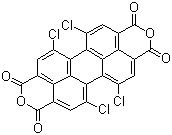 |
| Molecular Formula | C24H4Cl4O6 |
| Molecular Weight | 530.10 |
| CAS Registry Number | 156028-26-1 |
| EC Number | 692-562-4 |
| SMILES | C1=C2C3=C4C(=C1Cl)C5=C(C=C6C7=C5C(=C(C=C7C(=O)OC6=O)Cl)C4=C(C=C3C(=O)OC2=O)Cl)Cl |
| Density | 2.0±0.1 g/cm3 Calc.* |
|---|---|
| Boiling point | 757.1±55.0 °C 760 mmHg (Calc.)* |
| Flash point | 287.5±30.5 °C (Calc.)* |
| Index of refraction | 1.932 (Calc.)* |
| * | Calculated using Advanced Chemistry Development (ACD/Labs) Software. |
| Hazard Symbols |  GHS07 Warning Details GHS07 Warning Details |
|---|---|
| Risk Statements | H315-H319-H335 Details |
| Safety Statements | P261-P264-P264+P265-P271-P280-P302+P352-P304+P340-P305+P351+P338-P319-P321-P332+P317-P337+P317-P362+P364-P403+P233-P405-P501 Details |
| SDS | Available |
 chemBlink Chemical Story
|
1,6,7,12‑Tetrachloroperylene tetracarboxylic acid dianhydride is a polycyclic aromatic compound that belongs to the family of perylene derivatives. Its molecular formula is C24Cl4O6. Structurally, it consists of a perylene core substituted with chlorine atoms at the 1,6,7, and 12 positions and flanked by two anhydride groups at the perylene periphery. The presence of both electron-withdrawing chlorine atoms and reactive anhydride functionalities gives this compound distinctive chemical and physical properties, including strong π‑π stacking interactions, thermal stability, and electron-accepting behavior. The compound typically appears as a dark red crystalline solid and exhibits very low solubility in water but good solubility in polar aprotic solvents such as dimethylformamide or chloroform. The discovery of tetrachlorinated perylene dianhydrides stems from research into perylene tetracarboxylic acid derivatives, which have been extensively studied as dyes, pigments, and organic semiconductors. The introduction of chlorine substituents at selected positions on the perylene core modifies the electronic structure, enhancing the electron-withdrawing character and altering the photophysical properties. This makes 1,6,7,12‑tetrachloroperylene tetracarboxylic acid dianhydride suitable for applications requiring high stability, strong light absorption, and tunable electronic properties. The combination of anhydride groups and halogen substituents allows for selective functionalization, enabling its use as an intermediate in organic synthesis. Synthesis of 1,6,7,12‑tetrachloroperylene tetracarboxylic acid dianhydride typically begins with perylene tetracarboxylic dianhydride, which is chlorinated at the 1,6,7, and 12 positions using reagents such as chlorine gas, N-chlorosuccinimide, or other chlorinating agents under controlled conditions. Reaction temperature and stoichiometry are carefully managed to achieve selective tetra-substitution while avoiding over-chlorination or decomposition of the dianhydride functionality. The resulting compound is purified by recrystallization or chromatography to obtain the highly pure tetrachlorinated product. Chemically, the dianhydride groups of 1,6,7,12‑tetrachloroperylene tetracarboxylic acid dianhydride can react with nucleophiles such as amines or alcohols to form imides or esters, enabling the preparation of functionalized perylene derivatives. These reactions are typically performed under high-temperature or catalytic conditions and allow the design of perylene-based dyes, pigments, and organic semiconductor materials. The chlorine substituents influence both the reactivity and the electronic properties of the resulting derivatives, making them suitable for use in optoelectronic devices, including organic photovoltaics, light-emitting diodes, and field-effect transistors. 1,6,7,12‑Tetrachloroperylene tetracarboxylic acid dianhydride is particularly valued in materials chemistry for its ability to form highly ordered crystalline structures through π‑π stacking. This property contributes to high thermal and chemical stability in thin films and coatings. Functionalization of the anhydride groups allows attachment of solubilizing side chains or electron-donating/withdrawing substituents, which further tunes the optical and electronic properties of the material. The combination of rigidity, planarity, and electronic modulation has made chlorinated perylene dianhydrides key components in the design of high-performance organic electronic materials. From a safety perspective, this compound is chemically stable under ambient conditions but should be handled with care to avoid inhalation of dust or contact with skin and eyes. Solvent handling precautions are required, as the compound is typically processed in organic solvents. It is generally non-volatile, and thermal decomposition occurs only at high temperatures. Overall, 1,6,7,12‑tetrachloroperylene tetracarboxylic acid dianhydride is a highly functionalized polycyclic aromatic dianhydride that serves as a versatile intermediate in dye chemistry, pigment preparation, and organic electronics. Its combination of tetra-chlorination and reactive anhydride groups allows selective derivatization, making it useful for creating advanced materials with tunable electronic, optical, and structural properties. The chemical stability, π‑stacking ability, and reactivity of the anhydride groups continue to support applications in high-performance functional materials and research in organic semiconductor design. References 2024. Synthesis and Properties Study of PESF-b-PBIT White Fluorescent Copolyesters. Arabian Journal for Science and Engineering. DOI: 10.1007/s13369-024-09811-y 2023. Efficient soluble PTCBI-type non-fullerene acceptor materials for organic solar cells. Frontiers of Optoelectronics. DOI: 10.1007/s12200-023-00063-6 |
| Market Analysis Reports |