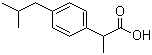
Ibuprofen is a nonsteroidal anti-inflammatory drug (NSAID) with the molecular formula C13H18O2. Since its introduction in the late 1960s, it has become one of the most widely used medicines worldwide for the relief of pain, fever, and inflammation. Its success reflects not only its pharmacological effectiveness but also a pivotal period in the evolution of modern medicinal chemistry, when pharmaceutical research increasingly emphasized the rational optimization of efficacy and safety.
The history of ibuprofen began during the 1950s at The Boots Company in Nottingham, England. At that time, aspirin remained the dominant anti-inflammatory drug, but long-term therapy for chronic diseases such as rheumatoid arthritis was frequently limited by gastrointestinal irritation and other adverse effects. Boots established a research program to identify safer alternatives while preserving the beneficial anti-inflammatory properties of existing therapies. Led by Stewart Adams and his colleagues, the team synthesized and evaluated hundreds of compounds before identifying ibuprofen as a particularly promising candidate.
Ibuprofen was patented in the early 1960s and first approved in the United Kingdom in 1969 for the treatment of rheumatoid arthritis. Clinical experience soon demonstrated that it combined effective analgesic and anti-inflammatory activity with a favorable safety profile at recommended doses. During the following decades, regulatory approval expanded to many countries, and ibuprofen became one of the first modern NSAIDs to achieve widespread global acceptance.
An important milestone in understanding ibuprofen occurred after its introduction. In 1971, John R. Vane demonstrated that aspirin-like drugs exert their effects by inhibiting prostaglandin synthesis, work that earned the 1982 Nobel Prize in Physiology or Medicine. Subsequent research established that ibuprofen acts through reversible inhibition of cyclooxygenase (COX-1 and COX-2), reducing the production of prostaglandins that mediate pain, inflammation, and fever. This mechanistic insight transformed the scientific understanding of NSAIDs and guided the development of later anti-inflammatory drugs.
The public-health impact of ibuprofen increased further when many countries approved lower-dose formulations for over-the-counter (OTC) sale. Consumers gained convenient access to an effective analgesic for common conditions such as headache, musculoskeletal pain, dental pain, dysmenorrhea, and fever. The availability of ibuprofen without prescription contributed significantly to modern self-care while reinforcing the importance of appropriate dosing and awareness of contraindications.
Commercial production has also illustrated advances in pharmaceutical manufacturing. Early synthetic routes required several reaction steps and generated significant waste. Continued research led to more efficient catalytic processes, including the BHC process developed by the Boots-Hoechst-Celanese partnership, which greatly improved atom economy and reduced by-products. This manufacturing innovation became a celebrated example of greener industrial chemistry and is frequently cited in discussions of sustainable pharmaceutical production.
Today, ibuprofen remains one of the most extensively used medicines in the world and appears on the World Health Organization Model List of Essential Medicines. Beyond its clinical applications, it continues to serve as a model compound in pharmaceutical research involving chiral chemistry, crystal engineering, drug formulation, and process development. Because ibuprofen contains a chiral center, studies of its stereochemistry have also contributed to understanding enantiomeric activity and metabolic inversion in drug action.
The development of ibuprofen demonstrates how advances in medicinal chemistry, clinical pharmacology, and industrial process engineering can converge to produce a medicine with lasting global impact. From a search for a safer alternative to aspirin to its position as one of the world's most familiar analgesics, ibuprofen has become a landmark in the history of modern pharmaceutical science.
**References**
1. Adams, S.S. (1992) 'The propionic acids: A personal perspective', *Journal of Clinical Pharmacology*, 32(Suppl.), pp. 317S–323S.
2. Vane, J.R. (1971) 'Inhibition of prostaglandin synthesis as a mechanism of action for aspirin-like drugs', *Nature New Biology*, 231, pp. 232–235.
3. Sheldon, R.A. (2000) 'Atom efficiency and catalysis in organic synthesis', *Pure and Applied Chemistry*, 72, pp. 1233–1246. (Includes discussion of the BHC ibuprofen process as an important example of green chemistry.)
|





 GHS07;GHS08 Warning Details
 chemBlink Chemical Story