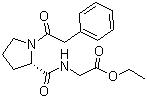
N-(1-(Phenylacetyl)-L-prolyl)glycine ethyl ester is a synthetic dipeptide-derived compound consisting of a proline–glycine peptide backbone modified at the N-terminus with a phenylacetyl group and at the C-terminal glycine with an ethyl ester. Structurally, it belongs to a class of peptide analogues in which natural amino acid sequences are chemically modified to alter stability, lipophilicity, and metabolic properties.
The core of the molecule is based on a prolyl–glycine dipeptide framework. Proline is a cyclic imino acid whose rigid pyrrolidine ring introduces conformational constraints into peptide structures, often influencing folding and molecular recognition. Glycine, being the smallest amino acid, provides flexibility at the C-terminal region. Together, this combination creates a relatively compact peptide scaffold with both rigidity and flexibility in different segments.
At the N-terminus, the amino group of proline is acylated with a phenylacetyl moiety. The phenylacetyl group consists of a benzene ring connected via a methylene linker to a carbonyl group. This aromatic acyl substitution increases hydrophobicity and introduces π-electron character, which can influence interactions with hydrophobic binding pockets or membranes. The phenyl ring also contributes to steric bulk, which can affect conformational preferences of the peptide backbone.
At the C-terminal end, glycine is present as an ethyl ester rather than a free carboxylic acid. Esterification of the carboxyl group reduces ionic character under physiological conditions and generally increases membrane permeability and lipophilicity. In peptide chemistry, such esterification is commonly used to modify pharmacokinetic behavior by reducing polarity and altering metabolic stability.
The peptide bond between proline and glycine forms the central linkage of the molecule and is characterized by partial double-bond character due to resonance stabilization. This restricts rotation and contributes to defined conformational preferences. The overall conformation of the molecule is influenced by the cyclic nature of proline, the flexibility of glycine, and the steric effects of the N-terminal aromatic substituent.
From a physicochemical standpoint, the molecule contains both hydrophilic and hydrophobic elements. The peptide backbone and carbonyl groups provide polarity and hydrogen-bonding capacity, while the phenyl group and ethyl ester contribute hydrophobic character. This balance often results in moderate solubility in polar organic solvents and limited solubility in water depending on ionization state.
The compound contains multiple sites capable of hydrogen bonding, including amide carbonyls and amide NH groups (where not substituted), which can influence intermolecular interactions and aggregation behavior. However, esterification and N-acylation reduce overall ionic character compared with unmodified peptides.
Without verified literature specific to this exact compound, no claims can be made regarding biological activity, pharmacological function, or therapeutic use. Based on established structural chemistry, it can be reliably described as a phenylacetyl-modified prolyl–glycine dipeptide ethyl ester with mixed hydrophobic and polar characteristics and conformational features influenced primarily by the proline residue and amide linkages.
References
2025. Regulation of Primary Hemostasis by Peptides with Neuroprotective Effect. Neurochemical Journal.
DOI: 10.1134/s181971242570059x
2025. Neuropeptide Cyclo-Prolylglycine: Discovery, Pharmacological Effects, and Mechanism of Action. Neurochemical Journal.
DOI: 10.1134/s1819712425700606
2024. The Influence of the Low-Molecular-Weight NGF Mimetic Dipeptide GK-2 on the Behavior of Mice from Two Outbred Strains That Differ in Brain Weight. Biology Bulletin Reviews.
DOI: 10.1134/s2079086424600346
|




 GHS07 Warning Details
 chemBlink Chemical Story