
Online Database of Chemicals from Around the World
| Wuhan Kemi-works Chemical Co., Ltd. | China | |||
|---|---|---|---|---|
 | www.kemiworks.net | |||
 | +86 (27) 8573-6489 | |||
 | +86 (27) 8573-6485 | |||
 | info@kemiworks.net sales@kemiworks.com | |||
| Chemical manufacturer | ||||
| chemBlink Premium supplier since 2011 | ||||
| Classification | Pharmaceutical intermediate >> Heterocyclic compound intermediate >> Pyridine compound >> Benzylpyridine |
|---|---|
| Name | N-Benzylniacin |
| Synonyms | 1-Benzyl pyridinium-3-carboxylate; N-Benzyl nicotinate betaine; N-Benzylpyridinium-3-carboxylate; 1-Benzyl-3-carboxypyridinium hydroxide inner salt; Benzyl pyridinium 3-carboxylate; BPC-48 |
| Molecular Structure | 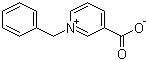 |
| Molecular Formula | C13H11NO2 |
| Molecular Weight | 213.23 |
| CAS Registry Number | 15990-43-9 |
| EC Number | 240-129-1 |
| SMILES | C1=CC=C(C=C1)C[N+]2=CC=CC(=C2)C(=O)[O-] |
| Hazard Symbols |  GHS07 Warning Details GHS07 Warning Details |
|---|---|
| Risk Statements | H302-H315-H319-H335 Details |
| Safety Statements | P261-P264-P264+P265-P270-P271-P280-P301+P317-P302+P352-P304+P340-P305+P351+P338-P319-P321-P330-P332+P317-P337+P317-P362+P364-P403+P233-P405-P501 Details |
| SDS | Available |
 chemBlink Chemical Story
|
N-Benzylniacin is a derivative of niacin (vitamin B3), where a benzyl group is attached to the nitrogen atom of the niacin molecule. This compound, with the molecular formula C13H11NO2, was first synthesized as part of ongoing efforts to explore the chemical modifications of niacin to improve its bioactivity and stability. The introduction of the benzyl group provides unique chemical properties that influence its solubility, reactivity, and potential biological activity. The synthesis of N-benzylniacin typically involves the reaction of niacin with benzyl chloride or a similar benzylating agent in the presence of a base. This straightforward method allows for the efficient formation of N-benzylniacin in good yields, making it a useful intermediate in organic synthesis. The introduction of the benzyl group enhances the lipophilicity of the molecule, which could potentially affect its absorption and distribution within biological systems. N-Benzylniacin has been studied for its potential pharmacological applications. The benzyl group can modify the interactions of the niacin molecule with cellular receptors, possibly enhancing or altering its biological effects. Niacin itself is well known for its role in lipid metabolism, where it helps to lower cholesterol levels and improve cardiovascular health. N-Benzylniacin could offer advantages over niacin in terms of its pharmacokinetics and tissue penetration due to the increased lipophilicity provided by the benzyl group. In addition to its cardiovascular applications, N-benzylniacin has been explored in the context of drug design and synthesis. The compound serves as a building block for the synthesis of more complex molecules, particularly in the development of new therapies for metabolic disorders and other conditions. Its ability to interact with specific biological targets, such as the GPR109A receptor, positions it as a potential candidate for further research in the treatment of conditions like dyslipidemia and type 2 diabetes. Moreover, N-benzylniacin has also shown promise in the field of dermatology, where niacin and its derivatives are studied for their effects on skin health. N-Benzylniacin may have potential in improving skin barrier function or as an anti-inflammatory agent, though further studies are required to establish its efficacy and safety for topical applications. In summary, N-benzylniacin is a modified derivative of niacin with promising applications in pharmacology and drug development. Its chemical properties and potential biological activities make it a valuable compound for further investigation. References 1981. Solvatochromic behaviour of intramolecular charge-transfer spectra of inorganic diimine complexes. Transition Metal Chemistry, 6(3). DOI: 10.1007/bf00624333 1981. The coordination chemistry of 2,2′-oxydibenzoic acid, 2,2′-thiobenzoic acid, 3,3′-oxydipropionic acid and 3,3′-thiodipropionic acid with selected first row transition metal ions. Transition Metal Chemistry, 6(3). DOI: 10.1007/bf00624334 2011. Effect of aromatic aldehydes on the electrodeposition of ZnCo alloy from cyanide-free alkaline-gluconate electrolytes. Journal of Applied Electrochemistry, 41(5). DOI: 10.1007/s10800-011-0279-y |
| Market Analysis Reports |