
Online Database of Chemicals from Around the World
| Zhengzhou Kingorgchem Chemical Technology Co., Ltd. | China | |||
|---|---|---|---|---|
 | www.kingorgchem.com | |||
 | +86 (371) 6551-1006 | |||
 | +86 (371) 6575-6965 | |||
 | sales@kingorgchem.com | |||
 | QQ Chat | |||
 | WeChat: 18625597674 | |||
| Chemical manufacturer since 2015 | ||||
| chemBlink Standard supplier since 2016 | ||||
| Classification | Organic raw materials >> Organometallic compound >> Organic palladium |
|---|---|
| Name | (t-Bu)PhCPhos Pd G3 |
| Synonyms | [2'-(Amino-?N)[1,1'-biphenyl]-2-yl-?C][2'-[(1,1-dimethylethyl)phenylphosphino-?P]-N2,N2,N6,N6-tetramethyl[1,1'-biphenyl]-2,6-diamine](methanesulfonato-?O)palladium |
| Molecular Structure | 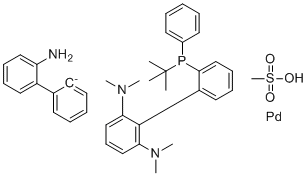 |
| Molecular Formula | C39H47N3O3PPdS- |
| Molecular Weight | 775.27 |
| CAS Registry Number | 1661042-31-4 |
| SMILES | CC(C)(C)P(C1=CC=CC=C1)C2=CC=CC=C2C3=C(C=CC=C3N(C)C)N(C)C.CS(=O)(=O)O.C1=CC=C([C-]=C1)C2=CC=CC=C2N.[Pd] |
| Hazard Symbols |  GHS07 Warning Details GHS07 Warning Details |
|---|---|
| Risk Statements | H302-H315-H319-H335 Details |
| Safety Statements | P261-P305+P351+P338 Details |
| SDS | Available |
 chemBlink Chemical Story
|
(t-Bu)PhCPhos Pd G3 is an advanced palladium complex utilized in various catalytic applications, particularly in the field of organic synthesis. This compound features the ligand (t-Bu)PhCPhos, which stands for 2-(tert-butyl)phenyl-2'-(diphenylphosphino)biphenyl. The "G3" designation indicates that this is the third generation of the (t-Bu)PhCPhos palladium system, reflecting its refined structure and enhanced performance. The (t-Bu)PhCPhos ligand is notable for its robust and versatile nature. It combines a bulky tert-butyl group with a diphenylphosphine moiety attached to a biphenyl backbone. This arrangement provides a combination of steric bulk and electronic donation that stabilizes the palladium center. The bulky tert-butyl group reduces steric hindrance around the metal center, while the diphenylphosphine groups enhance electronic interactions, facilitating catalytic activity. The development of (t-Bu)PhCPhos Pd G3 builds upon the success of earlier generations by optimizing the ligand's properties to improve catalytic performance. The third generation of this system incorporates enhancements that result in increased stability and efficiency in various catalytic reactions. One of the primary applications of (t-Bu)PhCPhos Pd G3 is in cross-coupling reactions, such as the Suzuki-Miyaura and Sonogashira couplings. These reactions are critical for forming carbon-carbon bonds, which are essential in the synthesis of complex organic molecules, including pharmaceuticals and advanced materials. The effectiveness of (t-Bu)PhCPhos Pd G3 in these reactions is due to its ability to facilitate high reaction rates and selectivities, leading to better yields. Additionally, (t-Bu)PhCPhos Pd G3 is used in other catalytic processes, including oxidative and reductive transformations. Its stability and reactivity, supported by the tailored ligand environment, allow for effective catalysis across a range of chemical transformations. The advancement to (t-Bu)PhCPhos Pd G3 highlights the significance of ligand design in optimizing catalytic efficiency. By refining the ligand's steric and electronic properties, researchers have achieved notable improvements in selectivity and reactivity, making this complex a valuable tool in both research and industrial settings. In summary, (t-Bu)PhCPhos Pd G3 is a highly effective palladium complex with significant applications in organic synthesis. Its specialized ligand system enhances catalytic performance, making it a powerful and versatile tool for a wide range of chemical reactions. |
| Market Analysis Reports |