
Online Database of Chemicals from Around the World
| Targetmol Chemicals Inc. | USA | |||
|---|---|---|---|---|
 | www.targetmol.com | |||
 | +1 (781) 999-5354 | |||
 | +1 (781) 281-9145 | |||
 | sales@targetmol.com | |||
| Chemical manufacturer since 2013 | ||||
| chemBlink Standard supplier since 2025 | ||||
| Classification | Biochemical >> Inhibitor >> Neuronal signaling >> 5-HT receptor antagonist |
|---|---|
| Name | 5-HT2 antagonist 1 |
| Synonyms | 5-[3-[4-(4-fluorophenyl)piperazin-1-yl]propyl]-8-hydroxy-1-methyl-7,8-dihydro-6H-pyrrolo[3,2-c]azepin-4-one |
| Molecular Structure | 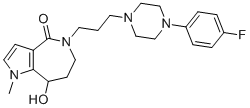 |
| Molecular Formula | C22H29FN4O2 |
| Molecular Weight | 400.49 |
| CAS Registry Number | 191592-09-3 |
| SMILES | CN1C=CC2=C1C(CCN(C2=O)CCCN3CCN(CC3)C4=CC=C(C=C4)F)O |
| Density | 1.3±0.1 g/cm3 Calc.* |
|---|---|
| Boiling point | 613.9±55.0 °C 760 mmHg (Calc.)* |
| Flash point | 325.1±31.5 °C (Calc.)* |
| Index of refraction | 1.629 (Calc.)* |
| * | Calculated using Advanced Chemistry Development (ACD/Labs) Software. |
| SDS | Available |
|---|---|
 chemBlink Chemical Story
|
5-HT2 antagonist 1 is a synthetic compound developed as a selective antagonist of the serotonin 5-hydroxytryptamine type 2 (5-HT2) receptor. The serotonin system plays an important role in modulating various physiological functions, including mood, vascular tone, and smooth muscle activity. The 5-HT2 receptor family, particularly the 5-HT2A subtype, has been studied extensively in neuropharmacology, cardiovascular physiology, and psychiatric disorders. The development of selective antagonists such as 5-HT2 antagonist 1 was aimed at providing specific tools for probing the receptor's role and identifying therapeutic avenues. The chemical structure of 5-HT2 antagonist 1 is based on a substituted pyrrolo[3,2-c]azepin-4(1H)-one core, which is modified with functional groups to enhance selectivity and receptor affinity. The molecule features a 5-[3-[4-(4-fluorophenyl)-1-piperazinyl]propyl] substitution, a characteristic often found in serotonin receptor-targeting ligands, especially those that interact with 5-HT2 subtypes. The presence of a 4-fluorophenyl group contributes to its binding affinity, and the piperazine ring structure is a common moiety found in pharmacologically active agents targeting the central nervous system. The compound also includes a tetrahydro-8-hydroxy-1-methyl configuration, providing further specificity and functional activity. The discovery of 5-HT2 antagonist 1 stemmed from efforts to improve the selectivity of serotonin receptor modulators and reduce off-target effects. Earlier compounds targeting serotonin receptors often showed poor receptor subtype selectivity, leading to unwanted pharmacological activity. Structure-activity relationship (SAR) studies were employed to identify substitutions that would retain binding affinity for the 5-HT2 receptor while minimizing activity at related receptors such as the α1-adrenergic receptor. The chemical development process involved systematic modification of lead compounds, followed by biological testing in receptor assays. The primary application of 5-HT2 antagonist 1 is as a research tool for studying serotonin-mediated physiological and pharmacological processes. Its ability to inhibit serotonin-induced responses in isolated tissues, such as vascular smooth muscle, has made it useful for dissecting the functional role of 5-HT2 receptors in contractility, vasoconstriction, and neurotransmission. In vascular pharmacology, it has been used to evaluate the contribution of 5-HT2 receptors in serotonin-induced contraction, with dose-dependent inhibition observed in experimental models. These studies have been instrumental in understanding receptor mechanisms in both central and peripheral tissues. 5-HT2 antagonist 1 has also been employed in preclinical research on psychiatric and neurological disorders, where dysregulation of the serotonin system is implicated. Its use in in vitro assays and animal models has contributed to the exploration of potential pathways involved in anxiety, depression, and psychosis. Because of its receptor selectivity, it helps distinguish the effects of 5-HT2 receptor inhibition from those of broader serotonin antagonism, providing a more precise pharmacological profile. Another area of application is in the study of drug-receptor interactions and pharmacokinetics. 5-HT2 antagonist 1 can serve as a reference compound in receptor-binding studies, allowing researchers to assess the binding affinities of new ligands relative to a known antagonist. In addition, its defined pharmacological profile makes it suitable for evaluating the selectivity of new therapeutic agents targeting the serotonin system. The compound is typically provided in research-grade purity for laboratory use. It is often stored as a lyophilized powder and dissolved in solvents such as dimethyl sulfoxide (DMSO) before application in biological systems. Standard laboratory procedures are followed to ensure the compound’s stability, solubility, and reproducibility in experimental assays. |
| Market Analysis Reports |