
Online Database of Chemicals from Around the World
| Sinocompound Catalysts Co., Ltd. | China | |||
|---|---|---|---|---|
 | www.sinocompound.com | |||
 | +86 (512) 6721-6630 | |||
 | +86 (512) 5631-6689 | |||
 | sales@sinocompound.com | |||
| Chemical manufacturer since 2008 | ||||
| chemBlink Standard supplier since 2010 | ||||
| BOC Sciences | USA | |||
|---|---|---|---|---|
| www.bocsci.com | |||
| +1 (631) 485-4226 | |||
| +1 (631) 614-7828 | |||
| info@bocsci.com | |||
| Chemical manufacturer | ||||
| chemBlink Standard supplier since 2010 | ||||
| Sigma-Aldrich, Inc. | China | |||
|---|---|---|---|---|
| www.sigmaaldrich.com | |||
| +86 (21) 6141-5566 800-819-3336 | |||
| orderCN@sial.com | |||
| Chemical manufacturer since 1992 | ||||
| chemBlink Standard supplier since 2013 | ||||
| Zhengzhou Kingorgchem Chemical Technology Co., Ltd. | China | |||
|---|---|---|---|---|
| www.kingorgchem.com | |||
| +86 (371) 6551-1006 | |||
| +86 (371) 6575-6965 | |||
| sales@kingorgchem.com | |||
 | QQ Chat | |||
 | WeChat: 18625597674 | |||
| Chemical manufacturer since 2015 | ||||
| chemBlink Standard supplier since 2016 | ||||
| Xinxiang Runyu Material Co., Ltd. | China | |||
|---|---|---|---|---|
| www.runvmat.com | |||
| +86 (373) 775-9608 | |||
| +86 (373) 775-9608 | |||
| sales@runvmat.com | |||
| QQ Chat | |||
| Chemical manufacturer since 2017 | ||||
| chemBlink Standard supplier since 2019 | ||||
| Classification | Organic raw materials >> Organic phosphine compound |
|---|---|
| Name | (S)-5,5'-Bis(diphenylphosphino)-4,4'-bibenzodioxole |
| Synonyms | (S)-Segphos; [4-(5-diphenylphosphanyl-1,3-benzodioxol-4-yl)-1,3-benzodioxol-5-yl]-diphenylphosphane |
| Molecular Structure | 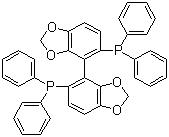 |
| Molecular Formula | C38H28O4P2 |
| Molecular Weight | 610.59 |
| CAS Registry Number | 210169-54-3 |
| EC Number | 811-741-1 |
| SMILES | C1OC2=C(O1)C(=C(C=C2)P(C3=CC=CC=C3)C4=CC=CC=C4)C5=C(C=CC6=C5OCO6)P(C7=CC=CC=C7)C8=CC=CC=C8 |
| Melting Point | 168-172 °C (Expl.) |
|---|---|
| Boiling Point | 715.4±60.0 °C (760 mmHg), Calc.* |
| Flash Point | 488.8±33.2 °C, Calc.* |
| * | Calculated using Advanced Chemistry Development (ACD/Labs) Software. |
| Hazard Symbols |  GHS07 Warning Details GHS07 Warning Details |
|---|---|
| Risk Statements | H315-H319-H335 Details |
| Safety Statements | P261-P264-P264+P265-P271-P280-P302+P352-P304+P340-P305+P351+P338-P319-P321-P332+P317-P337+P317-P362+P364-P403+P233-P405-P501 Details |
| SDS | Available |
 chemBlink Chemical Story
|
(S)-Segphos, a chiral diphosphine ligand, has established itself as a critical component in asymmetric catalysis. The molecule, derived from the binaphthyl family, features a backbone with two phosphorus atoms attached to a rigid, sterically demanding structure. This configuration provides exceptional control over enantioselective reactions. The ligand is notable for its role in transition metal-catalyzed processes, particularly in the synthesis of optically active compounds. Its discovery and subsequent applications have greatly influenced fields such as pharmaceuticals and agrochemicals, where precise stereochemical control is required. The development of (S)-Segphos traces back to extensive research on atropisomeric diphosphine ligands in the 1990s. Researchers, including Takasago International Corporation, sought to improve upon existing ligands like BINAP by increasing flexibility in steric and electronic tuning. The synthesis of (S)-Segphos involves the preparation of a binaphthyl core followed by the introduction of diphosphine groups in a manner that preserves the chiral integrity of the molecule. The ligand's structure offers improved reactivity and selectivity compared to its predecessors, particularly in rhodium- and palladium-catalyzed processes. The most popular synthesis route for (S)-Segphos begins with the resolution of 1,1'-binaphthyl-2,2'-diyl derivatives. After achieving the desired chirality, diphosphination reactions introduce the phosphine groups at the appropriate positions on the binaphthyl backbone. The synthetic process ensures high purity and enantiomeric excess, essential for its performance in asymmetric catalysis. The resulting ligand maintains high thermal and chemical stability, making it suitable for a range of reaction conditions. (S)-Segphos has become an invaluable ligand in asymmetric hydrogenation, where it coordinates to metals like rhodium or ruthenium to produce highly efficient chiral catalysts. These catalysts are capable of converting prochiral substrates such as ketones, imines, and olefins into enantiomerically enriched products with high yields and enantioselectivities. For example, the hydrogenation of functionalized alkenes and enamines using (S)-Segphos-rhodium complexes has enabled the synthesis of key intermediates for pharmaceuticals, including antibiotics and cardiovascular drugs. Additionally, (S)-Segphos has shown efficacy in asymmetric cross-coupling reactions, including Suzuki-Miyaura and Heck reactions, further expanding its versatility in synthetic organic chemistry. The ligand's ability to facilitate a wide range of enantioselective transformations has made it a cornerstone in modern catalysis. Its adoption in industrial processes highlights its reliability and effectiveness in large-scale synthesis. Continued research into modifications of the Segphos framework aims to enhance its properties, offering even greater selectivity and efficiency for future applications in green chemistry and sustainable manufacturing. References 2009. (S)-({-})-5,5'-Bis(diphenylphosphino)-4,4'-bi-1,3-benzodioxole. Acta Crystallographica Section E: Structure Reports Online, 65(5). DOI: 10.1107/s1600536809015335 2022. Transition-Metal-Catalyzed Enantioselective Synthesis of Indoles from 2-Alkynylanilines. Synthesis, 54(07). DOI: 10.1055/a-1729-9572 2022. Synthesis of P- and S-Stereogenic Compounds via Enantioselective C-H Functionalization. Synthesis, 54(24). DOI: 10.1055/a-1802-6793 |
| Market Analysis Reports |