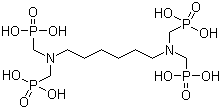
Hexamethylenebis(nitrilodimethylene)tetraphosphonic acid, often abbreviated as HMDTPA, is a complex organic compound that belongs to the family of phosphonic acids. Its molecular structure consists of a hexamethylene backbone with four phosphonic acid groups, which confer unique chemical properties and functionalities to the molecule. The compound is primarily utilized in various industrial applications due to its exceptional chelating and sequestering properties.
The discovery of HMDTPA dates back to the late 20th century, as researchers sought to develop new phosphonic acid derivatives that could effectively chelate metal ions in aqueous solutions. This interest was fueled by the need for advanced chemical agents in various fields, including agriculture, water treatment, and pharmaceuticals. The synthesis of HMDTPA typically involves the reaction of hexamethylenediamine with nitrilotriacetic acid (NTA) under specific conditions, followed by phosphonylation to introduce the phosphonic acid groups. This multi-step synthetic route enables the production of HMDTPA with a high degree of purity and functionality.
One of the most significant applications of HMDTPA is in the water treatment industry, where it is employed as a chelating agent. The compound effectively binds to metal ions, such as calcium, magnesium, and iron, preventing their precipitation and improving water quality. By sequestering these metal ions, HMDTPA helps to mitigate scaling and fouling in industrial systems, thereby enhancing the efficiency of water-based processes. This property is particularly valuable in cooling towers, boilers, and heat exchangers, where the accumulation of scale can lead to reduced heat transfer efficiency and increased maintenance costs.
In addition to its use in water treatment, HMDTPA has found applications in agriculture as a nutrient carrier. The ability of HMDTPA to chelate metal ions facilitates the delivery of essential micronutrients, such as zinc and iron, to plants. This enhanced nutrient bioavailability promotes healthy plant growth and development, ultimately improving crop yields. The use of HMDTPA as a fertilizer additive demonstrates its versatility and potential benefits in sustainable agricultural practices.
Another notable application of HMDTPA is in the field of pharmaceuticals and biomedicine. Research has shown that the compound exhibits promising properties as a potential drug carrier or imaging agent. Its ability to bind metal ions may enhance the delivery of therapeutic agents or contrast agents in medical imaging, facilitating targeted treatments and diagnostics. Ongoing studies are exploring the potential of HMDTPA in these areas, highlighting its significance in advancing medical science.
Despite its numerous applications, the environmental impact of HMDTPA and other phosphonic acids is an area of ongoing research. The persistence of these compounds in the environment and their potential toxicity to aquatic organisms raise concerns about their widespread use. Regulatory agencies are closely monitoring the use of phosphonic acids to ensure their safe application and minimize environmental risks.
In summary, hexamethylenebis(nitrilodimethylene)tetraphosphonic acid is a versatile compound with diverse applications in water treatment, agriculture, and pharmaceuticals. Its discovery has paved the way for the development of effective chelating agents that enhance industrial processes and promote sustainable practices. As research continues, it is crucial to address environmental considerations while maximizing the benefits of this innovative chemical substance.
References
2012. Synthesis and Temperature‐Induced Morphological Control in a Hybrid Porous Iron-Phosphonate Nanomaterial and Its Excellent Catalytic Activity in the Synthesis of Benzimidazoles. Chemistry (Weinheim an der Bergstrasse, Germany), 18(37).
DOI: 10.1002/chem.201201350
1995. Homolytic carbon to phosphorus bond scission of some phosphonates catalyzed by bacterial carbon-phosphorus lyase. Biodegradation, 6(3).
DOI: 10.1007/bf00695346
|





 GHS05;GHS07 Danger Details
 chemBlink Chemical Story