
Online Database of Chemicals from Around the World
| SynZeal Research Private Limited | India | |||
|---|---|---|---|---|
 | www.synzeal.com | |||
 | +91 7969-225-400 | |||
 | standards@synzeal.com | |||
| Chemical manufacturer since 2012 | ||||
| chemBlink Standard supplier since 2026 | ||||
| Classification | Analytical chemistry >> Standard >> Pharmacopoeia standards and magazine standards |
|---|---|
| Name | 2-Hydroxy Empagliflozin |
| Synonyms | (3S,4R,5R,6S)-6-(4-chloro-3-(4-(((S)-tetrahydrofuran-3-yl)oxy)benzyl)phenyl)-2-(hydroxymethyl)tetrahydro-2H-pyran-2,3,4,5-tetraol |
| Molecular Structure | 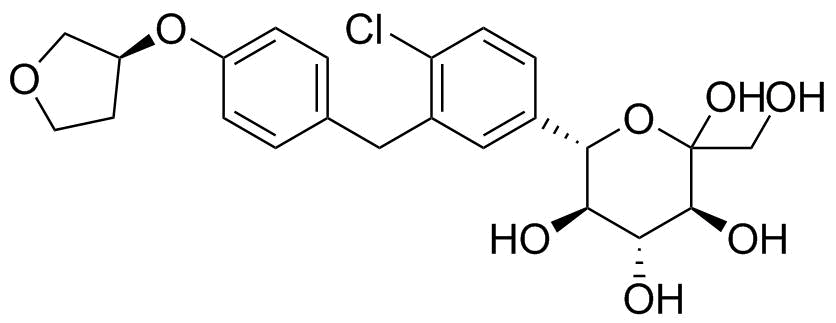 |
| Molecular Formula | C23H27ClO8 |
| Molecular Weight | 466.91 |
| CAS Registry Number | 2452301-34-5 |
| SMILES | O[C@H]([C@H]1O)[C@H](C(C=C2)=CC(CC(C=C3)=CC=C3O[C@H]4CCOC4)=C2Cl)OC(O)([C@H]1O)CO |
 chemBlink Chemical Story
|
2-Hydroxy Empagliflozin is a hydroxylated derivative and metabolite-related analogue of the antidiabetic drug empagliflozin. It belongs to the class of C-glucoside sodium–glucose cotransporter 2 (SGLT2) inhibitors, a group of compounds used to lower blood glucose levels by reducing renal glucose reabsorption. Empagliflozin itself is a highly selective inhibitor of the renal transporter SGLT2, which is expressed predominantly in the proximal tubules of the kidney. Under normal physiological conditions, SGLT2 is responsible for reabsorbing the majority of filtered glucose from the glomerular filtrate back into the bloodstream. Inhibition of this transporter increases urinary glucose excretion, thereby reducing plasma glucose concentrations independently of insulin secretion. Structurally, empagliflozin contains a glucose-derived moiety connected through a carbon–carbon (C-glycosidic) bond to a substituted aromatic aglycone. This C-glycoside linkage is significantly more resistant to enzymatic hydrolysis than conventional O-glycosidic bonds, contributing to the metabolic stability and oral bioavailability of the parent drug. 2-Hydroxy Empagliflozin differs from empagliflozin by the introduction of an additional hydroxyl group at a specific position within the molecule. Hydroxylation is a common phase I metabolic transformation catalyzed by cytochrome P450 enzymes and other oxidative systems. The addition of a hydroxyl group generally increases polarity, hydrogen-bonding capacity, and water solubility while potentially altering receptor or transporter binding characteristics. The exact pharmacological activity of a hydroxylated empagliflozin derivative depends on the site of hydroxylation. In many drug metabolism pathways, hydroxylated metabolites retain partial activity, exhibit reduced potency, or primarily serve as intermediates for further metabolism and elimination. Increased polarity often facilitates subsequent conjugation reactions such as glucuronidation and promotes renal or biliary excretion. Like the parent molecule, 2-Hydroxy Empagliflozin retains the characteristic polyhydroxylated glucose framework. This portion of the molecule contributes substantially to molecular recognition by SGLT transporters. The aromatic aglycone region provides hydrophobic interactions that enhance selectivity and binding affinity for SGLT2 relative to other glucose transport proteins. From a physicochemical standpoint, the additional hydroxyl group increases hydrophilicity and hydrogen-bonding potential. This modification may influence membrane permeability, plasma protein binding, metabolic stability, and distribution within biological systems. Such changes are commonly evaluated during drug metabolism and pharmacokinetic studies. Hydroxylated derivatives of pharmaceutical agents are frequently used as analytical reference standards in drug metabolism research. They help characterize metabolic pathways, identify circulating metabolites, and support pharmacokinetic investigations. In this context, 2-Hydroxy Empagliflozin may serve as a metabolite standard, synthetic intermediate, or research compound related to empagliflozin biotransformation. Empagliflozin belongs to a broader class of SGLT2 inhibitors that includes agents such as Empagliflozin, Dapagliflozin, and Canagliflozin. These compounds share a common mechanism of promoting urinary glucose excretion but differ in structural details, pharmacokinetics, and selectivity profiles. Overall, 2-Hydroxy Empagliflozin is a hydroxylated derivative of empagliflozin characterized by increased polarity and altered physicochemical properties relative to the parent drug. Its significance lies primarily in drug metabolism, pharmacokinetic studies, and research involving the biotransformation and disposition of SGLT2 inhibitor compounds. |
| Market Analysis Reports |