
Online Database of Chemicals from Around the World
| CAS: 298-57-7 Product: Stugeron No suppliers available. |
| Classification | API >> Circulatory system medication >> Peripheral vasodilator |
|---|---|
| Name | Stugeron |
| Synonyms | Cinnarizine; 1-(Diphenylmethyl)-4-(3-phenyl-2-propenyl)-piperazine |
| Molecular Structure | 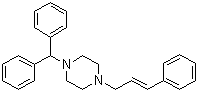 |
| Molecular Formula | C26H28N2 |
| Molecular Weight | 368.52 |
| CAS Registry Number | 298-57-7 |
| EC Number | 206-064-8 |
| SMILES | C1CN(CCN1C/C=C/C2=CC=CC=C2)C(C3=CC=CC=C3)C4=CC=CC=C4 |
| Hazard Symbols |  GHS07 Warning Details GHS07 Warning Details | ||||||||||||||||||||||||||||||||||||||||||||||||
|---|---|---|---|---|---|---|---|---|---|---|---|---|---|---|---|---|---|---|---|---|---|---|---|---|---|---|---|---|---|---|---|---|---|---|---|---|---|---|---|---|---|---|---|---|---|---|---|---|---|
| Risk Statements | H302-H315-H413 Details | ||||||||||||||||||||||||||||||||||||||||||||||||
| Safety Statements | P264-P270-P273-P280-P301+P317-P302+P352-P321-P330-P332+P317-P362+P364-P501 Details | ||||||||||||||||||||||||||||||||||||||||||||||||
| Hazard Classification | |||||||||||||||||||||||||||||||||||||||||||||||||
| |||||||||||||||||||||||||||||||||||||||||||||||||
| SDS | Available | ||||||||||||||||||||||||||||||||||||||||||||||||
 chemBlink Chemical Story
|
Stugeron is the trade name for **cinnarizine**, a first-generation antihistamine primarily used to manage and prevent symptoms related to motion sickness, vertigo, and other balance disorders. It is also prescribed in the treatment of vestibular disorders such as Ménière’s disease and for peripheral circulatory disorders due to its vasodilatory properties. Cinnarizine was first introduced in the 1950s and remains widely used in many countries, though it is not approved for medical use in the United States. Chemically, cinnarizine is a derivative of diphenylmethylpiperazine and has the molecular formula C26H28N2. It is a white or almost white crystalline powder, practically insoluble in water but soluble in organic solvents such as ethanol and chloroform. Its pharmacological action is mainly due to its antihistaminic (H1) and calcium channel blocking effects. The compound is administered orally and is usually available in 25 mg or 75 mg tablets. The primary mechanism of cinnarizine involves the inhibition of histamine H1 receptors, which suppresses the stimulation of the vestibular system in the inner ear and the associated symptoms of nausea, vomiting, and dizziness. By blocking these receptors, cinnarizine helps to prevent the transmission of abnormal signals from the vestibular apparatus to the vomiting center in the brainstem. In addition, cinnarizine acts as a calcium channel antagonist, which results in smooth muscle relaxation and vasodilation, particularly in cerebral and peripheral vessels. In clinical use, Stugeron is taken to prevent motion sickness during travel by car, sea, or air. The drug is typically taken about two hours before travel and then every eight hours as needed. For the treatment of vertigo and related balance disorders, it may be taken regularly for longer periods under medical supervision. In cases of peripheral vascular disorders, cinnarizine may improve microcirculation and reduce symptoms such as cold extremities, numbness, and muscle cramps. Common side effects associated with Stugeron include drowsiness, dry mouth, weight gain, and gastrointestinal disturbances. Because it can cause sedation, patients are advised to avoid operating machinery or driving while taking the drug. Long-term use, especially in elderly patients, may rarely lead to extrapyramidal symptoms such as tremors or parkinsonism-like effects due to its dopamine receptor antagonist activity. These effects are generally reversible upon discontinuation of the drug. Stugeron is contraindicated in patients with Parkinson’s disease due to the risk of worsening motor symptoms. It should also be used cautiously in elderly patients and those with hepatic or renal impairment. No teratogenic effects have been conclusively demonstrated, but use during pregnancy or lactation should be undertaken only if clearly needed and prescribed by a physician. Cinnarizine is metabolized in the liver and excreted primarily in the feces. Its half-life is approximately 4 to 6 hours, but the clinical effects may persist longer due to accumulation in fatty tissues. Because it is lipophilic, cinnarizine can cross the blood–brain barrier and exert central nervous system effects, which is important for its therapeutic action but also contributes to side effects such as sedation. In summary, Stugeron (cinnarizine) is a well-established antihistamine and calcium antagonist used to treat and prevent conditions related to motion sickness and vestibular dysfunction. Its dual action on histamine receptors and calcium channels makes it effective in reducing symptoms such as dizziness, nausea, and balance disturbance. Despite some side effects, it remains a commonly prescribed and over-the-counter drug in many countries. References 2011. Melanogenesis Inhibitory Activity of Two Generic Drugs: Cinnarizine and Trazodone in Mouse B16 Melanoma Cells. International Journal of Molecular Sciences, 12(12). DOI: 10.3390/ijms12128787 2007. The effect of cinnarizine and cocculus indicus on simulator sickness. Physiology & Behavior, 91(1). DOI: 10.1016/j.physbeh.2007.02.008 1994. Cinnarizine in the prophylaxis of seasickness: Laboratory vestibular evaluation and sea study. Clinical Pharmacology and Therapeutics, 55(6). DOI: 10.1038/clpt.1994.84 |
| Market Analysis Reports |